
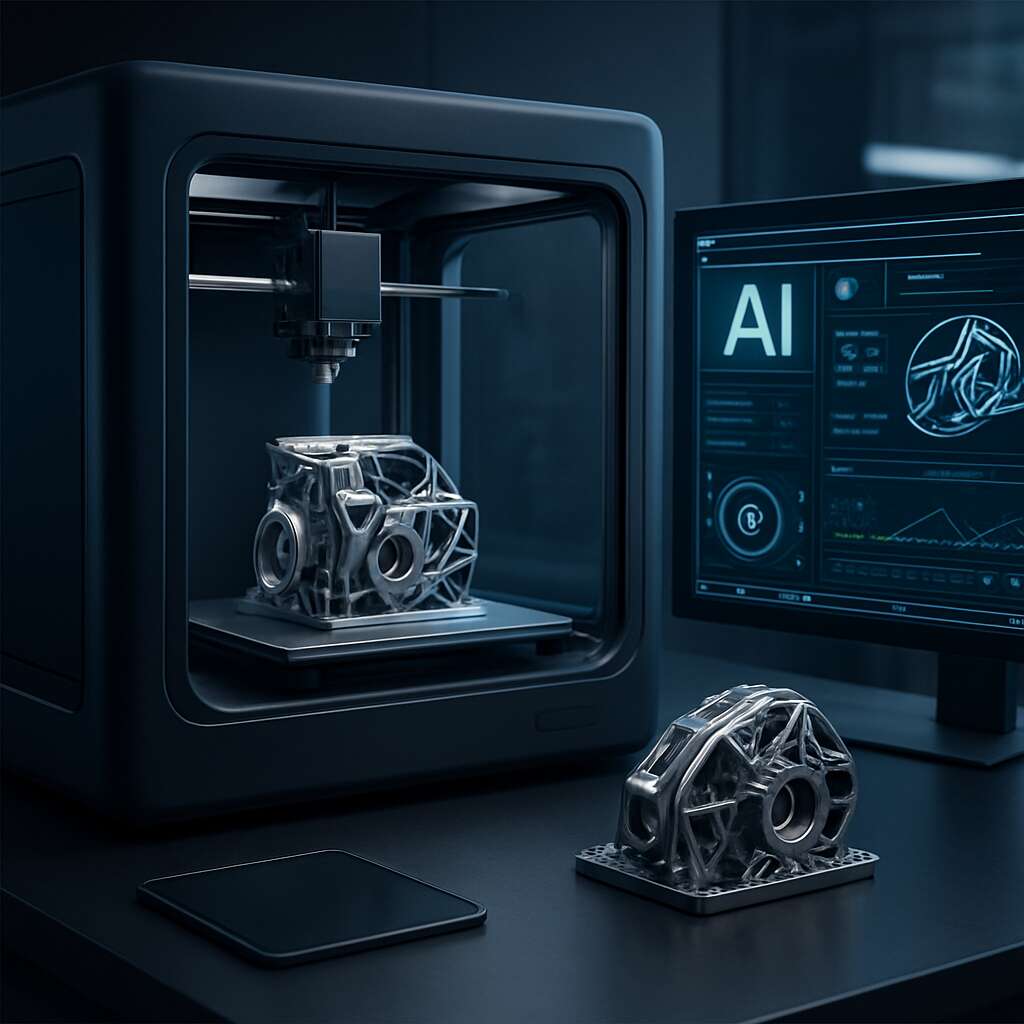
Advancements in AI-Driven 3D Printing Technologies
Understanding AI Integration – How artificial intelligence algorithms are embedded into 3D printing workflows
Artificial intelligence has officially crashed the party at the 3D printing table, transforming what was once a purely mechanical affair into a symphony of digital maestros. When AI-Powered 3D Printing first emerged, skeptics scoffed, but now it’s becoming the secret sauce in manufacturing and prototyping. The magic lies in how AI algorithms seamlessly embed into each stage of the workflow, turning complex design challenges into manageable tasks. This integration facilitates smarter decision-making during printing, enabling real-time adjustments that prevent costly errors and material waste.
Understanding AI integration reveals a fascinating blend of machine learning and automation, where algorithms analyze data from previous prints to improve accuracy and surface quality. These systems can predict and correct errors before they even happen—imagine a printer that knows you’re about to run out of filament before you do! As these AI-powered solutions evolve, it’s turning traditional 3D printing into a more intelligent, efficient process that saves time and resources. For those curious about the nitty-gritty, consider these aspects of AI integration:
- Automated error detection and correction
- Real-time quality control
- Optimized material usage and print paths
Automated Design Optimization – Using AI to enhance model accuracy, material efficiency, and structural integrity
Advancements in AI-Powered 3D Printing are transforming the way we approach design and manufacturing. One of the most promising developments is automated design optimization, which leverages artificial intelligence to refine models with impeccable accuracy.
Traditional design processes often involve a lot of trial and error, wasting time and materials. With AI integration, models are now generated with built-in considerations for material efficiency and structural integrity. This not only reduces waste but also ensures that printed components meet exacting standards, especially in fields like aerospace and healthcare, where precision is paramount.
- AI algorithms analyze previous print data to predict potential weaknesses in models.
- They automatically suggest adjustments to improve stability and durability.
- Optimized print paths are created, reducing print time and material consumption.
As these intelligent systems evolve, the potential for creating complex geometries and lightweight structures increases, pushing the boundaries of what’s possible with AI-Powered 3D Printing. It’s clear that automation in design is a vital step toward truly sustainable and efficient manufacturing, making the process more accessible and less error-prone for users across industries.
Real-Time Printing Monitoring – AI-powered sensors and analytics for precision and defect detection
In the realm of AI-Powered 3D Printing, real-time printing monitoring exemplifies a breakthrough that shatters the limitations of traditional craftsmanship. Using advanced AI-powered sensors and analytics, manufacturers now gain a window into the very heartbeat of the printing process. This technology allows for meticulous scrutiny of each layer, capturing even the subtlest deviations before they manifest as flaws.
Such systems employ an intricate array of sensors—visual, thermal, and acoustic—that continuously feed data to intelligent algorithms. These algorithms aren’t merely passive observers; they actively analyze the data stream, predicting potential defects with uncanny precision. The result is an environment where adjustments are made instantaneously, safeguarding the fidelity of complex geometries and lightweight structures frequently associated with AI-Powered 3D Printing.
- Defect Detection: Spotting anomalies early prevents costly wastage and structural failure.
- Precision Control: Fine-tuning process parameters dynamically ensures optimal material deposition.
- Efficiency Gains: Streamlined monitoring shortens print times while maintaining impeccable quality.
As AI-driven analytics become more sophisticated, the capacity for defect detection grows ever finer, empowering engineers with actionable insights that were once unimaginable in additive manufacturing. In a landscape where accuracy defines success, AI-powered 3D printing not only enhances productivity but also cultivates a new era of manufacturing excellence rooted in intelligent oversight.
Innovative Material Development – AI simulations accelerating the discovery of new printable materials
In the bustling world of AI-Powered 3D Printing, innovation isn’t just about making things faster; it’s about making things smarter. One of the most exciting frontiers is material development—where artificial intelligence is smashing through traditional trial-and-error methods to fast-track the creation of new printable materials. Imagine a simulation so precise, it can virtually test how a novel polymer or composite behaves under extreme conditions, all before a single filament is fed into the printer. It’s like having a crystal ball that reveals the secrets of materials’ performance without wasting expensive resources.
By leveraging AI simulations, researchers can explore dozens of potential formulas in the time it takes to brew a cuppa. This in silico approach not only accelerates discovery but also opens the door to customized materials tailored specifically for complex geometries or lightweight structures in AI-Powered 3D Printing. The process involves a clever interplay of predictive modeling and data analytics, transforming what used to be a painstaking process into something remarkably streamlined.
As the boundaries of material science expand, so too does the palette of printable options, ranging from biocompatible composites to ultra-durable polymers. This technological leap is wallpapered with sophisticated algorithms that assess variables like tensile strength, flexibility, and thermal stability—an essential step in pushing the limits of what 3D printing can achieve. Progress in AI-driven material development not only promises to redefine manufacturing standards but also underscores the pivotal role of AI in shaping the future of additive manufacturing.
Adaptive Printing Processes – Machine learning techniques that adjust parameters dynamically during printing
In the realm of AI-Powered 3D Printing, adaptability isn’t just a feature—it’s an evolution. Machine learning techniques enable printers to observe and respond to real-time conditions, transforming every print run into a dynamic, intelligent process. Instead of rigid, pre-set parameters, these systems continuously analyze variables like temperature, filament flow, and layer adhesion, adjusting on the fly with unmatched precision.
Imagine a process where the printer anticipates potential imperfections before they occur, seamlessly tweaking settings to maintain optimal quality. This adaptive printing process ensures higher fidelity, reduces waste, and accelerates production timelines. For instance, the system might modify extrusion speed or cooling rates automatically, responding to material inconsistencies or environmental fluctuations.
- Temperature fluctuations
- Layer stability
- Material flow variations
all become manageable challenges, handled with intuitive AI-led adjustments.
It’s akin to having a vigilant supervisor working tirelessly beneath the nozzle, ensuring each layer stacks perfectly even when conditions shift unexpectedly. This technological leap in AI-Powered 3D Printing elevates manufacturing, making it smarter, more responsive, and profoundly more reliable than ever before. The result? An era where printers don’t just follow instructions—they think and adapt in real-time, pushing the boundaries of what additive manufacturing can achieve.
Applications of AI in 3D Printing Across Industries
Manufacturing and Industrial Production – Custom parts, rapid prototyping, and scalable manufacturing with AI automation
In the labyrinth of modern manufacturing, where efficiency and precision have become non-negotiable, AI-Powered 3D Printing emerges as a silent revolution. Its potential to reshape industries stretches beyond mere automation—it’s a fundamental shift toward customization and scalability that challenges our understanding of production itself.
Industries are increasingly integrating AI to create bespoke parts tailored perfectly to complex specifications, reducing waste and accelerating time-to-market. For instance, industries like aerospace and automotive leverage AI automation for rapid prototyping—where design iterations become almost instantaneous, saving precious resources. Scaling up production no longer demands linear expansion; instead, intelligent algorithms dynamically adjust manufacturing parameters, ensuring consistency while accommodating high-volume demands.
A simple yet profound metamorphosis occurs: the traditional, linear methods of manufacturing give way to an adaptive, intelligent process. When combined with AI-Powered 3D Printing, real-time analytics identify defects at lightning speed, while machine learning optimizes material use, transforming how industries approach mass production. This fusion allows for a new art form—turning raw ideas into tangible realities with unprecedented agility and precision.
Healthcare and Medical Devices – Patient-specific implants, bioprinting, and AI-assisted device customization
In hospitals and laboratories across the UK, AI-Powered 3D Printing is revolutionising how medical professionals craft life-changing devices. Imagine a world where a patient’s unique anatomy guides the creation of an implant—precisely tailored for comfort and function. AI-driven bioprinting enables the fabrication of tissues and organs, transforming possibilities for regenerative medicine. This isn’t science fiction, but an emerging reality that enhances patient-specific treatments and outcomes.
Through AI-assisted device customization, complex surgical tools or prosthetics can now be designed with extraordinary precision, fitting individual needs like a glove. Such innovations demonstrate how AI-Powered 3D Printing makes bespoke healthcare accessible, reducing the often lengthy lead times traditionally associated with custom medical devices. These advancements are paving the way for breakthroughs, a testament to how technology can intimately improve lives.
Industries from dental to orthopedics are harnessing AI-powered algorithms to refine models, ensuring they meet exacting standards. This precision allows for intricate designs, biocompatible materials, and functional complexity that once seemed impossible. With real-time feedback from AI-guided systems, medical devices are becoming more adaptive, safe, and efficient, reflecting a profound shift in healthcare innovation driven by AI-Powered 3D Printing.
Aerospace and Automotive Sectors – Lightweight component design, complex geometries, and quality assurance
The aerospace and automotive industries are increasingly turning to AI-Powered 3D Printing to revolutionise component design and manufacturing. Traditional fabrication methods often struggle with complex geometries or weight reduction, but AI algorithms enable engineers to craft lightweight parts that maintain strength and durability. This technological synergy facilitates the creation of intricate structures that were once impossible with conventional techniques.
In these sectors, precision is everything. AI-Powered 3D Printing allows for rigorous quality assurance by integrating real-time monitoring during the printing process. Sensors equipped with AI analytics detect potential defects early, dramatically reducing errors and waste. This detailed oversight ensures that every component meets strict standards, whether it’s a turbine blade or a car chassis part.
For those interested in the nuts and bolts of the process, here’s a glance at some of the most impactful applications:
- Design optimisation driven by AI, which ensures that each model maximises material efficiency without sacrificing performance.
- The ability to produce complex geometries that traditional manufacturing cannot replicate, paving the way for more innovative structures.
- Advanced quality assurance protocols that leverage AI-powered sensors, guaranteeing every produced part adheres to the highest standards.
As the technology continues to evolve, AI-Powered 3D Printing will further enhance how industries approach manufacturing. From reducing weight for better fuel efficiency in cars to creating highly custom aerospace components, the potentials seem limitless. This ongoing revolution isn’t just about making parts faster; it’s about fundamentally rethinking what’s possible in the realm of industrial design and production.
Construction and Architecture – AI for large-scale 3D printing of buildings and infrastructural components
When it comes to reshaping skylines and transforming construction, AI-Powered 3D Printing is the phoenix rising from traditional rubble. Imagine a future where entire buildings are crafted layer by layer with the precision of a master sculptor—and significantly less neck strain. The remarkable thing? These colossal feats aren’t just tall stories. AI algorithms enable architects and engineers to conceive of large-scale infrastructural components that defy the usual limitations of conventional construction methods. Think custom-designed facades, intricate structural elements, and nodes that connect piece by piece much like an elaborate digital Lego set.
One of the most impressive applications? Large-scale 3D printing of buildings and infrastructural elements. With AI taking a starring role, these projects can be executed faster, with material efficiency that makes penny-pinching look amateurish. An emerging list of innovations includes:
- Customised urban façades that adapt to environmental conditions.
- Rapid deployment of emergency buildings in disaster zones—no more waiting months for concrete to dry.
- Highly detailed architectural features that would have been prohibitively expensive or impossible with traditional techniques.
Getting the mechanics right is no trivial feat—yet AI helps streamline coordination, optimise print paths, and manage materials dynamically. Picture a giant printer, but instead of boring straight lines, it sculpts complex, functional, and sometimes downright artistic structures at a scale previously reserved for sci-fi movies. The integration of AI in large-scale 3D printing not only accelerates construction timelines but also radically reduces waste—making it a favourite among eco-conscious designers and city planners alike. So, whether it’s a sleek new office block or a series of infrastructural components, AI-powered 3D printing is quietly rewriting the blueprint for the future of construction across the United Kingdom and beyond!
Consumer Products and Fashion – Personalized accessories, customizable items, and AI-driven creative processes
AI-Powered 3D Printing is revolutionising how industries personalise products and push creative boundaries. In the world of consumer products and fashion, it unlocks new possibilities for designing and manufacturing. Imagine custom accessories tailored precisely to individual style or ergonomic needs, all produced on demand. It makes mass customisation feasible and efficient, opening doors for brands to offer truly unique items.
The appeal extends beyond personalisation. AI-driven creative processes steer 3D printing into uncharted territory, blending art with functionality in ways previously impossible. For instance, AI algorithms can help craft intricate patterns, loopholes in traditional manufacturing, and highly detailed components that are difficult to produce elsewhere.
- Personalised jewelry and fashion accessories
- Customised footwear and apparel components
- Unique home decor items and collectibles
This integration means designer ideas rapidly turn into tangible products with minimal waste and unmatched precision. AI-powered 3D printing also allows for rapid prototyping, letting innovators test new concepts without costly delays. The versatility and efficiency of AI bring a fresh wave of innovation to consumer and fashion sectors, where uniqueness and sustainability matter most.
Benefits and Challenges of AI-Powered 3D Printing
Enhanced Precision and Efficiency – Improved accuracy, reduced waste, and faster production times
In a world where precision can make or break innovation, AI-Powered 3D Printing is changing the game—literally. Imagine parts fitting together with the accuracy of a Swiss watch, all while cutting down on messy material waste and slashing production times. That’s the undeniable beauty of AI-enhanced 3D printing: it transforms what used to take hours into moments of brilliant efficiency.
Thanks to the advanced capabilities of AI-powered 3D printing, manufacturers can now reduce errors before they even happen. Real-time sensing and analytics keep a watchful eye on every layer, ensuring defects are caught early and adjustments are made on the fly. This not only prevents costly rework but also dramatically improves overall quality.
In terms of manufacturing and industrial production, the benefits are clear. Streamlined workflows enabled by AI-driven algorithms allow for rapid prototyping, scalability, and customization. For example, adaptive printing processes dynamically modify parameters—like temperature or speed—based on material feedback, sharpening precision even further. It’s like having a Swiss Army knife of manufacturing at your fingertips, all powered by AI, and it’s just getting started.
Customization and Flexibility – Tailored solutions and on-demand manufacturing capabilities
Who knew that the future of manufacturing would look more like a sci-fi movie than a factory floor? AI-Powered 3D Printing has shifted the paradigm, making bespoke production and on-demand solutions not just doable but downright delightful. When every second counts and precision is king, this technology delivers with a splash of genius—turning what used to be long, laborious processes into swift, custom-crafted marvels.
One of the standout benefits of AI-Powered 3D Printing is its uncanny ability to tailor solutions to exact needs. Imagine being able to produce a part uniquely suited to your specifications—without the need for massive inventories or costly retooling. The flexibility that AI integration brings means that every print can be adapted on the fly—no more one-size-fits-all mentality. This makes it ideal for industries where customization isn’t just a bonus but a necessity.
But it’s not just about customization; it’s also about efficiency. AI-driven algorithms enable on-demand manufacturing, reducing lead times from days to hours or even minutes. Want a batch of prototype components for a new product? AI-Powered 3D Printing makes this a reality, with real-time adjustments ensuring each piece meets exact standards without wasting time or materials. Yet, the challenges shouldn’t be overlooked—issues like managing complex geometries, ensuring consistent quality, and integrating AI into existing workflows require careful planning and expertise.
In the end, AI-Powered 3D Printing opens a gateway to an era where manufacturing is as flexible as it is innovative. Its ability to deliver highly personalised, scalable parts on demand far surpasses traditional methods—making it a game-changer for those daring enough to explore its full potential.
Cost Reduction – Minimized material usage and labor costs through automation
When nuclear levels of innovation collide with manufacturing processes, AI-Powered 3D Printing emerges as a game-changer in reducing costs—a feat that’s capturing attention across industries. With the laser focus on minimizing material usage, automation takes the reins, refining the entire process from start to finish. This technology slashes labor expenses by replacing manual interventions with intelligent algorithms that manage intricate tasks effortlessly. The result? Faster production times and leaner operations, enabling companies to deliver highly personalized products without draining the purse strings.
In the heart of this evolution lies a quiet revolution: AI-driven optimization. Employing AI-Powered 3D Printing tools, manufacturers leverage sophisticated data analysis to enhance every facet of production. For instance, it uses predictive analytics to determine the optimal amount of material needed for each part, drastically reducing waste. This process not only curtails expenses but also lessens environmental impact—a winning combination in today’s eco-conscious marketplace.
Understanding the scope, some businesses adopt
- automated workflows that adjust printing parameters in real-time to improve precision
- precise control over material deposition
- predictive maintenance to forewarn of equipment failure
—all issues that once demanded manual oversight and costly rework. Given these efficiencies, cost savings are palpable, leaving more budget for innovation and scaling operations.
Yet, the terrain isn’t without hurdles. Managing complex geometries can strain automated systems, and ensuring consistency across batches remains a challenge. Optimizing workflows for bulk production while maintaining the benefits of AI involves a delicate balance—one that demands strategic planning. As technology continues to evolve, the integration of AI into 3D printing workflows promises to decimate waste and streamline processes further, but it remains essential to navigate these shifts with expertise and care.
Technical Limitations – Hardware constraints, AI model accuracy, and material compatibility issues
Behind the shimmering veil of innovation that cloaks AI-Powered 3D Printing lies a realm fraught with both awe and challenge. As this technological marvel ventures further into the fabric of manufacturing, its obstacles are as intricate as the wizardry it seeks to perfect. Hardware constraints stand as sentinel gates—sometimes the machinery simply cannot keep pace with the rapid advancements in AI algorithms. These limitations often cap the size and complexity of printable objects, holding back visions of grand architectural feats or expansive industrial parts.
Simultaneously, the accuracy of AI models is a double-edged sword. While they promise unprecedented precision, their fidelity depends heavily on the quality and diversity of training data. Flaws or gaps can lead to unpredictable outcomes, especially when working with materials that are finicky or new to the realm of AI-Powered 3D Printing. Material compatibility issues also reveal themselves as stubborn hurdles; not all materials play nicely with new automated processes, leading to prolonged experimentation and adjustments.
Within this tapestry of limitations, some enterprises turn to structured solutions:
- Enhancing hardware resilience through innovations in printing hardware
- Refining AI algorithms to improve predictive accuracy
- Expanding material libraries to include more versatile and compatible options
Addressing these issues demands a delicate balance—where technological prowess meets strategic foresight. Yet, for all the complexity, the promise of AI-Powered 3D Printing remains luminous: the continual evolution of hardware, AI models, and materials heralds a future where the boundaries of manufacturing are ever-expanding, despite these inherent limitations.
Data Security and Ethical Concerns – Protection of proprietary designs and responsible AI deployment
In the shadowy corridors of technological innovation, AI-Powered 3D Printing emerges as both a marvel and a menacing enigma. With the ability to forge intricate designs, it whispers promises of transformation—yet breaches in data security threaten to unravel the very fabric of this digital renaissance. The protection of proprietary designs becomes a clandestine struggle; leaks and theft loom like spectral shadows stalking the creative mind.
In an age where information is currency, responsible AI deployment must be meticulously guarded. Trapped within layered algorithms are secrets—visions of future manufacturing, personalized crafts, delicate medical implants. But each innovation demands vigilance. The specter of intellectual property theft haunts those who dare to unveil their creations to the vast web of connectivity.
- The risk of malicious hacking targeting sensitive design files
- The challenge of maintaining confidentiality in distributed AI-Powered 3D Printing workflows
- The ethical dilemma of using AI to replicate or modify creative works
As the lines blur between human ingenuity and machine mimicry, concerns about misuse and transparency intensify. Ensuring ethical practices and fortifying digital arsenals is no longer optional but an imperative. Concealed within the cathedral of progress is a core truth: safeguarding data security and adhering to ethical standards are the guardians of trust. Without them, even the most luminous promise of AI-Powered 3D Printing risks dissolving into the mist—an echo of what could have been.
Future Trends and Innovations in AI-Powered 3D Printing
Integration with IoT and Smart Manufacturing – Connected devices for seamless production workflows
As industries race towards near-instantaneous production cycles, the future of AI-Powered 3D Printing lies in seamless integration with the Internet of Things (IoT) and smart manufacturing ecosystems. Imagine a factory floor where connected devices communicate effortlessly, orchestrating the entire workflow with minimal human intervention. The potential for AI-Powered 3D Printing to evolve into fully autonomous systems is tantalising, promising unparalleled levels of efficiency and adaptability.
One foreseeable trend involves the use of AI-driven sensors and real-time analytics to create interconnected production units. These units will dynamically adjust parameters such as temperature, print speed, and material flow based on continuous feedback loops. This not only ensures consistent quality but also reduces waste, an ever-present challenge in additive manufacturing. To facilitate this, some manufacturers are adopting
- edge computing hardware
- advanced data security protocols
to support the rapid processing and safeguarding of proprietary data within these connected environments.
In future applications, AI-powered decision-making systems will enable a new level of customization and flexibility—where complex geometries and tailored solutions can be produced with minimal setup time. The integration of AI palette with IoT devices fosters a more intelligent, responsive production line, unlocking new possibilities in industries like aerospace, automotive, and healthcare. This convergence of AI-Powered 3D Printing and connected manufacturing infrastructure looks set to redefine the boundaries of creativity and operational efficiency in the years ahead.
AI-Driven Material Innovation – Emerging printable composites and sustainable materials
As the realm of additive manufacturing evolves, a luminous frontier beckons: AI-Powered 3D Printing weaving itself into the tapestry of sustainable innovation. Here, from the crucible of cutting-edge research, emerges a new class of printable composites and eco-friendly materials that promise to redefine industry standards. Imagine biomimicry-inspired filaments infused with biodegradable polymers, or composite blends engineered at a molecular level for enhanced strength while minimizing environmental impact—this is where AI-driven material innovation transforms possibility into reality.
The enchantment of AI-Powered 3D Printing lies in its capacity to accelerate the discovery of groundbreaking materials through sophisticated simulations. By harnessing machine learning models that mimic nature’s mastery, manufacturers can experiment with hundreds of configurations in a fraction of the time. This rapid iteration process paves the way for a spectrum of sustainable options that exemplify both durability and conscious craftsmanship.
Within this emerging landscape, some innovators are exploring the creation of recyclable thermoplastics compatible with existing 3D printers, while others develop composites with embedded bio-resins. These advancements are not purely technical; they echo a commitment to ecological stewardship, casting a spell of ecological responsibility over traditional manufacturing paradigms. The promise of AI-powered solutions in creating environmentally conscious materials continues to grow, aligning economic viability with sustainability.
In the pursuit of harmony between technology and nature, AI-Powered 3D Printing stands as a beacon—illuminating pathways toward a future where manufacturing is both inventive and mindful, fostering a new era of eco-aware customization and resilient resource management.
Autonomous 3D Printing Systems – Robotics and AI for unmanned, self-correcting fabrication
Imagine a world where machines not only build, but also repair and optimise themselves in real-time—this is no longer a distant dream but an emerging reality with AI-Powered 3D Printing. Autonomous 3D printing systems equipped with robotics and artificial intelligence are transforming the landscape of manufacturing. These self-correcting fabrication assets operate tirelessly, reducing the need for human intervention while increasing precision and efficiency.
Future trends in AI-Powered 3D Printing point towards fully autonomous factories—where robotic arms, guided by machine learning algorithms, navigate complex assembly lines without oversight. Think of hyper-efficient production lines that adapt dynamically based on sensor feedback, adjusting print parameters on-the-fly to prevent defects and optimise material usage. For example, AI algorithms can analyse data from embedded sensors, identifying issues before they manifest into defects, effectively making printing processes smarter and more reliable.
Some innovations include critical features like in-built diagnostic tools and adaptive algorithms capable of recalibrating in real-time. This means that as an object is being printed, the system can detect flaws, correct errors, and even change design parameters to meet specific requirements—without halting the process. Such systems are paving the way for next-generation manufacturing, where unmanned, AI-empowered 3D printers serve as the backbone of scalable, on-demand production models.
In this age of rapid prototyping and customisation, these self-driving systems are also reducing lead times significantly. Consider a scenario where the entire printing process adapts seamlessly, ensuring high-quality outputs with minimal waste. By harnessing the power of AI and robotics, companies can deliver tailor-made solutions more swiftly than ever before. It’s an era where AI-Powered 3D Printing doesn’t just support manufacturing but actively redefines what’s achievable in automation and precision engineering.
Enhanced Simulation and Predictive Models – Virtual testing and pre-print analysis using AI
As AI-Powered 3D Printing evolves, a realm of virtual possibilities emerges where simulated worlds and predictively modelled structures redefine innovation. Imagine a universe where every detail of a design can be tested in a digital environment before a single filament is laid—saving time, materials, and resources. This virtual testing capability heralds a new era of precision, where predictive models act as the oracle of manufacturing, foreseeing potential flaws and structural weaknesses with uncanny accuracy. These advanced simulations enable engineers and designers to explore complex geometries, optimize material utilization, and refine intricate designs long before they are physically realised.
In this magic of digital foresight, AI algorithms harness vast arrays of data to perform pre-print analyses, transforming what was once guesswork into a science. Through machine learning-driven predictive models, AI-Powered 3D Printing systems can anticipate defects, evaluate mechanical properties, and simulate environmental stresses—all within a virtual environment. This means that every print is an act of faith, increasingly leaning on AI for validation and correction, minimising costly errors and reducing material waste.
Innovations in this domain extend to enhanced simulation tools that make real-time adjustments during the digital modelling phase, aligning with the dynamic needs of modern manufacturing. A growing trend involves integrating AI-driven material innovation, where predictive algorithms not only simulate but also suggest the most suitable composites and sustainable materials for each project. These integrated systems offer a seamless pathway from concept to creation, with virtual testing serving as an enchanted mirror reflecting the future of whether an object will withstand the rigours of real-world application.
Ultimately, the marriage of AI-powered virtual analysis with physical 3D printing positions manufacturers at the brink of a new frontier—a landscape where digital craftsmanship harmonises with physical precision. As the artefact of this union becomes more sophisticated, the potential for hyper-customisation, rapid prototyping, and scalable production expands exponentially. AI-Powered 3D Printing’s capacity for predictive accuracy and simulation-driven design makes it a true marvel for those eager to venture beyond traditional manufacturing boundaries, into a realm where imagination meets mastery with unprecedented clarity.
Global Impact and Sustainability – Reducing environmental footprint and enabling localized manufacturing
A future where environmental consciousness meets manufacturing prowess sounds almost poetic—except when you consider that AI-Powered 3D Printing is turning this poetry into pragmatic reality. As nations grapple with reducing their carbon footprint, innovations in AI-Powered 3D Printing carve a path towards sustainability and localised production, reshaping industries in the process.
One of the most enticing prospects lies in the capacity for decentralised manufacturing. Imagine a world where complex components are printed right on-site, slashing the need for long supply chains and shipping—an idea that redefines efficiency, especially amidst global supply chain chaos. With AI algorithms optimising material usage and enabling rapid prototyping, manufacturers can produce bespoke items with a fraction of the waste historically associated with traditional methods.
The push for greener practices also manifests through AI-driven material development. Machine learning accelerates the discovery of sustainable composites and biodegradable filaments, aligning ecological concerns with technological advancement. Some companies are experimenting with AI to forecast the lifespan and recyclability of new materials, crafting an ecosystem where innovation no longer comes at the planet’s expense.
Small-scale, localized manufacturing hinges on the precision of AI-Powered 3D Printing systems, facilitating on-demand production that minimises inventory and reduces excess waste. This paradigm shift not only diminishes the environmental footprint but also empowers artisans, designers, and entrepreneurs to operate with a freedom once confined to large factories.
- Integrating AI with IoT devices transforms 3D printers into intelligent, self-correcting entities capable of adapting to varying environmental conditions. This fusion enhances the feasibility of autonomous, environmentally conscious production lines.
As the realm of AI-powered innovations continues to flourish, the promise of sustainable, scalable, and frictionless manufacturing remains tantalisingly within reach. With each iteration, AI-Powered 3D Printing edges closer to a future where ingenuity and responsibility coalesce seamlessly, crafting a world where the marvels of digital craftsmanship leave behind a gentler, greener planetary imprint.