
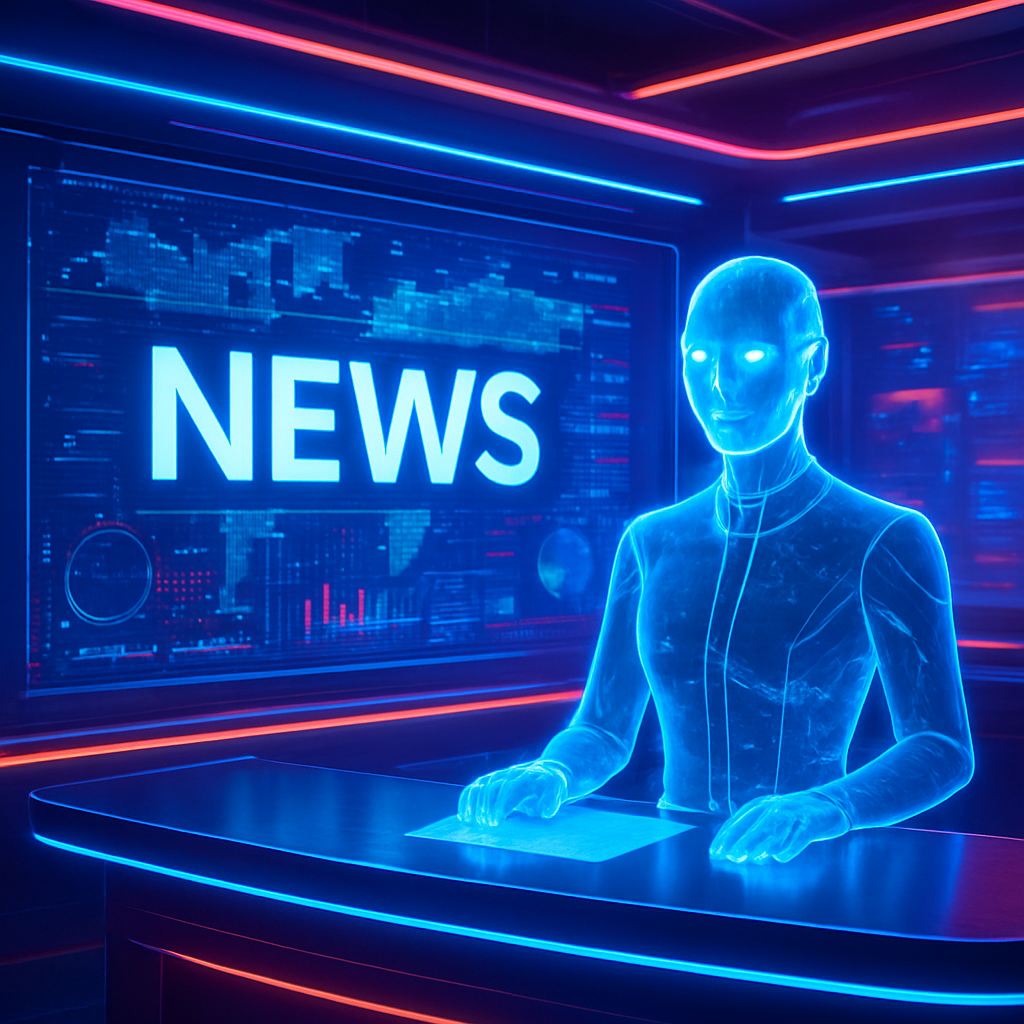
Overview of AI-Generated News Anchors
Understanding AI in News Broadcasting – Overview of artificial intelligence applications in media
Artificial intelligence is transforming news broadcasting, with AI-Generated News Anchors emerging as a fascinating frontier. These virtual anchors can deliver news with a fluidity and consistency that rivals their human counterparts, all while operating around the clock without fatigue. It’s a leap forward in media technology that continues to stir debate and anticipation.
The core of this innovation lies in the ability of AI to generate hyper-realistic avatars capable of engaging audiences in a natural, persuasive manner. This is no longer science fiction. AI-Generated News Anchors are being integrated into live reports, automated updates, and even scripted content, providing a seamless experience for viewers. Understanding AI in news broadcasting reveals a landscape where machine learning and deep neural networks play a pivotal role — crafting speech, mimicking gestures, and responding dynamically to breaking news.
For those curious about how this impacts the future of media, consider the following points:
- Real-time content generation with minimal human intervention
- Enhanced consistency and availability for 24/7 news coverage
- Potential for personalized news delivery tailored to viewer preferences
History and Evolution of AI-Generated Hosts – Timeline of developments leading to current AI anchors
The evolution of AI-Generated News Anchors is a testament to the relentless march of technological innovation in media. From primitive digital avatars to hyper-realistic virtual hosts, each milestone is a chapter in a story of relentless pursuit and creative mastery. At the dawn of this journey, developers experimented with basic text-to-speech algorithms, setting the stage for what was to come.
By the mid-2010s, machine learning and deep neural networks matured, bringing lifelike avatars capable of mimicking human gestures and speech patterns with uncanny precision. The timeline of developments leading to current AI-Generated News Anchors reveals a phased progression:
- Initial automation of news scripts through basic AI models
- Integration of realistic facial animations and gestures
- Deployment of AI-generated avatars as primary news anchors in live broadcasts
- Advancements enabling personalized and interactive news experiences for viewers
Today, these virtual anchors no longer seem like mere simulations—they embody a new era, where each story delivered echoes the seamless and poised delivery of seasoned journalists. The sophistication of AI-Generated News Anchors suggests not just a technological feat but a metamorphosis grounded in artistry, precision, and an unyielding desire to redefine the communication landscape.
How AI Anchors Work – Technological processes behind AI news presenters
In an era driven by technological marvels, AI-Generated News Anchors stand as a testament to our relentless pursuit of innovation in media. These virtual counterparts are no longer mere simulations—they embody a seamless fusion of artistry and cutting-edge technology that captures the attention of viewers worldwide. But how exactly do these AI news presenters come to life? The process is a fascinating blend of advanced algorithms and creative engineering, transforming lines of code into credible, charismatic broadcasters.
At the core of AI-Generated News Anchors lies a series of layered technological processes. First, natural language processing (NLP) algorithms generate the scripted content, which is then fed into sophisticated speech synthesis systems. These systems produce a lifelike voice that mimics human intonation and emotion, ensuring the delivery feels genuine and engaging. Simultaneously, computer graphics and machine learning algorithms animate hyper-realistic facial expressions and gestures, enhancing the anchoring experience.
For an immersive viewing experience, developers often employ a combination of techniques, such as facial animation transfer and deep neural networks, to ensure the virtual host can deliver stories with poise and precision. The entire workflow can be summarised in an ordered list, illustrating the complexity behind AI-Generated News Anchors:
- Script generation using AI-based natural language models
- Speech synthesis creating natural-sounding voice output
- Facial animation applying realistic gestures and expressions
- Real-time rendering and integration for seamless live broadcasts
This intricate choreography of technology not only brings AI-Generated News Anchors to life but also opens doors to personalised and interactive news experiences—an evolution that continuously pushes the boundaries of what virtual broadcasters can achieve in the modern media landscape.
Advantages of Using AI-Generated Anchors – Benefits like cost savings, consistency, and 24/7 operation
In the twilight of traditional broadcasting, AI-Generated News Anchors emerge as beacons of innovation, illuminating a path paved with digital artistry and advanced technology. These virtual presenters are no longer just a glimpse into what the future holds—they are a testament to how artificial intelligence can redefine storytelling in modern media. With their ability to deliver news around the clock, AI-Generated News Anchors exemplify the marriage of efficiency and consistency, seamlessly engaging viewers without fatigue or distraction.
The advantages of integrating AI-Generated News Anchors into newsrooms are manifold. Cost savings, for one, are significant when considering the reduction in staffing and production expenses. Unlike human anchors, these virtual broadcasters do not require breaks, eliminating downtime and ensuring constant news coverage. Their reliable delivery system guarantees uniformity in tone, style, and accuracy, creating a trusted source of information that remains unwavering, regardless of the hour.
For broadcasters seeking adaptability, AI-Generated News Anchors offer unmatched flexibility. They can be tailored to present diverse content varieties, accommodate multiple languages, and adapt to regional dialects—all instantaneously. While their core benefit lies in operational efficiency, there’s a poetic elegance in seeing media outlets harness technology to serve audiences tirelessly—an ode to the endless pursuit of progress.
Challenges and Ethical Considerations – Addressing accuracy, bias, and public trust issues
While AI-Generated News Anchors herald an era of unprecedented efficiency and innovation, they are not without their shadows. Ethical concerns surrounding these virtual broadcasters cast a long shadow over their technological allure. Central to this debate are issues of accuracy, bias, and public trust—elements that are paramount in the realm of journalism where credibility reigns supreme.
AI systems learn from vast datasets, but if that data contains biases or inaccuracies, the resulting news presentation can inadvertently perpetuate misinformation or skewed perspectives. This raises critical questions about accountability—who is responsible when an AI-generated anchor shares false or misleading information? The challenge becomes not just technical but philosophical: can a machine foster genuine trust with viewers when its integrity is sometimes questioned?
Addressing these concerns often involves implementing rigorous validation processes, but a fundamental challenge remains: transparently communicating the nature of AI-generated content to audiences. Public trust in AI-Generated News Anchors hinges on openness, clear disclaimers, and consistent performance—factors that ensure these technological marvels serve the public interest while respecting journalistic standards.
- Ensuring ongoing oversight and calibration of AI algorithms to minimise bias
- Promoting transparency about the machine-generated nature of anchors to foster trust
- Developing ethical guidelines that align AI practices with societal values and journalistic integrity
Discussion surrounding the adoption of AI-Generated News Anchors reminds us that even in an era of rapid technological evolution, the human element — in terms of ethics, trust, and responsibility — remains irreplaceable. As these virtual anchors become commonplace, broadcasters must navigate not only technical advancements but also the moral landscape that frames responsible media consumption in a digital age.
Technological Infrastructure Behind AI News Anchors
Core AI and Machine Learning Techniques – Details on speech synthesis, deep learning, and natural language processing
The technological infrastructure underpinning AI-Generated News Anchors is a marvel of modern innovation, blending multiple core AI and machine learning techniques to create lifelike virtual presenters. At the heart of this system lies speech synthesis technology, which transforms written text into natural-sounding speech with remarkable realism. This process is essential for maintaining audience engagement and ensuring the anchor’s voice feels authentic and emotionally resonant.
Deep learning models, specifically neural networks trained on vast datasets, power the visual and vocal realism of AI news anchors. These models continuously improve, allowing the animated face to replicate subtle facial expressions and gestures, fostering a human-like connection. Natural language processing (NLP) complements this by enabling the AI to interpret and generate contextually appropriate news content, making the broadcast seamless and authentic.
- Speech synthesis algorithms that imitate human intonations and pauses
- Deep learning architectures like convolutional neural networks (CNNs) and recurrent neural networks (RNNs)
- NLP techniques such as sentiment analysis and contextual understanding
Data Collection and Training – Sources of training data and methods of AI model refinement
The foundation of AI-Generated News Anchors rests upon a meticulously curated edifice of data. These digital emissaries do not emerge from silence; instead, they are born from a labyrinth of information sources that shape their every utterance. Vast repositories of scripted news, public speeches, and media archives serve as the crucible from which they learn to mirror human diction and tone. These datasets are often augmented with media content spanning diverse accents, expressions, and contexts, fostering a rich tapestry of linguistic and visual cues.
Training these virtual hosts demands a nuanced methodology — iterative refinement through machine learning algorithms. Developers employ techniques like supervised learning, where the model is gently guided by human-curated data, and unsupervised learning, which allows AI to uncover patterns independently. The process involves painstaking validation, where AI-Generated News Anchors are evaluated against real broadcasts, ensuring seamless delivery and heightened realism.
Practical refinement also involves employing real-time feedback mechanisms, where neural networks adapt continually. A combination of deep learning architectures such as convolutional neural networks (CNNs) and recurrent neural networks (RNNs) allows AI to interpret visual gestures and vocal nuances. These layers of sophistication are underpinned by an ongoing cycle of data collection, embodying both innovation and an almost artistic craftsmanship in perfecting AI-Generated News Anchors.
Real-time Video and Voice Synthesis – Technologies enabling lifelike presentation and speech
The backbone of AI-Generated News Anchors lies in an intricate technological infrastructure that breathes life into digital hosts. At the heart of this system are real-time video and voice synthesis technologies that enable these virtual personalities to present news with astonishing realism. Advances in deep learning architectures, such as convolutional neural networks (CNNs) and recurrent neural networks (RNNs), facilitate the nuanced interpretation of visual gestures and vocal inflections, creating a seamless blend between human-like expression and robotic precision.
Central to their lifelike presentation is the process of speech synthesis, which transforms text into natural-sounding speech. Sophisticated algorithms meticulously mimic intonation, pitch, and rhythm, ensuring that the AI-Generated News Anchors convey emotion and credibility akin to real broadcasters. Visual rendering systems employ high-resolution animation techniques that enable the virtual anchor to display subtle facial expressions and gestures, making interactions authentic and engaging.
Underlying these advancements is a carefully designed technological ecosystem that often includes:
- High-performance GPUs for rapid processing
- Advanced neural network models for speech and visual synthesis
- Cloud-based servers for scalable data handling
The integration of these components allows AI-Generated News Anchors to operate continuously, delivering updates with a natural flow that blurs the line between human and machine. As these systems evolve, their architecture embodies a fusion of artistic craftsmanship and cutting-edge technology, pushing the boundaries of what automated news presentation can achieve while maintaining the authenticity and engagement expected by viewers in the UK and beyond.
Hardware and Software Requirements – Essential components for deploying AI news anchors
Behind every convincing AI-Generated News Anchor lies a sophisticated technological infrastructure comprising both hardware and software components. This intricate setup transforms raw data into a seamless, lifelike broadcast experience. Initially, powerful GPUs handle the intensive processing required for real-time video and voice synthesis, enabling the AI to generate high-fidelity visual and auditory output without missing a beat.
The software ecosystem is equally vital, with advanced neural network models—such as convolutional neural networks (CNNs) and recurrent neural networks (RNNs)—driving the synthesis of speech and visual gestures. These algorithms interpret nuanced human expressions and vocal inflections, creating an engaging and authentic presentation. To maintain scalability and smooth operation, cloud-based servers distribute computational workload across multiple data centres, facilitating 24/7 news delivery without interruption.
- High-performance GPUs for demanding processing tasks.
- Neural network architectures optimized for speech and visual synthesis.
- Cloud infrastructure for scalability and real-time data handling.
In essence, these hardware and software requirements form a cohesive ecosystem that powers AI-Generated News Anchors with exceptional fidelity. As the technology continues to evolve, this seamless integration of components ensures the virtual hosts become increasingly convincing and capable of engaging viewers across diverse media landscapes, including in the UK. The synergy of cutting-edge processors, neural networks, and cloud computing sets the stage for a new era of automated news broadcasting that is as authentic as it is efficient.
Security and Data Privacy – Measures for protecting training data and preventing misuse
Behind the sleek facade of AI-Generated News Anchors lies a web of complex security measures designed to protect sensitive data and uphold public trust. In an era where misinformation spreads faster than wildfire, safeguarding the training data used to develop these virtual hosts is paramount. Advanced encryption protocols, multi-layered firewalls, and strict access controls serve as the first line of defense, preventing malicious actors from tampering with vital information.
To ensure that AI-generated news remains reliable and ethical, continuous monitoring and audit trails are implemented. These measures not only prevent misuse but help in detecting any bias or deviation from accepted standards. Integrating robust authentication processes, such as blockchain-based data handling, adds an extra layer of transparency and accountability.
- Protection of training datasets from unauthorized access
- Implementation of encryption during data transfer and storage
- Regular security audits and compliance checks
- Strict control over AI model updates and deployments
When deploying AI-Generated News Anchors, managing data privacy is as crucial as perfecting their visual and speech synthesis capabilities. The ongoing challenge is maintaining a delicate balance—leveraging vast datasets for realism while preventing any possibility of data misuse or compromise. This relentless focus on security and privacy defines the future landscape of automated news broadcasting, ensuring trust remains intact in this rapidly evolving technology.
Impact on News Industry and Broadcast Media
Operational Efficiencies and Cost Reduction – How AI anchors reduce expenses and improve efficiency
The influence of AI-Generated News Anchors on the broadcast media landscape is nothing short of revolutionary. As technology weaves its way into the fabric of journalism, a striking transformation unfolds—cost reduction and operational efficiencies are becoming the new currency of the media industry. Traditional newsrooms, often hampered by the heavy burdens of staffing and logistical expenses, find a silver lining in the advent of AI-Generated News Anchors. These virtual presenters, with their non-stop vigilance, eliminate the need for shifts and overtime, driving expenses into manageable realms.
The deployment of AI anchors streamlines workflows, allowing news outlets to operate around the clock without compromising quality or consistency. Instead of recurring costs associated with human talent—training, salaries, or scheduling conflicts—AI-generated counterparts maintain a seamless delivery of news content, ensuring that viewers always receive timely updates.
For media executives, this shift signifies a fertile ground for operational agility, heralding a future where broadcast media becomes not only more cost-effective but also more responsive to the ever-evolving demands of the audience.
Changing Roles of Human Newsanchormen – From presenters to editors and supervisors
In the bustling arena of broadcast media, a quiet revolution stirs — an era where AI-Generated News Anchors are reshaping the very soul of journalism. With their unwavering vigilance and relentless delivery, these virtual personalities are transforming how news is produced, consumed, and perceived. The impact on the news industry is profound, orchestrating a symphony of efficiencies and innovations that once belonged to dreams of science fiction.
As broadcast media evolves, the roles of human news anchors are seamlessly shifting from traditional presenters towards vital positions such as editors and supervisory strategists. This metamorphosis allows seasoned journalists to focus on investigative storytelling and nuanced analysis while AI-Generated News Anchors handle the steady, repetitive flow of headline updates.
- Editorial oversight
- Content accuracy verification
- Audience engagement strategy
These responsibilities become even more refined as AI-driven tools assist in curating news, ensuring the integrity and trustworthiness of information remain intact amidst rapid deployment.
Behind the curtain, a tapestry of innovation weaves together lifelike speech synthesis, deep learning, and natural language processing, creating AI news anchors that speak with a human touch yet possess the resilience of machinery. The shift does more than just change who or what delivers the news; it transforms the narrative creation, blurring traditional lines and inviting media professionals to explore new horizons. The impact echoes through the industry, pushing journalists toward roles that emphasize critical thinking, ethical oversight, and storytelling mastery—areas where human intuition still holds sway.
Audience Engagement and Perception – Public reception, trust levels, and viewer preferences
The advent of AI-Generated News Anchors has stirred up more than just a digital buzz; it’s reshaping how the public perceives news and trustworthiness. With headlines delivered at lightning speed and curated by sophisticated algorithms, audiences are seeing a shift in their news experience.
Public reception varies quite a bit—some viewers marvel at the novelty of AI-generated voices, while others remain sceptical about handing over their news to a virtual face. Trust levels are subtly evolving, influenced by factors like perceived accuracy and transparency. Despite some initial scepticism, many fans appreciate the nonstop convenience that AI-Generated News Anchors offer, especially when combined with human oversight to maintain journalistic integrity.
As the media landscape relaxes its traditional boundaries, audience engagement strategies are becoming more tailored. Digital platforms now harness AI’s data-driven insights to deliver hyper-relevant news stories, making viewers feel genuinely connected—almost as if the AI anchor understands their local concerns. This fusion of machine precision and human nuance is gradually altering viewer preferences, favouring efficiency without sacrificing authenticity.
Content Personalization and Localization – Tailoring news content for different demographics and regions
The landscape of broadcast media is undergoing a silent revolution—one driven by the subtle yet profound power of AI-Generated News Anchors. Their impact reaches far beyond mere novelty, reshaping how content is personalized and localized to resonate with diverse audiences. As our world becomes increasingly segmented, the capacity to tailor news stories for specific demographics or regions offers a kind of journalistic intimacy that traditional broadcasts could hardly achieve.
In practice, this means platforms can deliver hyper-relevant news with uncanny precision. For instance, AI-Generated News Anchors can be programmed to incorporate regional dialects, cultural references, and local issues, making each broadcast feel bespoke. This aligns seamlessly with the demands of modern viewers who crave authenticity and relevance more than ever. The ability to adapt content swiftly to regional trends or crises not only enhances viewer engagement but also instills a sense of trust rooted in understanding.
From a strategic perspective, deploying AI-Generated News Anchors allows media outlets to navigate the complex fabric of regional identities while maintaining operational efficiency. A straightforward approach involves a numbered list:
- Data collection focused on regional preferences and pressing topics;
- AI algorithms analyse and identify locally resonant narratives;
- Content is generated and personalized for each audience segment;
- Broadcasts are tailored in real-time, reflecting dynamic regional developments.
This level of rapid, localized content creation underscores how AI-Generated News Anchors can redefine media’s role in community engagement. It sparks a digital dialogue—one that emphasizes connection, authenticity, and immediacy—serving as a testament to the relentless march of technological innovation reshaping broadcast liberalism.
Regulatory and Legal Challenges – Legal considerations surrounding AI-generated media and liability issues
The rise of AI-Generated News Anchors in the media sphere is not without ripple effects—sometimes turbulent—on the fabric of journalism. As these near-sentient voices become part of our daily broadcast landscape, questions of legal liability come sharply into focus. The challenge lies in establishing accountability: if an AI anchor disseminates false information, who bears responsibility—the developer, the broadcaster, or the platform? This is where the legal considerations surrounding AI-generated media demand meticulous scrutiny.
Increasingly, regulators face the task of crafting frameworks that balance innovation with consumer protection. Some jurisdictions are considering legislation that mandates transparency when viewers are engaging with AI-generated content. An unordered list of the most urgent legal considerations might include:
- Liability for content inaccuracies or misrepresentation.
- Intellectual property rights over AI-created narration and visuals.
- Data privacy concerns related to training datasets and biometric capture.
The debate continues about the extent of legal responsibility in cases of misuse or manipulation of AI-Generated News Anchors. As the technology matures, the need for clear guidelines becomes more pressing—lest the very trust we place in broadcast news falter under the weight of unregulated innovation. The evolution of laws surrounding AI in media signals a new chapter—one where accountability must keep pace with technological breakthroughs.
Emerging Business Models – New monetization strategies and partnerships involving AI news anchors
The emergence of AI-Generated News Anchors is quietly revolutionizing the broadcast media landscape, ushering in an era where technology meets storytelling with a glimmer of unprecedented potential. These digital personas are not merely cost-effective alternatives; they are reshaping revenue streams through innovative monetization strategies and creative partnerships. For broadcasters exploring new avenues, collaborating with AI developers to produce branded content or exclusive news segments offers a lucrative path forward in the crowded media marketplace.
This technological evolution hints at a future where AI-Generated News Anchors serve as central figures in content personalization and targeted advertising. By tailoring news delivery to specific demographics or regional preferences, media companies craft more engaging viewer experiences—fostering loyalty and audience retention. Streaming platforms and traditional outlets alike are experimenting with new business models, integrating AI anchors into subscription packages or interactive news experiences that captivate audiences with hyper-relevant content.
The shifting landscape also raises intriguing questions about the roles of human presenters. As AI-Generated News Anchors take on greater prominence, they pave the way for hybrid models nurturing relationships between artificial intelligence and human journalists. The potential for these digital anchors to generate revenue while maintaining credibility cements their place as a transformative force—blurring the lines between innovation and tradition in the modern media ecosystem.
Future Trends and Innovations in AI-Generated News Anchors
Advances in Natural Language Understanding – Improved contextual awareness and responsiveness
Futuristic horizons for AI-Generated News Anchors are coming into sharper focus, driven by breakthroughs in natural language understanding. Imagine AI that not only reads scripts effortlessly but also interprets context at a level previously thought impossible. Advances in deep learning now allow these digital anchors to respond with a nuanced awareness of current events, tone, and audience sentiment—creating a more authentic experience.
This evolution signals a shift where AI-Generated News Anchors will transcend simple broadcast duties. They will adapt seamlessly to breaking news, employing complex algorithms that process vast amounts of data within milliseconds. Innovations in natural language processing (NLP) enable these anchors to craft responses that feel genuinely spontaneous, heightening viewer engagement. And it’s not just about smarter speech synthesis; these developments pave the way for more personalized news delivery, catering to regional or demographic preferences with remarkable precision. As hardware and software convergence accelerates, AI news presenters are poised to redefine the future of media—making it more responsive and adaptable than ever.
Multi-language and Multicultural Capabilities – Expanding global reach through language diversity
As the worlds of technology and media continue their relentless march forward, one development stands out as particularly transformative: AI-Generated News Anchors with multi-language and multicultural capabilities. In an increasingly interconnected society, the demand for news that transcends borders has never been higher. These intelligent digital hosts are designed not just to communicate in multiple languages but to do so with cultural nuance, making news feel more personal and authentic across diverse audiences.
Picture an AI news anchor fluently switching from Mandarin to Spanish within seconds, seamlessly adapting tone and context to resonate with local viewers. It’s a fusion of linguistic mastery and cultural sensitivity—an aspect that elevates the credibility of AI-Generated News Anchors on a global scale. These advancements in multilingual natural language processing (NLP) enable the delivery of tailored content, fostering a sense of familiarity and trust among various demographics.
Implementation of such sophisticated technology involves layered algorithms trained on vast repositories of regional dialects, idioms, and societal nuances. These systems use deep learning to interpret context and sentiment, ensuring that the news presentation feels genuinely relatable. This capability provides broadcasters with a remarkable opportunity to expand their reach, engaging audiences from Kuala Lumpur to Stockholm, without the limitations of language barriers.
For media companies eyeing international markets, the integration of multi-language support in AI-Generated News Anchors represents a lucrative avenue. It not only amplifies global influence but also offers a customisable approach for regional preferences—creating a more personalized user experience. As AI technology continues to evolve, we can anticipate these anchors increasingly adopting local dialects, humour, and cultural references, making them indispensable in the future of digital journalism.
Integration with Augmented and Virtual Reality – Immersive news experiences powered by AI
AI-Generated News Anchors are entering an exciting phase, especially with the integration of augmented reality (AR) and virtual reality (VR). These immersive news experiences are transforming how viewers engage with information. Imagine donning a VR headset and being transported to a virtual newsroom where an AI-Generated News Anchor interacts with a digital audience in real time. This fusion creates a sense of presence that traditional screens simply can’t match.
Future trends aim to enhance this immersive environment by combining AI with AR and VR. The goal is to craft seamless, lifelike interactions—making viewers feel as if they are right there with the anchor. This interactivity enables dynamic storytelling, where audiences can explore news stories from multiple angles. It also opens doors for personalized, regionalised content that adapts to individual viewer preferences.
- Real-time facial and gesture recognition enriches the experience, allowing AI-Generated News Anchors to respond to viewer cues with human-like authenticity.
- Haptic feedback technology could add tactile sensations, making interactions even more convincing.
- Development of mobile VR platforms ensures accessibility for a wider audience, bringing AI-driven news to smartphones globally.
This seamless blend of AI, AR, and VR is setting the stage for truly revolutionary news delivery models. It isn’t just about showing the news anymore; it’s about creating an engaging, multi-sensory experience that captures attention and builds trust. As these technological advances continue, AI-Generated News Anchors integrated with immersive environments will redefine how audiences consume and connect with news stories worldwide.
Personalized News Delivery – Custom content tailored to individual interests and behaviors
In the bustling realm of news delivery, news anchors are no longer just human faces on screens—they’re evolving into hyper-personalized, immersive experiences driven by AI-Generated News Anchors. The future isn’t just about what’s reported; it’s about how information is tailored to each viewer’s unique interests and behaviors. Imagine a news bulletin that adapts in real time, presenting stories curated specifically for your regional tastes or even your current mood. Talk about news with a personal touch!
As AI-Generated News Anchors become smarter, expect a natural progression toward seamless content personalization and localization. Picture a future where your AI news host remembers your favourite topics, adjusts its tone, and even recommends stories based on your previous engagement. This level of customization transforms passive viewers into active participants, making news consumption both engaging and relevant.
The advent of advances in natural language understanding, combined with sophisticated data collection, fuels this innovation. Plus, with real-time video and voice synthesis technologies, these AI anchors will increasingly mimic human quirks—responding to viewer cues with convincing gestural and facial expressions. Who wouldn’t want an AI-Generated News Anchor that’s as empathetic as your favourite presenter, but without the coffee breaks?
The trend doesn’t stop at simple personalization; multichannel adaptability, regional dialects, and multicultural capabilities will allow AI news presentations to resonate across geographical and cultural boundaries. This creates a truly global newsroom where every viewer gets a tailored experience, no matter where they’re tuning in from. Expect to see more AI-Generated News Anchors integrated into mobile platforms, turning your smartphone into a portal of hyper-relevant news, accessible anytime, anywhere.
Ethical Frameworks and Regulation – Establishing standards and guidelines for responsible AI use
Future trends in AI-Generated News Anchors are steering us toward a landscape where responsibility and integrity take centre stage. As these virtual hosts become more commonplace, establishing solid ethical frameworks and regulation becomes not just prudent but imperative. Such standards will guide responsible AI use, ensuring that these advanced tools serve the public interest without compromising trust or transparency. Public skepticism isn’t unwarranted, given ongoing concerns about misinformation and bias in media. To counter this, it’s likely that industry bodies and regulators will develop comprehensive guidelines covering data privacy, accountability, and transparency.
- Clear criteria on data collection and usage
- Standards for mitigating bias and ensuring fairness
- Protocols for accountability and correction of errors
Anticipating these developments, regulators could introduce licensing systems for AI-Generated News Anchors, much like traditional broadcasters undergo licensing. Such measures would ensure these AI hosts meet rigorous standards for accuracy, cultural sensitivity, and ethical reporting. Collaborative efforts among tech firms, media organisations, and government agencies seem destined to shape this evolving landscape, fostering a safer, more trustworthy future for AI in journalism.
Balancing innovation with societal responsibility, this regulatory evolution promises to help us navigate the conversational waves of AI-generated media, setting a benchmark that aligns with public expectations. As AI-Generated News Anchors continue their ascent, these ethical frameworks will serve as the foundation upon which responsible storytelling is built, ensuring that technological progress enhances journalism without eroding public trust.
Potential for Interactive and Dynamic News Presentation – Two-way communication and adaptive reporting
In an era where technology whispers the future into our ears, AI-Generated News Anchors are beginning to carve their dominion into the broadcasted realm. With their ability to adapt and respond in real-time, these virtual hosts promise a level of interactive and dynamic news presentation that once only danced in the realm of imagination. Imagine a news segment that isn’t merely broadcast but converses—answering questions from viewers, tailoring stories to individual interests, and adjusting tone and nuance with uncanny precision. This two-way communication heralds a new epoch—an epoch where news is no longer static but a living, breathing dialogue.
Innovation in AI-Generated News Anchors illuminates potential for fluid, personalized storytelling. These AI hosts can seamlessly navigate multiple languages, engaging global audiences with cultural sensitivity, or shift focus based on viewer preferences. Such adaptive reporting isn’t mere spectacle; it is a transformation of the very fabric of news dissemination. Integrating advances like natural language understanding enables these virtual presenters to grasp context with depth and respond with human-like nuance.
As this technology evolves, expect to see an increasing focus on ensuring these anchors operate within well-defined ethical parameters. Transparency, data privacy, and fairness become the cornerstone of responsible deployment. Two possibilities stand out for the future: first, the integration of more immersive experiences—virtual reality combined with AI-Generated News Anchors—delivering immersive, hyper-personalized news journeys. Second, the implementation of sophisticated algorithms will push these anchors beyond mere presentation to become interactive editors, capable of engaging audiences with compelling, tailored content that resonates on individual levels.
This technological revolution in media, driven by AI-Generated News Anchors, promises a canvas where storytelling is not only informative but also engaging. With the ability to adapt instantly, respond authentically, and present the news in captivating new formats, these virtual hosts are poised to redefine what it means to watch, listen, and connect with the news in our swiftly transforming world.