
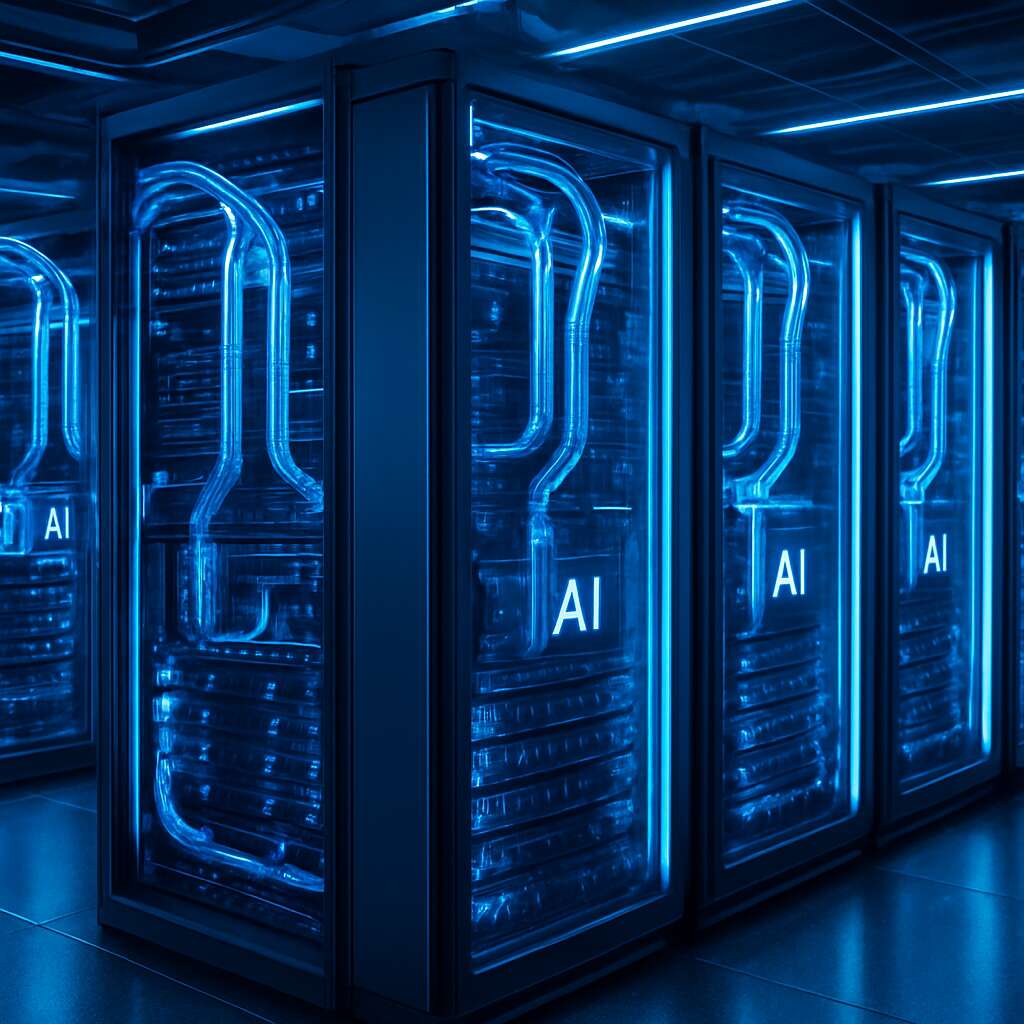
Types of Liquid Cooling Systems for AI Servers
Immersion Cooling – Overview, How it Works, Advantages for AI Data Centers, Types of Fluids Used, Challenges and Limitations
Liquid Cooling Systems for AI Servers are revolutionising data centre infrastructure by enabling unprecedented thermal management efficiency. Among the various types, immersion cooling stands out as an innovative approach. This system involves submerging server components directly into a specially designed cooling fluid, allowing heat to transfer rapidly from the hardware. Unlike traditional air cooling, immersion cooling offers a highly effective method to maintain optimal operating temperatures while reducing energy consumption.
In practical terms, immersion cooling works by encasing AI server components in a non-conductive liquid, which absorbs heat and dissipates it efficiently. This process not only enhances performance but also extends the lifespan of critical hardware. For AI data centers that demand constant, intense processing power, immersion cooling provides distinct advantages, such as noise reduction and space savings. Common types of fluids used include mineral oils and specially formulated dielectric liquids tailored for thermal conductivity and safety.
While liquid cooling systems for AI servers present numerous benefits, they do face certain challenges. The complexity of maintaining and safely managing immersion tanks, along with potential issues of fluid compatibility and leakage, can complicate widespread adoption. Nevertheless, ongoing innovation continues to address these limitations, promising a future where immersion cooling becomes a standard. As AI demands escalate, mastering the nuances of these systems—ranging from fluid selection to operational protocols—becomes increasingly vital for data centres aiming to stay at the forefront of sustainability and performance.
Closed-Loop Liquid Cooling – System Components, Integration with Existing Infrastructure, Efficiency Benefits, Maintenance Requirements
When it comes to Liquid Cooling Systems for AI Servers, the game is increasingly about precision and efficiency. Unlike traditional cooling methods that rely on fans or huge airflows, the closed-loop system takes a more elegant approach—circulating coolant in a sealed environment. This means fewer dust problems, less noise, and a lot more control over thermal performance. Think of it as giving your AI servers a bespoke jacket lined with thermal conductivity, wrapped up in a tidy, self-contained package.
These systems typically feature a compact loop that includes a pump, radiator, reservoir, and cooling block—each component working tirelessly to maintain optimal temperatures. Integrating these systems with existing infrastructure is straightforward, thanks to standardized fittings and modular designs. This seamless compatibility allows data centres to upgrade without major overhauls, making Liquid Cooling Systems for AI Servers a practical choice for modern facilities. And because they operate in a sealed environment, maintenance often involves checking fluid levels and ensuring no leaks—simple, strategic upkeep rather than daily drudgery.
Efficiency benefits are hard to ignore. A well-designed closed-loop liquid cooling system can lower energy costs by reducing the reliance on power-hungry air conditioning, freeing up space and shaving noise levels—perfect for open-plan data halls desperate for serenity. The system’s precision cooling means AI hardware can run at peak performance without overheating, even under high loads.
- Reduced energy consumption
- Smoother hardware operation
- Scalability for growing AI demands
All these advantages reinforce why Liquid Cooling Systems for AI Servers are gaining ground in the data centre arena, offering an elegant alternative to messy, inefficient cooling approaches. As AI workloads intensify, these systems shine brighter, promising a future where cooling is as smart as the servers they serve—precise, efficient, and hassle-free.
Chiller-Based Systems – Design and Functionality, Suitability for High-Performance AI Tasks, Cost Implications, Reliability Factors
Chiller-based systems are a classic choice among Liquid Cooling Systems for AI Servers. They operate by circulating chilled water through a network of pipes and cooling blocks attached directly to server components. This design ensures efficient thermal management, especially during intense AI training tasks. These systems can handle high heat loads with ease, making them ideal for data centres that need reliable performance under continuous high demand.
Designed for high-performance AI tasks, chiller-based systems excel at maintaining consistent temperatures. They often incorporate a dedicated compressor and refrigeration cycle that ensures the coolant stays at a predictable, low temperature. This reliability makes them suitable for AI environments where uptime and stability are non-negotiable. Cost-wise, they tend to be more expensive upfront due to their complex components and cooling capacity. Nonetheless, their durability and effectiveness can offset initial expenses over time.
- High-capacity chillers ensure optimal cooling for demanding AI workloads.
- Precision regulation keeps server temperatures steady, even during peak processing.
- Built with redundancy options to uphold continuous operation, reducing risk of failure.
Reliability factors are critical when choosing a liquid cooling system for AI servers. Chiller-based systems are renowned for their robustness, but they require regular maintenance. Proper leak detection and coolant management are vital to prevent downtime. When well-maintained, they provide a dependable solution that balances cost and performance, ensuring AI servers run at their best without interruption.
Direct-to-Chip Cooling – Implementation Details, Compatibility with AI Hardware, Thermal Management Efficiency
When it comes to liquid cooling systems for AI servers, one implementation stands out for its precision and adaptability: direct-to-chip cooling. Think of it as giving each processor a VIP treatment—coolant is channeled directly onto the hottest spots, guaranteeing peak performance without breaking a sweat (or melting down). This method entails specialized cold plates that sit snugly over the CPU or GPU, allowing for ultra-efficient heat removal with minimal fault lines.
What sets direct-to-chip cooling apart is its compatibility with high-performance AI hardware—no awkward fit or compatibility dramas here. The design ensures thermal management efficiency is maximised, keeping even the most ravenous AI training workloads at manageable temperatures. Plus, with fewer components compared to traditional systems, it’s easier to integrate into existing infrastructure, making it a popular choice for data centres pushing the limits of thermal regulation.
Consider the following advantages:
- Superior heat dissipation from demanding AI workloads
- Exact temperature regulation at chip level
- Enhanced hardware longevity and reduced downtime
Implementing direct-to-chip cooling isn’t just about smarts; it’s about artistry in thermal design. It’s a tailored solution that can keep AI servers performing at their best—without the need for massive overhead or worrying about ambient air temperature fluctuations. As machine learning models grow increasingly complex, so too must our approach to keeping the hardware cool and running smoothly.
Benefits of Liquid Cooling for AI Servers
Enhanced Thermal Performance – Superior Heat Dissipation, Temperature Stability, Impact on Hardware Longevity
In the realm of high-performance AI servers, battling against the relentless march of heat is an ongoing saga. Liquid Cooling Systems for AI Servers offer a compelling solution, providing unmatched thermal performance that traditional air cooling simply cannot rival. With their superior heat dissipation, these systems maintain a delicate equilibrium—preventing overheating without sacrificing operational stability. For AI servers tasked with complex computations, consistent temperature stability is more than a convenience; it’s the backbone of reliable performance.
Impact on hardware longevity is another often-overlooked benefit. Persistent thermal stress can degrade sensitive components over time, but liquid cooling’s effective heat management minimizes this wear and tear. As a result, industries leveraging AI servers experience an extension in hardware lifespan—a wise investment that can save substantial maintenance costs down the line. These systems do more than just keep things cool: they preserve the integrity of critical hardware, ensuring continuous, uninterrupted AI processing prowess.
Energy Efficiency – Reduced Power Consumption, Lower Cooling Costs, Sustainability Advantages
In the high-stakes game of AI server management, where overheating can lead to costly crashes or hardware meltdowns, liquid cooling systems for AI servers stand as the unsung heroes. While traditional air cooling has served its purpose, it often struggles under the weight of modern AI workloads, which generate enough heat to power a small city. Enter liquid cooling—an elegant, efficiency-packed alternative that promises to not just keep things cool but do so with finesse.
One of the standout advantages of liquid cooling systems for AI servers is their energy efficiency. These systems consume significantly less power compared to massive air conditioning setups, translating into lower operational costs. Instead of pouring energy into fighting heat like a frantic firefighter, liquid cooling gently transmits heat away, making the whole process more sustainable—an increasingly important factor as industries strive for greener data centres.
No longer do AI servers need to accept sky-high cooling bills as the cost of doing business. With liquid cooling systems, industries can enjoy a reduction in cooling costs while simultaneously slashing their carbon footprint. This dual benefit appeals to the eco-conscious and budget-savvy alike. For those who want to marry performance with responsibility, this innovative approach offers a compelling proposition, ensuring that high-performance AI workloads are maintained without draining resources or harming the environment.
Higher Server Density – Consolidation of Hardware, Space Optimization, Increased Computational Power per Rack
In the fierce arena of AI server management, where rack after rack is crammed with processors each demanding cooling that would give Antarctica a run for its money, the concept of higher server density is the secret weapon. Traditional cooling methods simply can’t keep pace with the relentless heat generated by modern AI workloads, and space is at a premium, especially in cramped data centres across the UK. Enter liquid cooling systems for AI servers—these marvels are not just about keeping things cool; they’re about reimagining what’s possible in server consolidation.
By slashing the need for sprawling cooling infrastructure, liquid cooling enables the tight packing of hardware—think of it as fitting a Formula 1 car into a compact racing pod. This results in a dramatic increase in the number of servers per rack, making data centre floors more efficient and dramatically reducing physical footprints. This space optimization doesn’t just mean less clutter; it opens doors for deploying more compute power in the same area, transforming server rooms into compact powerhouses.
For those aiming to crush performance barriers without the usual thermal penalty, liquid cooling systems for AI servers make it possible. The technology supports higher server density by meticulously managing heat at the chip level, allowing more CPUs and GPUs to operate simultaneously without overheating. This high-density configuration saves money and energy, freeing up space for new projects or consolidating existing infrastructure into sleek, energy-efficient modules.
Some data centres are even exploring the benefits of clustered arrangements, where
- consolidated hardware
- better space utilization
elevates computational density beyond traditional limits. With liquid cooling, deploying high-performance AI systems becomes less of a logistical nightmare, more of an elegant ballet of thermal management that amplifies both capacity and efficiency. In essence, these liquid cooling systems for AI servers are the unsung heroes enabling a new era of server craft, where higher server density isn’t just a pipe dream but a tangible, profitable reality.
Reduced Noise Levels – Quieter Operation, Benefits for Data Center Environments
In the relentless pursuit of quieter, more refined data centres, liquid cooling systems for AI servers are quietly making waves—offering a sanctuary of calm in a typically cacophonous environment. Noise pollution, often a byproduct of industrial-grade cooling fans and machinery, can be both a nuisance and a distraction, especially in UK-based facilities where focus and precision are paramount. Enter liquid cooling, a solution that remarkably reduces noise levels by exchanging the roar of fans for the gentle hum of liquid circulation. This not only creates a more pleasant working environment but also enhances operational stability, as fewer moving parts translate into less mechanical discord.
With the adoption of liquid cooling systems for AI servers, data centre environments enjoy several tangible benefits. For one, the absence of large airflow fans means a significant reduction in ambient noise—sometimes by as much as 50% compared to traditional air-cooled solutions. This sonic tranquility fosters better concentration and minimizes distractions for staff managing sensitive workloads. The clean, quiet operation is especially advantageous in settings where precision and data integrity are paramount—such as research labs or innovative tech hubs across the UK.
Beyond sound, the strategic design of liquid cooling enables the creation of more adaptable and efficient data centres. For instance,
- lower acoustic emissions aid in creating conducive environments for collaborative workspaces within the same facility
and make the entire ecosystem more pleasant to be around. The shift away from noisy fans also reduces vibration and mechanical wear, leading to higher hardware longevity—a subtle yet valuable perk for those who prefer their hardware to last longer than a seasonal UK weather cycle. In essence, the marriage of thermal performance with minimal noise positions liquid cooling systems for AI servers as not just a technological upgrade but a societal one—making data centres quieter, cleaner, and more human-centric.
Design Considerations for Implementing Liquid Cooling Systems
Compatibility with AI Hardware – Types of Processors and GPUs, Thermal Interface Materials, Customization Needs
When designing Liquid Cooling Systems for AI Servers, one must navigate a labyrinth of hardware compatibility and thermal intricacies. AI hardware is evolving at dizzying speeds—think processors and GPUs that could give your grandmother’s vintage tea set a run for its money in raw power. While some chips lean on traditional air cooling, high-performance AI processors often demand the finesse of liquid solutions, which excel in maintaining optimal temperature levels without turning your server room into a sauna.
Matching the cooling system to the type of processor and GPU is paramount. Modern AI servers employ a diverse array of components, from dense processor clusters to hyper-efficient GPUs tailored for machine learning calculations. An understanding of thermal interface materials (TIM) becomes crucial, as these materials facilitate heat transfer between the chip and the cooling interface.
- High-end thermal pastes
- Metal-based TIMs
- Phase-change materials
each offers its own set of advantages, influencing the design considerations of liquid cooling systems for AI servers. Customization needs often dictate whether a bespoke liquid cooling loop or a preconfigured, modular solution is the best fit—after all, one size rarely fits all in AI hardware cooling.
The compatibility of liquid cooling systems for AI servers with various processors and GPUs also hinges on form factor and connection interfaces. Ensuring seamless integration means scrutinising connector types, flow rates, and pump capacities, all while keeping an eye on future hardware upgrades. This level of meticulous planning helps prevent bottlenecks and ensures the thermal interface materials deliver maximum efficiency throughout the lifespan of the server. Selecting the right components and configuration not only safeguards hardware longevity but also preserves the computational agility that AI workloads demand.
Infrastructure Requirements – Piping and Pumping Systems, Power and Space Considerations, Safety Protocols
Designing Liquid Cooling Systems for AI Servers isn’t exactly a walk in the park — unless that walk involves dodging coolant spills and deciphering complex pipe layouts. A standout challenge? Ensuring the infrastructure can handle the relentless flow of heat, especially as AI hardware continues its rapid evolution. Pumping systems must be robust enough to maintain a steady circulation of coolant, while piping needs to be both resilient and leak-proof. Think of it as plumbing with a PhD—precision and reliability are non-negotiable.
Space and power considerations often feel like a game of Tetris—allocate wisely or face the chaos of cramped racks or overloaded power supplies. You’ll need to evaluate the physical footprint of the cooling components against existing data centre infrastructure, making sure everything integrates without causing bottlenecks. To keep things flowing smoothly, some setups incorporate
- high-capacity pumps
- adjustable flow rate controllers
allowing customization to specific hardware requirements and future upgrades. Remember, a well-designed liquid cooling system for AI servers is as much about safety as it is about efficiency.
Safety protocols are often overlooked but could spell disaster if ignored. Think robust leak detection, emergency shut-off valves, and anti-corrosion materials to protect your investment. Plus, a cooling system that relies heavily on tight connections and high-pressure piping demands vigilant maintenance checks. With the right infrastructure, a server room becomes a liquid-cooled fortress that stands up to even the most relentless machine learning workloads—without turning into the local swimming pool.
In sum, integrating a liquid cooling system for AI servers calls for meticulous planning around infrastructure needs. Ensuring optimal piping and pumping configurations, respecting power limits, and adhering to strict safety protocols all converge to create a resilient, efficient cooling environment. After all, nothing ruins a data centre faster than a coolant leak—except perhaps a coffee spill on the server racks. In the end, a smart design keeps thermals under control and your AI hardware running at peak performance with surprisingly little fuss.
Maintenance and Monitoring – Leak Detection, Fluid Replacement, System Diagnostics
In a realm where computational power accelerates at an exponential pace, the intricacies of maintaining optimal thermal environments for AI hardware can no longer be relegated to mere afterthoughts. Liquid Cooling Systems for AI Servers are transforming cooling paradigms, demanding meticulous attention to maintenance and monitoring. These systems, sophisticated in their design, extend beyond simple heat transfer; they embody a complex ballet of precision, safety, and relentless vigilance. Failures here aren’t just inconvenient—they threaten catastrophic hardware damage or data loss, making vigilant upkeep not an option but an imperative.
Leak detection stands as the sentinel—an ever-watchful guardian preventing the silent degradation that coolant leaks could cause. State-of-the-art leak sensors, often integrated with real-time alerts, discriminate between harmless micro-drips and dangerous breaches, alerting technicians before damage escalates. Fluid replacement, perhaps deceptively straightforward, demands strategic planning—ensuring coolant purity and viscosity, and preventing contamination that could impair thermal transfer efficiency. For systems implementing closed-loop configurations, routine fluid checks and replacements maintain optimal performance, ensuring the liquid cooling process remains unhampered and reliable.
System diagnostics weave through the arteries of liquid cooling infrastructure like a high-precision nervous system. Advanced monitoring tools scrutinize flow rates, pressure levels, and temperature differentials at granular resolutions—facilitating preemptive maintenance that curtails downtime. These diagnostics often integrate seamlessly with building management systems, delivering actionable insights that inform proactive interventions. A well-maintained liquid cooling system for AI servers thus becomes a continuous feedback loop—adapting and optimizing in response to operational shifts, ensuring thermal stability even amid demanding workloads.
- Regular system audits—checking for corrosion, wear and tear on piping, seals, and pump components—are indispensable in safeguarding integrity.
- Scheduled fluid exchanges—aligned with manufacturer specifications—help prevent stagnation and ensure the coolant’s superior thermal properties remain unimpaired.
- Routine calibration of flow controllers and pressure sensors keeps system parameters within safe margins, averting unnecessary strain on the infrastructure.
The nexus of these monitoring and maintenance practices transforms the liquid cooling setup from a fragile, reactive system into a resilient, self-sustaining powerhouse—an indispensable element in the modern data centre. The investment in vigilant upkeep pays dividends, prolonging hardware lifespan and maintaining peak operational efficiency. In a landscape where AI servers process mountains of data at blistering speeds, the sanctity of their thermal environment hinges on these meticulous attention points. Liquid cooling systems for AI servers are no longer a luxury but a strategic necessity—fusing technological ingenuity with disciplined maintenance to keep the digital engines firing without interruption.
Cost Analysis – Initial Investment, Operational Expenses, ROI Factors
Implementing liquid cooling systems for AI servers involves a nuanced balance between upfront investment and long-term gains. It’s tempting to focus solely on initial costs, but understanding the broader financial picture reveals a more profound story. The startup expense for these sophisticated systems encompasses custom components, high-quality coolants, and specialized installation, often making the initial investment seem steep.
Yet, in a landscape where AI servers generate unprecedented thermal loads, the operational expenses—particularly power consumption for traditional cooling—can spiral. Liquid cooling systems for AI servers are renowned for their energy efficiency, markedly reducing cooling costs. This shift isn’t just a matter of savings; it’s an act of strategic foresight.
Design considerations for these systems often include decision-making about potential return on investment (ROI). An effective analysis weighs the initial costs against ongoing operational savings, hardware longevity, and increased server density. For example, using
- modular designs
- advanced thermal materials
can reduce scalability barriers, while innovative configurations optimise space and thermal management.
Given these factors, calculating the ROI of liquid cooling systems for AI servers becomes more than a mere financial exercise—it transforms into an ethical commitment to sustainable and resilient infrastructure. The choice of system components, durability, and maintenance practices all play into this calculus, ensuring that the investment remains justified by tangible benefits over time. The overarching goal is to craft a system that not only withstands relentless workloads but also aligns with the broader drive towards more energy-conscious data centres.
Future Trends and Innovations in Liquid Cooling for AI Servers
Integration with AI-Optimized Hardware – Designing for AI Workloads, Custom Cooling Solutions
As AI workloads become more complex and demanding, the future of Liquid Cooling Systems for AI Servers lies in seamless integration with AI-optimized hardware. Innovations are increasingly focused on designing cooling solutions that are tailored specifically for high-performance AI hardware like GPUs and specialized processors. This ensures thermal management keeps pace with the rapid pace of AI advancements, enabling systems to operate at peak efficiency without overheating.
Emerging trends include the development of modular, custom cooling solutions that can adapt to evolving hardware configurations. These are paired with intelligent monitoring systems that precisely control coolant flow and temperature, reducing energy consumption. Integration of AI-driven diagnostics allows for predictive maintenance, minimizing downtime. As server density increases, future designs will focus on higher thermal dissipation within minimal space, maintaining hardware longevity and operational stability.
A new wave of liquid cooling innovation is also exploring natural and eco-friendly fluids, aligned with sustainability goals. These advancements will continue to propel Liquid Cooling Systems for AI Servers toward unmatched performance, reliability, and eco-conscious operation.
Advancements in Cooling Fluids – Eco-Friendly and High-Performance Liquids, Thermal Conductivity Improvements
As artificial intelligence continues its rapid ascent, the demand for high-performance computing has never been greater. Within this realm, Liquid Cooling Systems for AI Servers are redefining the landscape, paving the way for unprecedented thermal management that keeps hardware operating at peak conditions. Advances in cooling fluids illustrate this evolution, with eco-friendly and high-performance liquids emerging as game-changers in balancing sustainability with efficiency. These innovative fluids, often derived from natural sources or biodegradable composites, offer superior thermal conductivity while reducing environmental impact—an essential step toward greener data centers.
Future trends are taking a fascinating turn with improvements in thermal conductivity, which directly influence how effectively heat is dissipated from densely packed AI hardware. Design innovations now favor modular, adaptable cooling solutions that can seamlessly integrate with evolving hardware architectures. Such flexibility ensures that liquid cooling remains precise—paired with intelligent monitoring systems that regulate coolant flow and temperature with remarkable accuracy, reducing both energy consumption and operational costs.
Here’s what to look out for:
- Enhanced formulations of natural or eco-conscious cooling fluids to align with sustainability goals.
- Development of liquid cooling systems that adapt dynamically to hardware thermal loads, maintaining optimal performance under varying workloads.
- The integration of AI-driven diagnostics within cooling infrastructure, enabling predictive maintenance to further minimise down-time and extend hardware longevity.
Amidst this progress, the focus is on elevating energy efficiency and server density. By employing advanced thermal interface materials and high-conductivity liquids, Liquid Cooling Systems for AI Servers can facilitate higher server density without compromising operational stability. This results in a remarkable space-saving effect and quieter operation—features highly valued in high-stakes data environments where precision and peace matter equally.
Sustainable advancements, such as eco-friendly liquids with comparable or superior thermal performance, ensure that the pursuit for technological excellence does not come at the planet’s expense. The synergy between high-performance liquids and intelligent cooling architectures heralds an era where hardware longevity and resource conservation walk hand in hand—supporting the ever-growing demands of AI workloads with elegance and resilience.
Automated Monitoring and Control Systems – Smart Sensors, AI-Driven Optimization, Predictive Maintenance
In the realm of AI servers, where every millisecond of performance counts, the future of cooling technology is being reshaped by automated monitoring and control systems. These innovations empower data centres to not merely react to temperature fluctuations, but to predict and adapt before problems arise. The integration of smart sensors within liquid cooling systems for AI servers enables real-time data collection on coolant flow, temperature, and hardware stress points, creating a closed-loop feedback system that continually maintains optimal conditions.
AI-driven optimization algorithms analyse this influx of data, fine-tuning cooling parameters on the fly. Such systems dynamically adjust coolant circulation, regulate thermal loads, and distribute cooling resources more efficiently than traditional methods ever could. This continuous, predictive approach minimises energy consumption—an aspect that resonates strongly with sustainability goals—while simultaneously extending hardware longevity.
Significantly, one cannot overlook the importance of predictive maintenance within liquid cooling systems for AI servers. Automated diagnostics identify leaks or potential component failures before they escalate into costly downtime. These systems also schedule fluid replacements and system checks autonomously, reducing human intervention and enhancing operational reliability. This seamless orchestration of maintenance tasks not only preserves hardware integrity but also improves overall lifecycle management of the data centre infrastructure.
Innovative advancements include:
- Development of AI-optimised sensors capable of detecting micro-level temperature shifts, allowing for unprecedented control precision.
- The deployment of machine learning models that forecast cooling requirements based on workload patterns, enabling pre-emptive system adjustments.
- The integration of remote diagnostics and control features, culminating in a resilient cooling ecosystem that can be monitored and managed from anywhere—a vital component for dispersed infrastructure in the UK and across Europe.
What makes these innovations so compelling is their capacity to enhance energy efficiency, especially as server densities in AI applications continue to multiply. Smart control systems, embedded within liquid cooling systems for AI servers, make it possible to balance high-performance demands with eco-conscious operation, aligning technological prowess with long-term sustainability objectives. This synergy promises data centres that are not just high-functioning but also environmentally responsible, setting new standards for responsible innovation in the industry.
Scaling Liquid Cooling for Large Data Centers – Modular Designs, Hybrid Cooling Approaches, Global Deployment Strategies
The future of data centre infrastructure hinges on the evolution of liquid cooling systems for AI servers, especially as demands on computational power skyrocket. Scaling these systems to accommodate large data centres requires innovative approaches that transcend traditional models. Modular designs are gaining traction, offering flexible, scalable solutions that simplify deployment and maintenance across dispersed sites. These designs enable rapid expansion without disrupting existing operations, creating a seamless integration pathway.
Hybrid cooling approaches are emerging as game-changers, blending immersion cooling with direct-to-chip or chilled water systems. This hybrid strategy combines the strengths of each method, offering enhanced thermal management and energy efficiency. Think of it as a carefully choreographed dance—balancing high-density server racks with sustainable power consumption, all orchestrated through advanced automation.
Deployment strategies are becoming increasingly global, with data centres across the UK and Europe adopting these cutting-edge solutions to meet regional climate challenges and infrastructural constraints. The focus on modular, adaptable liquid cooling systems for AI servers aligns perfectly with the needs of modern data centres—establishing a foundation for resilient, environmentally-conscious computing at an unprecedented scale.