
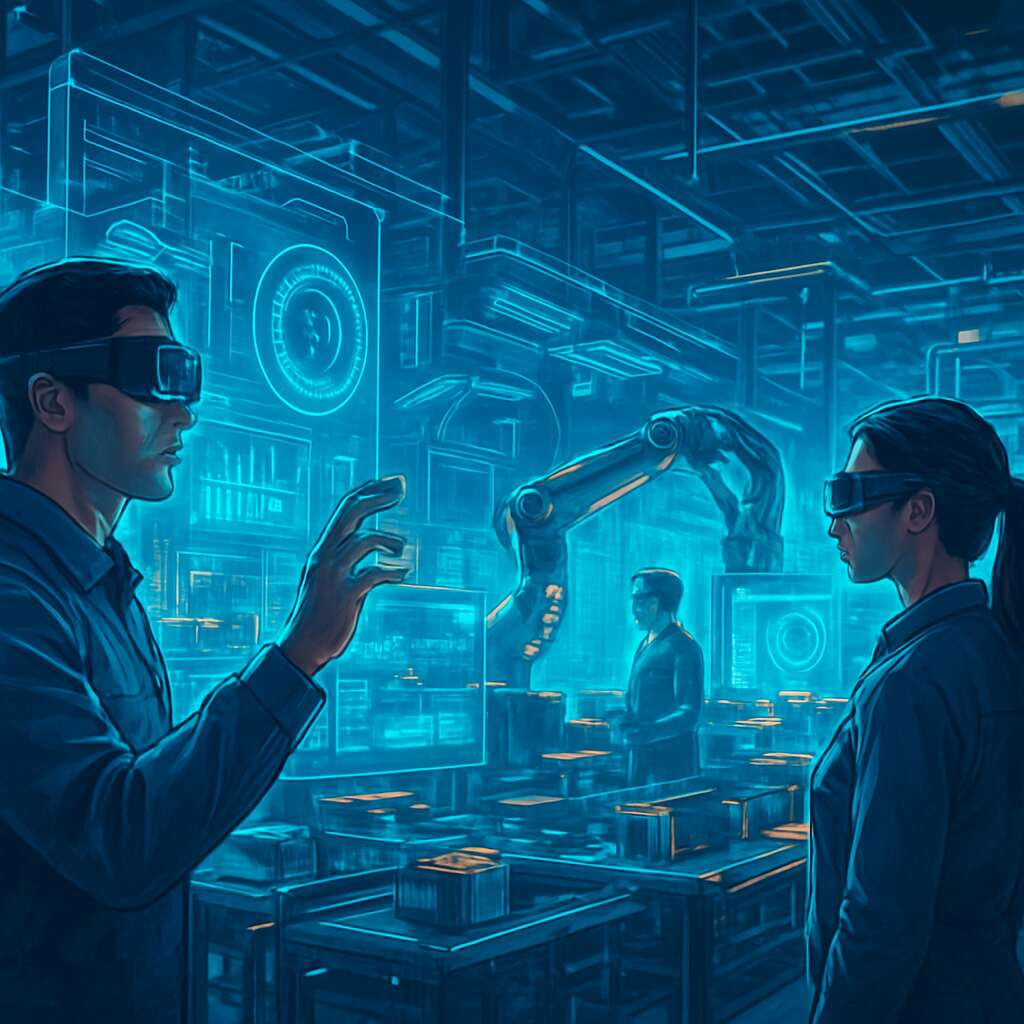
Industrial Manufacturing Transformations through the Metaverse
Smart Factory Simulations – Utilizing virtual environments for factory layout planning, equipment scheduling, and process optimization
Industrial manufacturing is undergoing a revolution driven by the rise of the Industrial Metaverse Use Cases. Virtual environments enable companies to simulate factory layouts, equipment scheduling, and process optimization with unprecedented precision. By creating digital twins of facilities, manufacturers can identify bottlenecks, test new workflows, and streamline operations before making costly changes on the ground.
Smart factory simulations are transforming how factories plan and operate. For example, virtual models allow engineers to fine-tune factory layouts, reducing downtime and enhancing safety. Equipment scheduling becomes more efficient through real-time virtual adjustments. This approach minimizes errors, cuts costs, and accelerates project timelines, all within a safe, controlled setting.
Many businesses adopt these Industrial Metaverse Use Cases for ongoing process management. They can run multiple scenarios quickly—like a digital playground—without disruption. This iterative process leads to better decision-making and real-world improvements. It’s clear that virtual simulations are reshaping how manufacturers approach efficiency and innovation. The integration of these technologies signals a new era of manufacturing leadership that’s agile, precise, and highly responsive to change.
Remote Maintenance and Repair – Enabling technicians to perform repairs using augmented reality and virtual guidance
Imagine a technician, half a world away, guiding a repair with nothing but a smart device and their trusty augmented reality (AR) glasses. Thanks to Industrial Metaverse Use Cases, remote maintenance has gone from sci-fi dream to everyday reality. Instead of sending expensive specialists on a globe-trotting expedition, companies can summon them virtually, guiding onsite teams through complex repairs with real-time AR overlays. This digital duet not only shortens downtime but also dramatically reduces travel costs and logistical headaches.
Modern industrial maintenance leverages the power of virtual guidance, transforming how factories handle unforeseen hiccups. By integrating augmented reality into routine repairs, technicians can access step-by-step instructions and safety alerts projected directly onto their field of view. For instance, using augmented reality, a technician might see a live 3D model of the machinery’s internal components—cutting through the clutter like a hot knife through butter. This seamless melding of virtual assistance and physical effort exemplifies how Industrial Metaverse Use Cases revolutionize the maintenance landscape.
- Remote diagnostics become a walk in the park, with experts guiding onsite workers through intricate repairs in a shared hyper-realistic virtual environment.
- Virtual repair simulations empower technicians to practice and perfect their skills before touching the actual equipment, increasing safety and precision.
- Instant access to digital twins allows for real-time troubleshooting, decreasing downtime and keeping factory operations humming along smoothly.
Workforce Training and Skill Development – Simulating real-world scenarios for training workers in a risk-free digital space
In the relentless race of industrial innovation, skill development stands at the forefront of technological evolution. The Industrial Metaverse Use Cases are transforming traditional workforce training into an immersive experience, where workers can step into hyper-realistic digital environments that mirror the unpredictable chaos of real-world operations. These virtual training grounds eliminate the risks associated with hands-on learning, making it possible to simulate hazardous scenarios without endangering lives or equipment.
Imagine a trainee navigating a virtual explosion in a refinery, learning to shut down valves and deploy safety protocols—all within a digital realm that reacts dynamically to their actions. The advantage? Repetition of complex procedures in a safe, controlled space hones skills faster and with greater confidence. For companies eager to keep pace, leveraging the Industrial Metaverse Use Cases means ramping up employee expertise without the logistic nightmares of on-site training sessions.
- Real-time simulation of machinery failure and repair in a risk-free environment.
- Interactive scenarios that develop problem-solving and decision-making skills under pressure.
- Customized modules tailor-made for different roles within the manufacturing ecosystem.
This virtual mastery not only accelerates learning curves but also cements safety as an unwavering priority. Through the seamless integration of digital twins and augmented reality training modules, organisations empower their workforce to operate more efficiently. The days of static instruction manuals are fading—welcome to a future where skill acquisition is an exhilarating journey through the expansive world of the Industrial Metaverse Use Cases.
Design and Prototyping – Accelerating product development cycles with virtual prototyping and testing
The promise of transforming industrial manufacturing through virtual innovation is no longer a distant dream; it is unfolding at a remarkable pace. Certainly, the Industrial Metaverse Use Cases are revolutionising how products are designed and refined, presenting a seamless blend of imagination and precision. Imagine the ability to create a digital twin of a product—an exact virtual replica—allowing engineers to simulate performance and stress-test materials under various conditions without ever leaving their desks.
This approach accelerates product development cycles significantly. Virtual prototyping isn’t just a preliminary step; it becomes an artist’s studio where ideas take shape in hyper-realistic environments, with every detail scrutinised before a single component is physically produced. Using immersive testing, teams can identify flaws early, saving countless hours and costs associated with traditional trial-and-error methods. Such innovations epitomise the transformative capacity of the Industrial Metaverse Use Cases, where digital environments serve as a laboratory of endless possibility.
- Design iterations that respond instantly to simulated feedback
- Rapid testing of new materials and geometries
- Collaborative development across geographically dispersed teams
Innovation driven by the Industrial Metaverse Use Cases heralds a new era—one where ideas are not confined by physical constraints but instead flourish within boundless virtual realms. Here, the artistry of engineering marries the precision of digital science, opening doors to unprecedented speed and flexibility in product development. As this technology advances, manufacturers will find themselves more capable than ever to create prototypes that are not only beautiful and functional but also reflective of tomorrow’s realities.
Supply Chain and Logistics Enhancements with Virtual Environments
Digital Twin of Supply Networks – Creating real-time virtual models to monitor and optimize supply chain operations
In a world where supply chains are often likened to a game of 3D chess, the advent of Virtual Environments in the Industrial Metaverse Use Cases has added a new dimension of tactical advantage. Imagine creating a digital twin of your entire supply network—dynamic, real-time, and eerily accurate—serving as your virtual cockpit. These digital twins allow companies to monitor every ripple in the logistical pond with the precision of a hawk eyeing its prey. You can pinpoint bottlenecks, forecast disruptions, and optimise routes without breaking a sweat, or spilling a drop of expensive coffee during morning coffee runs.
It isn’t just about watching from afar; these virtual supply chain models enable hands-on experimentation at a scale that real-world testing simply cannot match. For example, you could simulate the impact of unexpected port closures or supplier delays and see how your supply chain reacts within the safety of a virtual environment. Instead of costly mistakes, you get actionable insights from a virtual space. This approach transforms traditional supply chain management by integrating digital twin technology—an innovative facet of Industrial Metaverse Use Cases that turns chaos into clarity.
Inventory Management Simulations – Forecasting and managing inventory through immersive digital representations
In the rapidly evolving realm of Industrial Metaverse Use Cases, virtual environments are revolutionising inventory management. Imagine walking through a digital replica of your warehouse—each product, pallet, and container rendered in precise detail. This immersive visualization transforms traditional stock control, allowing real-time forecasting and management at a granular level. With dynamic digital representations, companies can anticipate stock shortages, overstock scenarios, or obsolescence before they even happen, turning uncertainty into strategic insight.
Interactive virtual simulations enable businesses to experiment with inventory scenarios without risking costly errors. By creating virtual prototypes of warehouse layouts or logistical pathways, teams can identify bottlenecks or inefficiencies. This proactive approach ensures smoother operations and reduces waste. As part of Industrial Metaverse Use Cases, these simulations are not merely futuristic fancifulness—they offer practical, tangible benefits for supply chain resilience and agility.
Some companies are leveraging digital twin technology to simulate demand fluctuations, seasonal peaks, or unexpected disruptions—helping them stay a step ahead. Here’s a quick look at how these innovations are reshaping inventory control:
- Real-time visibility into stock levels across multiple locations
- Predictive analytics for ordering and replenishment planning
- Virtual scenario testing for supply chain resilience
This convergence of digital twin technology with immersive digital environments exemplifies the expansive scope of Industrial Metaverse Use Cases. As inventory management becomes increasingly personalized and anticipatory, supply chains are no longer just reactive systems—they’re proactive, intelligent networks powered by virtual, data-driven insights.
Transportation Planning – Simulating logistics routes and transportation methods for efficiency and risk reduction
Transport logistics might not be the most glamorous topic, but in the world of Industrial Metaverse Use Cases, it’s about to get a serious upgrade. Imagine simulating entire supply chain routes in a virtual environment—no more relying solely on old paper maps or guesswork. Virtual transportation planning lets companies test alternative routes and transportation methods, all within a digital twin of their logistics network. The result? An astonishing level of efficiency and risk reduction that could make even the most stoic supply chain manager crack a rare smile.
Through immersive digital environments, logistics teams can play out scenarios that highlight potential delays, congestion, or disruptions before they happen in the real world. It’s like having a crystal ball—but one that actually works. Here’s where Industrial Metaverse Use Cases truly shine: they provide the ability to optimize routing strategies, reduce fuel consumption, and identify bottlenecks long before they cause chaos.
- Route simulations that account for weather patterns and traffic
- Assessing different transportation modes—from trucks to drones
- Testing contingency plans without risking expensive cargo or equipment
By creating a virtual map of the entire logistics landscape, businesses can fine-tune their approach and stay several steps ahead of unforeseen events. Whether it’s rerouting shipments during a strike or adjusting transportation for seasonal surges, these digital simulations turn guesswork into data-driven decision-making. As part of the broader set of Industrial Metaverse Use Cases, transportation planning in virtual environments isn’t just futuristic concept fluff—it’s a practical, game-changing tool for supply chain resilience in the UK and beyond. Now that’s an innovation worth navigating!
Warehouse Automation Testing – Testing warehouse layouts and automation solutions in a virtual setting
Step into a realm where the digital and physical worlds entwine — the Industrial Metaverse is transforming the fabric of supply chain and logistics operations with a touch of magic. Recent studies reveal that companies leveraging virtual environments for warehouse automation testing report a 30% reduction in layout redesign time, paving the way for unprecedented agility. Such figures showcase how virtual real estate is no longer just speculative terrain but a crucial battleground for operational excellence.
In this enchanted landscape, warehouses become living simulations where layouts and automation solutions are tested with the precision of a master craftsman. By harnessing the power of virtual environments, logistics architects can visualize the movement of goods, identify bottlenecks, and refine workflows long before physical deployment. Imagine orchestrating an entire inventory management system amid a digital twin of the warehouse, where every forklift maneuver or conveyor tweak can be previewed, tested, and perfected—saving both time and treasure.
Within this virtual realm, a tapestry of possibilities unfolds:
- Replication of real-world disruptions such as power failures or equipment breakdowns
- Experimentation with new automation technologies to ascertain compatibility and performance
- Simulation of peak periods to evaluate handling capacity
This is the essence of industrial metaverse use cases—an immersive space where innovative solutions are born, refined, and validated without risking real goods or incurring downtime. As digital twins evolve into more sophisticated proxies of physical operations, software tools enable teams across the UK and beyond to streamline supply chain processes, decrease operational costs, and elevate safety standards in a manner that once belonged to the realm of fantasy.
Industrial Safety and Compliance Improvements
Safety Drills in Virtual Reality – Conducting safety training sessions using immersive simulations to prevent accidents
In a realm where the boundaries of reality dissolve like morning mist, the Industrial Metaverse emerges as a guardian of safety and compliance. Imagine safety drills unfolding within immersive simulations, where operators don virtual gear and navigate hazardous scenarios without a hint of risk. These virtual safety drills harness the power of the Industrial Metaverse to create an environment that mimics the chaos and unpredictability of real-world emergencies with astonishing fidelity. Such digital trainings serve as enchanted gates that prevent accidents before they happen, fostering a culture of vigilance and preparedness.
Within this virtual domain, safety protocols are woven into the fabric of daily operations, transforming traditional training into an interactive journey of discovery. The technology allows organizations to simulate the response to chemical spills, machinery malfunctions, or fire outbreaks, cultivating muscle memory and quick decision-making skills. As safety becomes second nature, compliance with stringent regulations is seamlessly maintained. Embracing these Industrial Metaverse Use Cases empowers industries to elevate their safety standards, ensuring a resilient, accident-free environment for all who venture into the digital safety realm.
Hazard Recognition and Response – Simulating emergency scenarios to improve response times and protocols
In the shadowy realm of industrial operations, safety hazards lurk like unseen predators waiting to strike. As industries grow more complex, the need for rapid hazard recognition and precise response becomes vital. The Industrial Metaverse Use Cases open a portal to a new era of safety and compliance, transforming how emergencies are managed. Virtual simulations expose workers to life-threatening scenarios—chemical spills, fires, machinery failures—without any real risk hanging in the air. These immersive environments sharpen the instincts and reaction times of teams, making genuine emergencies less daunting and more manageable.
By building detailed, dynamic digital twins of hazardous situations, industries can train responders to assess threats swiftly and implement effective protocols. A common approach within these Industrial Metaverse Use Cases is the deployment of scenario-based training modules that enhance hazard response strategies. For instance, safety teams can navigate through multiple layers of a simulated factory fire, learning to coordinate evacuations and mitigate damage with unprecedented clarity. This kind of digital preparedness reduces response times significantly, translating into fewer accidents and safer workplaces linked directly to immersive safety training programs.
Such virtual environments serve as enchanted gates, not just for individual skill enhancement but for ingraining a safety-first culture across entire organisations. These simulations are more than visualizations—they’re living, breathing laboratories for hazard recognition and response optimization, scripting a new chapter in safety compliance powered by the Industrial Metaverse Use Cases. The potential to revolutionize safety protocols ensures that industries remain resilient, prepared, and almost prophecy-like in their ability to prevent accidents before they unfold.
Regulatory Compliance Testing – Using virtual prototypes to ensure products and processes meet industry standards
In an era where industries are navigating turbulent waters of compliance and safety, the Industrial Metaverse Use Cases shine like guiding stars—illuminating pathways to unprecedented levels of regulatory rigor. Virtual prototypes become the architect’s brush, painting detailed replicas of products and processes that can be scrutinized without risking real-world repercussions. These digital twins serve as veritable guardians of industrial integrity, ensuring every design aligns perfectly with industry standards before a single component is forged or assembled.
Such immersive environments not only streamline the testing of compliance but also unveil hidden flaws that traditional methods might overlook. They act as advanced testing grounds where simulated scenarios reveal how products respond under diverse conditions, safeguarding both environment and personnel. It’s truly remarkable how virtual testing can rectify potential regulatory infractions early in development—saving time, resources, and peace of mind.
- Enhanced accuracy in safety standards validation
- Reduced testing costs through virtual prototyping
- Accelerated approval processes by preemptively resolving compliance issues
The advent of these virtual models signifies more than a technological shift—it heralds a new philosophy of meticulous craftsmanship and accountability. Industries investing in virtual prototypes within the framework of Industrial Metaverse Use Cases find themselves better equipped to meet soaring regulatory expectations while maintaining operational agility. Each digital iteration is a step closer to flawless conformity—an ever-evolving ballet of precision and ingenuity, choreographed on the vast stage of the metaverse. It’s a compelling testament to how innovations in digital simulation forge pathways toward safer, more compliant industrial landscapes without compromise.
Remote Site Inspections – Allowing experts to perform virtual inspections of facilities to reduce travel and inspection costs
When it comes to maintaining safety and compliance at remote sites, virtual inspections are revolutionising the way industries operate. Instead of costly travel and logistical challenges, experts can now perform comprehensive virtual inspections using the power of the Industrial Metaverse. This technology allows inspectors to access detailed digital twins of facilities, ensuring thorough evaluations without leaving their offices.
Through immersive environments, safety standards can be validated with increased accuracy. Virtual site walkthroughs reveal potential hazards and compliance issues early, reducing the risk of incidents and ensuring industry standards are met. As a result, companies can save time and resources, making safety audits more efficient and less disruptive.
For industries with sprawling or hard-to-reach facilities, remote site inspections simplify oversight. They enable quick intervention, improved hazard recognition, and quicker response to emergencies. With the integration of the Industrial Metaverse, these virtual inspections transform traditional maintenance and safety procedures, providing a safer, smarter way to manage compliance across multiple sites.
Innovation and R&D Accelerations via the Industrial Metaverse
Virtual Collaboration Hubs – Fostering cross-disciplinary innovation with immersive collaboration spaces
In the silent corridors of innovation, an unseen revolution is unfolding—one that could redefine how industries approach R&D accelerations. The Industrial Metaverse Use Cases are transforming traditional collaboration with immersive virtual collaboration hubs that foster cross-disciplinary innovation. These spaces serve as dynamic environments where engineers, designers, and scientists can converge in real-time, transcending geographical limitations.
Imagine a space where ideas collide in an expansive virtual arena—facilitating faster problem-solving, seamless prototyping, and collaborative testing. This digital arena offers a unique platform for teams to visualize complex systems, iterate on designs, and simulate experimental processes without the delays of physical setup. Such hubs inspire serendipitous discoveries, catalyzing breakthroughs across sectors.
- Fostering cross-disciplinary innovation in safe, immersive environments
- Accelerating product development through virtual prototyping and testing
- Enhancing collaborative problem-solving with real-time virtual feedback
Penguins of creativity are no longer confined to the Arctic—they’re now thriving in the Industrial Metaverse. These collaborative hubs unlock new avenues for R&D accelerations, making the future of industrial innovation more interconnected and agile than ever before. As industries embrace these use cases, the potential for revolutionary discoveries becomes tantalisingly close—each virtual collaboration echoing with the promise of transformative breakthroughs.
Simulated Testing of New Technologies – Rapid trial and refinement of new machinery, tools, or processes in a digital space
In the race to accelerate manufacturing innovation, the Industrial Metaverse offers a revolutionary approach through simulated testing of new technologies. Instead of costly, time-consuming physical trials, industries can now perform rapid virtual experiments on machinery, tools, and processes within immersive digital environments. This shift not only slashes development timelines but also enhances safety and precision—crucial elements in today’s competitive landscape.
Imagine fine-tuning a new piece of manufacturing equipment in a virtual setting before committing to its real-world deployment. By leveraging digital twins and simulation platforms, engineers can identify potential flaws and optimize design elements with unmatched agility. Such capabilities enable a more iterative, responsive development process, leading to better products and faster market entry.
- Virtual prototypes are subjected to a range of conditions—stress, thermal, or operational—without the risks inherent in physical testing.
- Teams collaborate remotely to refine tools and machinery, reducing downtime and streamlining workflows.
- Planners simulate entire processes, from assembly lines to logistics, ensuring seamless integration before physical implementation.
This approach epitomizes the power of Industrial Metaverse Use Cases, creating an environment where innovation can flourish unfettered by traditional constraints. As industries embrace these capabilities, the pace of technological refinement accelerates, fueling a new era of smarter, more adaptable manufacturing systems. In essence, simulated testing in the Industrial Metaverse is reshaping how we conceive, validate, and optimise technological progress in the digital age.
Customer-Driven Product Design – Engaging clients in virtual environments to co-create or customize products
In the realm where imagination meets innovation, the Industrial Metaverse emerges as a canvas for limitless creativity. Among its most captivating use cases is the realm of Customer-Driven Product Design. Here, brands and clients convene within immersive digital environments, transforming the traditional dance of development into an elegant ballet of co-creation. Imagine a customer sketching their vision into a virtual model—touching, tweaking, and experiencing products before a single prototype is forged in steel. This synergy of human insight and digital precision accelerates the journey from concept to market, ensuring solutions are tailored with unprecedented fidelity.
Within these virtual worlds, stakeholders embrace a shared narrative, engaging in real-time feedback loops that refine aesthetics and functionality. The vibrant possibilities accommodate diverse preferences, whether it’s customizing intricate details or exploring new configurations in a room-sized visual space. Such versatility makes the Industrial Metaverse use cases a veritable forge for innovation—an arena where the boundaries of traditional design dissolve into a seamless blend of creativity and technology.
In this dance of digital craftsmanship, designers can harness an ordered list of strategic steps:
- Engaging clients through virtual prototypes
- Allowing for instant customization and iteration
- Simulating real-world use cases in an immersive environment
- Gathering invaluable user insights to inform subsequent designs
The efficacy of these processes exemplifies how the Industrial Metaverse fosters a new paradigm, one where collaboration and innovation are no longer hindered by physical constraints. As industries embrace these virtual conduits for design, they not only shorten development cycles but also craft products that resonate deeply with client needs—an avenue where creative passions and technological prowess entwine in a symphony of progress.
Ecosystem Digital Twins – Creating comprehensive digital replicas that enable ecosystem-wide innovation and analysis
The Industrial Metaverse ecosystem is revolutionising the way we approach innovation and research and development (R&D). By creating digital twins—precise, dynamic replicas of physical assets—companies can perform comprehensive analysis and testing within a virtual universe. These digital twins serve as a foundation for ecosystem-wide innovation, allowing stakeholders to simulate and scrutinise every aspect of a product’s lifecycle before physical creation begins.
This virtual environment enables real-time monitoring, scenario testing, and predictive analysis that were once unimaginable. For example, manufacturers can simulate the effects of wear and tear on machinery, or test how a new design performs under varying conditions—all within the safety of a digital twin. It’s a game-changing approach that accelerates development cycles and reduces costly prototyping errors.
In the context of Industrial Metaverse Use Cases, embracing these digital replicas facilitates collaboration across disciplines and locations. Stakeholders can gather to analyse simulations and make data-driven decisions faster and more efficiently. An ordered list of strategic steps in leveraging these digital ecosystems could include:
- Developing accurate virtual models of complex systems
- Running exhaustive simulations to identify potential flaws or inefficiencies
- Conducting cross-collaborative analysis within a shared digital environment
- Implementing iterative modifications based on virtual feedback, before physical deployment
This technology enables not only targeted innovation but also an adaptive R&D framework that responds swiftly to changing market demands. The ability to analyse virtual prototypes within a connected ecosystem accelerates problem-solving and fosters a culture of continuous experimentation. As industries deepen their investments in the Industrial Metaverse, the digital twin becomes a pivotal asset—serving as a knowledge hub to inspire future innovations and streamline the path from concept to market.