
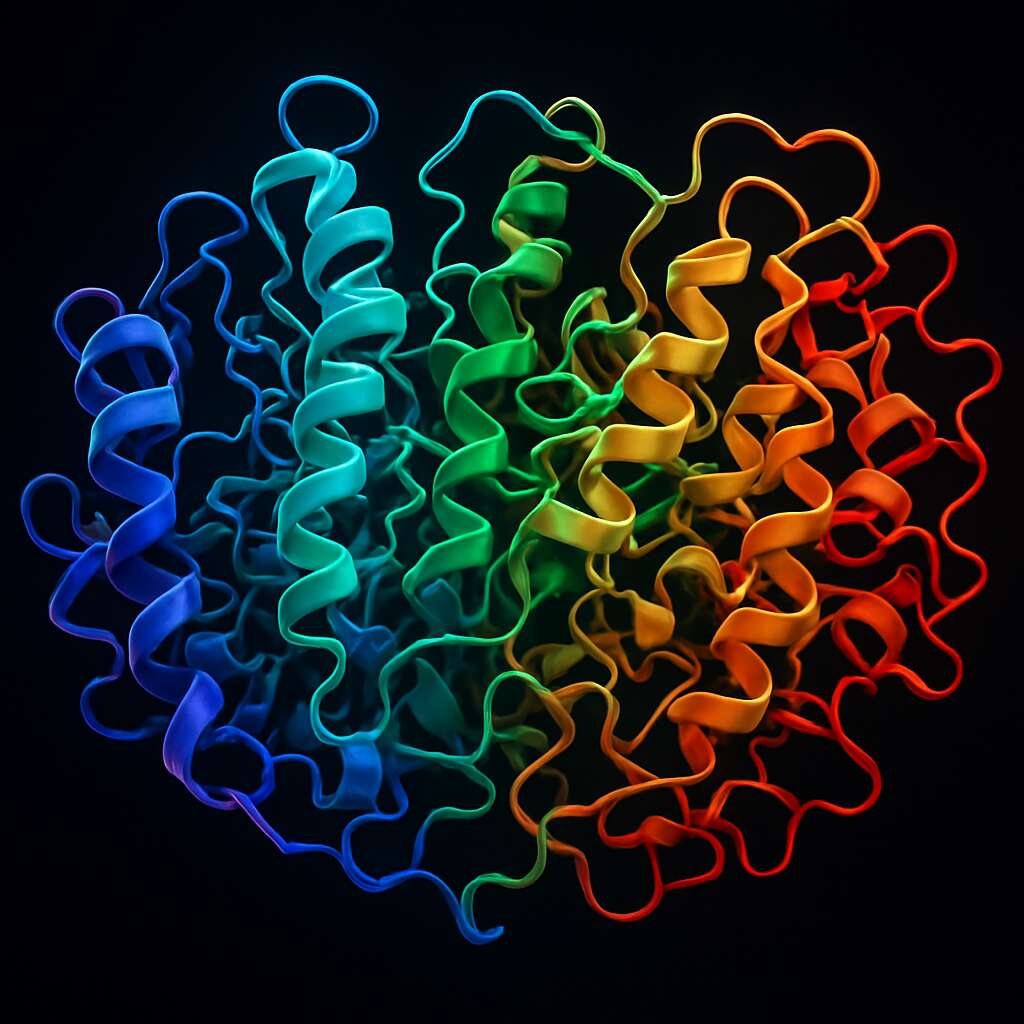
The Fundamentals of Protein Folding and AI Integration
Understanding Protein Structure and Folding – An overview of how proteins fold and why their 3D structures are vital for biological functions.
In the vast and intricate tapestry of life, proteins serve as the foundational threads that weave biological function into existence. Understanding the process of protein folding—how a linear chain of amino acids gracefully transforms into a complex, three-dimensional masterpiece—is pivotal for unlocking the secrets of health, disease, and innovation. At its core, protein folding is a dance of molecular precision, dictated by physical forces that guide the chain into a defined structure, critical for its role in cellular activity.
Recent advances in AI-Powered Protein Folding have begun to illuminate this hidden world with unprecedented clarity. By harnessing machine learning algorithms rooted in deep neural networks, researchers can now predict protein structures with remarkable accuracy, reducing what was once a painstaking puzzle into a near-instantaneous revelation. This integration of AI technology not only accelerates understanding but also opens new avenues for designing proteins that can fight diseases, craft novel medicines, and explore complex biological systems—turning the once mythical realm of molecular architecture into tangible scientific reality.
Engaging with the fundamentals of protein structure and folding highlights why AI-Powered Protein Folding is revolutionising the field. It’s not simply about prediction but about crafting a deeper, more intuitive grasp of how life’s building blocks assemble and interact in a universe governed by molecular magic.
Challenges in Traditional Protein Folding Methods – Limitations of experimental approaches like X-ray crystallography and NMR spectroscopy.
The pursuit of unraveling protein structures has long been hampered by limitations inherent in traditional experimental methods. Techniques such as X-ray crystallography and NMR spectroscopy, while invaluable, often resemble intricate puzzles—arduous to assemble and sometimes impossible to solve for unstable or complex proteins. These approaches demand extensive time, sophisticated equipment, and delicate sample preparations, limiting the scope of their application and leaving many biological mysteries in shadow.
Amidst these constraints, the advent of AI-Powered Protein Folding has ignited a new era of scientific exploration. Unlike classic methods that can take months or years, machine learning algorithms can predict protein conformations with surprising speed and accuracy. Yet, integrating AI into this domain is not without its hurdles. Challenges include training neural networks on limited data, ensuring the biological relevance of predictions, and refining models to interpret the subtleties of molecular interactions. Despite these obstacles, progress is relentless, illuminating pathways toward understanding the intricate dance of proteins in living organisms.
- Handling the sheer complexity of protein dynamics
- Addressing the variability in experimental data inputs
- Refining neural network architectures for biological accuracy
Introduction to AI’s Role in Protein Analysis – How artificial intelligence techniques are being integrated into the study of protein structures.
Artificial intelligence’s entrance into the realm of protein analysis marks a fascinating chapter in scientific innovation. Unlike the laborious, sometimes Sisyphean task of traditional methods, AI-Powered Protein Folding harnesses the cleverness of machine learning to predict protein structures with remarkable speed and precision. Picture an algorithm that learns from both successes and failures, continuously refining its understanding of complex molecular interactions—an extraordinary feat in the quest to unravel biological mysteries.
This integration isn’t merely about replacing old techniques; it’s about transforming them. By feeding neural networks with vast datasets of known protein structures, researchers enable AI to recognize patterns and anticipate how proteins fold under various conditions. The process involves sophisticated AI algorithms that handle the inherent variability in experimental data inputs, offering insights that once seemed unreachable.
For those keen on following the latest in this field, understanding the various applications of AI-powered protein folding—such as refining neural network architectures for biological accuracy—becomes essential. The synergy between cutting-edge AI techniques and molecular biology is opening routes to therapies, drug design, and even novel biomaterials, all while navigating the complex landscape that lies at the intersection of biology and computer science.
Technologies Powering AI-Driven Protein Folding
Deep Learning Algorithms in Protein Modeling – Explanation of neural networks and their application in predicting protein structures.
In the shadowy depths of scientific innovation, AI-Powered Protein Folding emerges as a celestial compass guiding us through the labyrinth of molecular mysteries. At the heart of this revolution lie deep learning algorithms, harnessing neural networks that mimic the intricate dance of neurons in the human mind. These networks, often layered with complexity, analyze vast reservoirs of data to predict the elusive three-dimensional structures of proteins with uncanny precision.
Neural networks are the bedrock of AI-Powered Protein Folding, employing a process akin to an artist refining a masterpiece. By feeding these models with experimental data, they learn to recognize patterns and infer the most probable structures. This approach transforms the quest for understanding protein conformations from a painstaking puzzle to a streamlined, almost poetic pursuit. Alongside this, sophisticated algorithms such as convolutional neural networks and graph neural networks work in tandem to unravel the tangled web of amino acid interactions, bringing clarity to objects once shrouded in mystery.
- The neural network receives input data — patterns, affinities, and spatial relationships— forming the initial brushstrokes;
- It then iteratively refines predictions, aligning computational estimations with empirical data;
- The process culminates in an elegant, high-fidelity model, illuminating the protein’s true structure.
Through the symbiotic relationship between AI and molecular science, the realm of protein modeling becomes an odyssey—one that whispers secrets long kept in the dark, beckoning us deeper into the shadows of the microscopic universe. The application of neural networks in AI-Powered Protein Folding not only accelerates discoveries but also transforms our understanding of life’s building blocks into an art of celestial precision.
Key AI Models and Frameworks – Overview of prominent models like AlphaFold and RoseTTAFold.
In the realm of protein science, AI-Powered Protein Folding is transforming the ancient puzzle of molecular architecture into an almost mystical art. Central to this revolution are ambitious AI models like AlphaFold and RoseTTAFold—each a marvel of modern innovation that embodies the poetic dance between biology and artificial intelligence. These models leverage sophisticated frameworks akin to the intricate play of celestial bodies, capturing the very essence of how proteins fold and interact.
AlphaFold, developed by DeepMind, utilizes a deep neural network architecture that learns from vast datasets to predict three-dimensional structures with unprecedented accuracy. It employs attention mechanisms to focus on critical regions within amino acid sequences, turning complex folding problems into manageable calculations. In parallel, RoseTTAFold, crafted by researchers at the University of Washington, employs a multitrack neural network that simultaneously predicts amino acid contacts, distances, and ultimately, the entire folded structure.
- AlphaFold’s transformative leap was heralded by its victory in the CASP competition, where it outperformed traditional experimental methods.
- RoseTTAFold offers an elegant yet powerful alternative, capable of modeling large and complex proteins with remarkable fidelity.
These frameworks exemplify the potential of AI-driven techniques to unravel the tangled web of amino acid interactions. By harnessing the layered complexity of neural networks, they simulate the folding process as an elaborate choreography of molecular forces—illuminating the secret lives of proteins that are the building blocks of life itself.
Through the enchanting lens of AI-Powered Protein Folding, these models embody a harmonious blend of technological ingenuity and biological mystery. They enable researchers to explore uncharted territories within the microscopic universe, where the secrets of structure and function emerge from elegant algorithms and deep learning architecture.
Data Requirements and Training Processes – Discussion on large datasets, computational resources, and training methodologies.
AI-Powered Protein Folding relies on vast quantities of data and intensive computational resources to achieve high-precision predictions. These models require large datasets of known protein structures, which serve as the foundation for training. Without ample data, the neural networks cannot learn the subtle patterns that govern folding behavior.
Training these models involves sophisticated methodologies. Neural networks are exposed to thousands of protein sequences paired with their 3D structures, enabling the AI to recognize intricate patterns of amino acid interactions. This iterative process demands significant computational power — often utilizing high-performance GPUs and cloud-based clusters — to process complex algorithms efficiently.
- Extensive datasets containing annotated protein structures
- Innovative training techniques like transfer learning for improved accuracy
<li Powerful GPU clusters for parallel processing
This combination of data and hardware forms the backbone of AI-Powered Protein Folding, allowing models like AlphaFold and RoseTTAFold to continually refine their predictions. The process is a marvel of modern technology, transforming raw data into detailed, reliable models of protein structures that once took years to elucidate through traditional experimental methods. The relentless march of advances in AI, data curation, and computational infrastructure keeps pushing the boundaries of what’s possible in this field.
Impact of AI-Powered Protein Folding on Scientific Research
Accelerating Drug Discovery and Development – How AI-driven predictions facilitate target identification and drug design.
AI-Powered Protein Folding is revolutionising the way scientists approach the arduous process of drug discovery. By accurately predicting the 3D structures of proteins, this technological marvel accelerates the identification of promising biological targets. When the complexities of protein conformations are demystified through AI-driven predictions, researchers gain a clearer roadmap for designing molecules that can modulate disease pathways effectively. The potential to streamline this phase means that promising treatments may reach clinical trials in a fraction of the usual time, saving lives and resources.
In practical terms, AI-powered models like AlphaFold and RoseTTAFold facilitate a deeper understanding of protein interactions critical for drug development. This enables scientists to bypass traditional laboratory bottlenecks, focusing instead on what’s most promising for therapeutic innovation. As a result, the pharmaceutical industry witnesses a paradigm shift, where AI-powered insights inform both target identification and drug design, making every step more precise and efficient.
Ultimately, the integration of AI technology into the process of protein analysis signifies a new era of insights and possibilities, transforming the landscape of medicine and opening pathways to novel treatments that once seemed out of reach.
Advancements in Understanding Genetic Diseases – Insights into structural mutations and disease mechanisms enabled by AI.
In the shadowy world of genetic mysteries, understanding the precise nature of how proteins mutate can mean the difference between life and death. Recent advances in AI-Powered Protein Folding have cast a revealing light on this enigma, unraveling structural mutations that once baffled scientists for decades. By accurately modeling these conformational changes, researchers can dissect the disease mechanisms at play—bringing clarity to conditions like Alzheimer’s, cystic fibrosis, and rare genetic disorders.
Leveraging AI, scientists are now able to identify subtle yet impactful structural mutations that trigger malfunctioning proteins. These insights create a ripple effect—they inform targeted therapeutic strategies and deepen our grasp of disease pathways. Notably, AI-powered models excel at deciphering complex interactions between mutated proteins and their environments, providing an unprecedented window into disease progression.
- Understanding how mutations alter protein structures at a granular level
- Mapping disruptions in biological pathways caused by genetic variations
- Identifying novel targets for precision medicine interventions
By harnessing the extraordinary capabilities of AI-Powered Protein Folding, medical researchers are stepping into a realm where once-intractable genetic diseases become solvable puzzles. This technological leap refines our ability to interpret the impacts of mutations, transforming the landscape of biomedical research and patient care. Every deeper level of insight brings us closer to therapies tailored specifically to genetic intricacies—a real game-changer in the fight against hereditary illnesses.
Facilitating Personalized Medicine – The role of accurate protein models in tailoring treatments for individuals.
The ability to tailor treatments to individual genetic makeup is transforming modern medicine, and AI-Powered Protein Folding stands at the forefront of this revolution. Accurate protein models provide a window into the very core of biological function, revealing how unique genetic variations shape disease pathways. These models enable clinicians to craft precisely targeted therapies, reducing trial-and-error approaches that have long plagued treatment outcomes.
Imagine a future where treatments aren’t just broadly effective but personalized to each patient’s genetic profile. AI-Powered Protein Folding makes this vision a reality by illuminating the subtle conformational nuances that dictate how proteins behave in different individuals. Such insights allow for the development of highly specific medication plans, increasing success rates and minimizing side effects.
A growing number of researchers are now employing AI-driven models to identify unique molecular signatures. Often, this involves analyzing genetic data alongside protein structures to reveal disruptions in biological pathways. With a clearer picture of each patient’s unique protein landscape, medicine becomes an act of precision, not guesswork. This technological leap is redefining how we approach complex hereditary illnesses—making personalized medicine not just a possibility but an imminent standard.
Future Directions and Ethical Considerations
Emerging Trends in AI and Protein Science – Potential innovations such as AI for protein-protein interactions and simulation enhancements.
As AI-Powered Protein Folding advances, the horizon reveals tantalizing prospects that could redefine our grasp of biology itself. Future innovations are poised to go beyond static structures, delving into complex **protein-protein interactions**—a realm where subtle molecular dialogues dictate life’s most intricate processes. Imagine AI systems capable of simulating interaction networks in silico, illuminating pathways previously shrouded in mystery. Such precision will make the invisible visibly tangible, revolutionising drug design and therapeutic interventions.
Emerging trends hint at a new epoch of **simulation enhancements**, where AI models mimic dynamic biological environments with unprecedented fidelity. This isn’t merely about predicting static protein structures but understanding how proteins behave in live cells. These innovations could facilitate breakthroughs in artificial intelligence, leading to even more sophisticated models that comprehend the nuances of protein milieu. As we stride forward, ethical considerations around data-sharing and the societal implications of AI-driven biology remain as crucial as the scientific advancements themselves. The trajectory promises a future where AI-Powered Protein Folding plays a pivotal role in shaping personalized medicine and tackling complex genetic diseases like never before.
There’s also a growing exploration of how artificial intelligence can elucidate the tangled web of **protein-protein interactions**, unveiling how proteins communicate and collaborate at the molecular level. Combining this with advances in high-throughput simulations will accelerate understanding of biological systems in their entirety. As these trends unfold, it’s worth considering how such technological progress raises questions about data privacy, bias in training datasets, and the moral responsibility embedded within AI’s expanding influence on science. The journey ahead beckons us to contemplate not only the scientific potential but also our collective duty in navigating the ethical landscape of AI-Powered Protein Folding.
Challenges and Limitations – Addressing issues like prediction accuracy, data biases, and computational costs.
The frontier of scientific innovation often feels like peering into a digital crystal ball, yet with AI-Powered Protein Folding, that future is unfolding faster than most could have imagined. While we’ve cracked plenty of structural secrets, the truth remains: prediction accuracy, data biases, and computational costs still cast shadowy figures over this promising domain. As the technology matures, so too must our understanding of its limitations — lest we find ourselves caught in a web of flawed assumptions or, worse, cost spirals that make even the heartiest researchers groan.
The road ahead is not without challenges. AI models need enormous datasets to learn from, and despite leaps in computational power, real-world accuracy can sometimes be more about approximation than perfection. If the training data is skewed or biased — which is all too common in biological datasets — then the predictions risk becoming as unpredictable as a squirrel on a sugar rush. Implementing solutions that mitigate bias while improving prediction fidelity demands careful scrutiny. One way to conceptualise this is through
- rigorous validation protocols
- transparent dataset curation
- constant model refinement
— essential ingredients to ensure AI-Powered Protein Folding doesn’t become just another overhyped gadget.
Then there’s the elephant in the server room: computational costs. The immense processing power needed to run advanced neural networks for protein modeling can make even the sturdiest IT infrastructure sweat. The more elaborate the model, the more energy and hardware it gobbles up, inflating expenses and introducing barriers to accessibility. Balancing the scale of model complexity with computational efficiency will be pivotal. Otherwise, we risk relegating AI-Powered Protein Folding to the realm of well-funded giants, leaving smaller labs in the dark, eyes glazed over from the constant drip-feed of data crunching.
It’s worth noting that some hurdles could be addressed with smarter algorithms, more efficient hardware, and even a dash of good old-fashioned human oversight. As AI becomes more adept at mimicking real biological environments, we’re walking a tightrope between scientific possibility and practical feasibility. The promise of understanding the hidden conversations between proteins and wrestling with their dynamic nature hinges on overcoming these technical limitations—not to mention the ongoing effort to stay ahead of biased datasets and data privacy concerns.
Ethical and Regulatory Aspects – Considerations related to data privacy, dual-use concerns, and scientific transparency.
As AI continues to transform scientific frontiers, one area shimmering with potential is AI-Powered Protein Folding. This technology promises to revolutionise our understanding of biological complexity, but it also raises urgent ethical and regulatory questions that demand thoughtful consideration. While the power of AI to accelerate breakthroughs in medicine and biological research is undeniable, it’s crucial to navigate the associated challenges with care and transparency.
At the heart of ethical concerns lie issues surrounding data privacy and dual-use technology. AI models require vast amounts of sensitive biological data, much of which could include proprietary or personal health information. Protecting this data from misuse is paramount, especially as AI-Powered Protein Folding advances into clinical applications. Additionally, dual-use concerns—that the same technology could be leveraged for harmful purposes—necessitate strict oversight and international cooperation. Accountability and transparency must be woven into the development process, ensuring public trust is maintained while fostering innovation.
One way to promote scientific transparency is through open-access datasets and clear validation protocols. These practices allow researchers worldwide to scrutinise datasets, ensuring integrity and reducing bias. Implementing consistent frameworks for ethical review can further align AI-Powered Protein Folding with societal values. As new models emerge, regulatory bodies should establish guidelines to oversee safety, efficacy, and ethical use, preventing misuse while encouraging responsible progress.
- Establishing global standards for data privacy and security in biological datasets.
- Creating accountability mechanisms for dual-use concerns, reducing potential misuse of AI models.
- Promoting open scientific discourse and transparent validation processes to uphold trust.
Public engagement and education are equally important. Explaining how AI-Powered Protein Folding is used and regulated can foster societal acceptance, even amid complex technical debates. As this field evolves, it will benefit from interdisciplinary collaborations that include ethicists, policymakers, and biomedical researchers—each ensuring that the rapid pace of innovation does not outstrip our moral compass. Balancing the immense promise with ethical responsibility will be the guiding principle, helping to shape a future where AI-powered insights serve humanity’s best interests and safeguard our collective dignity.