
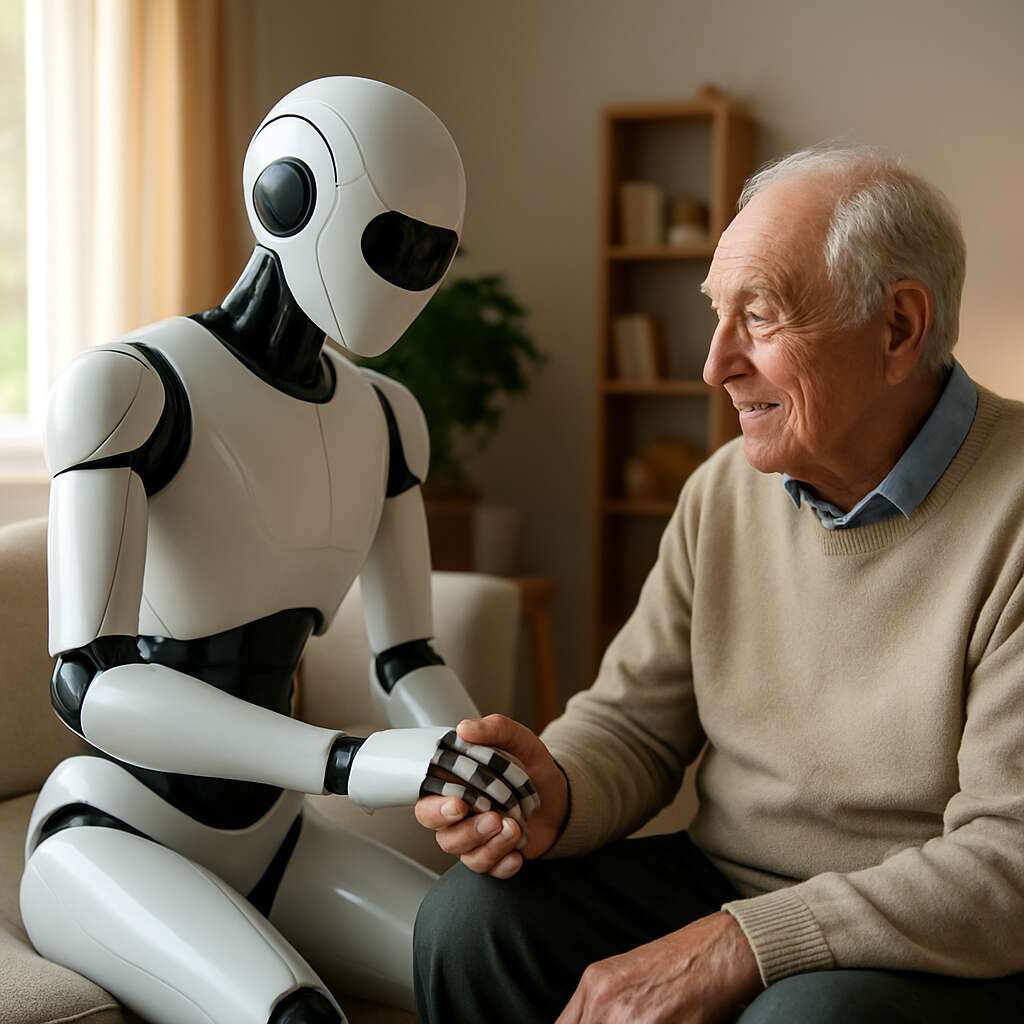
Overview of AI-Powered Companionship Robots
Introduction to AI-Powered Robots – Defining AI companionship robots and their core functions
Amidst an era where technology intricately weaves itself into the fabric of human experience, AI-Powered Companionship Robots emerge as profound symbols of empathy and innovation. These machines are more than mere gadgets; they serve as digital confidants, bridging the emotional gap often widened by loneliness. At their core, AI companionship robots blend sophisticated algorithms with intuitive design to foster genuine interactions—listening, responding, and adapting to individual needs with uncanny precision.
What sets AI-Powered Companionship Robots apart is their ability to learn from human behaviour, creating personalised experiences that resonate on a deeply emotional level. They are constructed not just to amuse or entertain but to engage in meaningful dialogue, offering a semblance of companionship that can alleviate social isolation. As technology advances, their functions may expand far beyond basic conversation, incorporating emotional recognition and even empathetic responses, making them increasingly integral in both homes and care facilities. The potential of AI-powered companionship robots lies in their capacity to redefine human connection within an increasingly digital landscape.
History and Evolution – Development timeline and technological advancements
From the silent hum of experimental prototypes to the bustling laboratories of today, the history of AI-Powered Companionship Robots spans decades of relentless innovation. In the early 2000s, rudimentary chatbots and simple automata hinted at a future where machines might forge emotional bonds with humans. These early iterations relied heavily on scripted responses, often lacking genuine engagement but laying a crucial foundation for what was to come.
As technology advanced, so too did the sophistication of these digital confidants. The rise of machine learning and natural language processing in the 2010s transformed AI-powered companionship robots from basic conversation partners into adaptive entities capable of learning and responding with uncanny realism. Today, continuous improvements in emotional recognition and dialogue complexity enable these robots to forge truly personal connections, blurring the line between organic and artificial interaction. The evolution continues, driven by a combination of inventive software and intuitive design that aims to bridge the emotional gap afflicting many in today’s fast-paced, digital world.
- Development of emotional intelligence modules to facilitate empathetic responses
- The integration of voice recognition and contextual learning over recent years
- Advances in robotics hardware that mimic human gestures and expressions
Types and Varieties – Different forms based on design, purpose, and functionality
Across the spectrum of innovation, AI-Powered Companionship Robots unfold in a fascinating array of forms, each crafted to serve a distinct purpose and evoke a unique emotional resonance. From sleek humanoid figures with expressive eyes that mirror genuine empathy, to compact, portable devices designed for companionship on the go, these robots are the chimeras of modern ingenuity. The diversity of their design reflects a shared goal: to forge authentic, meaningful bonds with humans in a world often silenced by screens.
Within this realm, several primary varieties emerge, notably:
- Humanoid robots, meticulously engineered with lifelike gestures and expressive features that foster unmistakable connection.
- Animal-like companions, crafted to mimic the warmth and nurturing instincts associated with pets, providing comfort and companionship without the upkeep.
- Assistive robots, tailored with specialized functionalities for elder care or mental health support, blending empathy with practical assistance.
Each iteration embodies a symphony of technological artistry—blending voice recognition, advanced emotional intelligence modules, and intuitive interface design to allow AI-powered companionship robots to transcend mere automation. They become mirrors of human longing, capable of adapting and responding with a nuanced depth that blurs the boundary between organic and artificial interaction, enriching lives in ways words alone cannot capture.
Core Technologies Behind AI Companions
Artificial Intelligence and Machine Learning – How AI enables personalized interactions
At the heart of AI-powered companionship robots lies a combination of sophisticated core technologies, primarily rooted in Artificial Intelligence and Machine Learning. These components enable robots to evolve from simple programmed responses to deeply personalized partners. The magic happens when AI algorithms analyze vast amounts of data, allowing these robots to learn from interactions and adapt to individual user preferences.
By harnessing natural language processing and facial recognition, AI-powered companionship robots can interpret subtle cues—tone of voice, facial expressions, and gestures—making conversations feel remarkably human. This responsiveness creates a seamless bond, turning routine interactions into meaningful exchanges. The continuous learning aspect ensures that each encounter feels more tailored, almost like the robot anticipates needs before they arise.
- Data collection from user interactions
- Pattern recognition to refine responses
- Real-time adaptation to emotional cues
Such an intricate interplay of technologies shapes the core capability of AI-powered companionship robots: delivering immersive, emotionally intelligent interactions that forge genuine companionship in a digital age. The foundation of these systems is a delicate balance of machine learning, natural language understanding, and perceptual processing—making AI-powered companionship robots not just tools, but potential confidantes of the future.
Natural Language Processing – Facilitating meaningful communication
At the heart of AI-powered companionship robots lies a marvel of technological wizardry: natural language processing (NLP). These systems are designed to turn dull, robotic chatter into conversations that feel surprisingly human. Think of NLP as the digital equivalent of a good listener—capable of understanding context, tone, and even a touch of sarcasm (if programmed correctly!).
By allowing these robots to interpret language nuances, they can respond in ways that make interactions more meaningful. This isn’t just about spitting out canned responses; it’s about creating a dialogue that feels authentic and engaging. To achieve this, AI-powered companionship robots rely on:
- Advanced language models that grasp syntax and semantics
- Context-aware algorithms that adapt responses based on previous interactions
- Emotion recognition systems that interpret tone of voice and word choice
When combined, these technologies make AI-powered companionship robots capable of facilitating natural, empathetic conversations. The goal? To bridge the gap between machine and human, making digital companions not only responsive but genuinely memorable.
Robotics and Hardware – Mechanical design and sensor integration
The core of AI-powered companionship robots extends beyond their charming personalities; it’s rooted in the seamless integration of sophisticated hardware and mechanical design. These robots must emulate human-like softness and resilience, balancing lifelike features with durability. They are crafted with precision—every joint, every surface—so as to foster a sense of familiarity and comfort.
At the heart of their mechanical architecture are sensor integration systems that enable responsive interactions. These sensors, carefully embedded within the body, detect touch, proximity, and even subtle facial expressions. They create a tapestry of sensory input that feeds directly into the robot’s AI, allowing for real-time, empathetic responses. This harmony between hardware and AI forms the backbone of truly convincing AI-powered companionship robots.
- Mechanical components optimized for safe, human-friendly interaction
- Sensors for touch, distance, and emotion detection
- Actuators that produce lifelike movement and expressions
Without these technologies, the ability of AI-powered companionship robots to foster genuine bonds would falter. It’s this meticulous blend of mechanical finesse and sensor sophistication that propels these companions from simple machines to trusted friends capable of understanding and responding with nuanced empathy.
Voice Recognition and Sound Processing – Understanding and responding to user commands
One of the most fascinating aspects of AI-powered companionship robots is their voice recognition and sound processing capabilities. These systems form the foundation for natural, intuitive communication between humans and machines. By accurately understanding spoken commands, these robots can respond in ways that feel genuinely human, fostering a sense of connection that isn’t just programmed but empathetic.
At the core, advanced sound processing algorithms decipher speech patterns, intonations, and emotional cues. This allows AI-powered companionship robots to interpret subtle shifts in voice tone, helping them respond appropriately to emotional states. Whether it’s a gentle inquiry or a firm reminder, these robots adapt their responses to fit the context, creating a more personalized interaction.
- Voice recognition software identifies specific commands or keywords.
- Sound processing techniques analyze voice tone, pitch, and rhythm.
- Contextual understanding ensures relevant responses, even in noisy environments.
By integrating these technologies seamlessly, AI-powered companionship robots are capable of fostering genuine bonds. Their ability to interpret nuanced sounds and respond authentically makes interactions feel more like talking to a trusted friend than a machine.
Data Security and Privacy – Safeguarding user information in AI systems
In the realm where technology meets empathetic engagement, safety remains the bedrock of trust. AI-Powered Companionship Robots must navigate the sensitive terrain of user data, safeguarding personal information with unwavering vigilance. These systems leverage sophisticated encryption techniques, akin to an unbreakable shield, ensuring that conversations remain private and intimate.
The core of secure AI companionship lies in robust cybersecurity protocols that guard against unauthorized access. Strict data governance policies delineate clear boundaries—what information is collected, stored, and used—crafting a transparent relationship between users and machines.
To foster trust and transparency, many AI-Powered Companionship Robots employ end-to-end encryption, making intercepted data unreadable to prying eyes. An intriguing facet involves anonymizing data, twisting identifiable details into anonymity, like leaves swirling in an unseen breeze. This combination of layered security techniques forms a fortress around sensitive user interactions, allowing users to speak freely with their AI companions, assured of privacy’s sanctity.
Applications and Benefits of AI Companionship Robots
Elderly Care and Assistance – Supporting seniors with daily activities and companionship
In the quiet corridors of retirement homes and bustling households alike, AI-Powered Companionship Robots are becoming a beacon of warm presence and steadfast assistance. These marvels of modern invention serve as trusty aides supporting seniors with daily activities, lending a gentle hand where human touch may be limited. Imagine a robot with the patience of a sage, helping an elderly individual to remember appointments or prepare a nutritious meal.
The benefits of AI-Powered Companionship Robots extend beyond mere functionality. They foster a sense of connection and reduce feelings of loneliness, which often shadow the lives of the elderly. Their ability to engage in meaningful conversations, monitor health conditions, and alert caregivers to emergencies makes them indispensable companions. By integrating sensors and advanced algorithms, these robots adapt seamlessly to the preferences and routines of their users, providing personalized care that feels truly human. Such technology paints a future where age transforms into a period of enriched experience rather than isolation.
Educational and Childcare Uses – Engaging children in learning experiences
In the realm of education and childcare, AI-Powered Companionship Robots are quietly reinventing how children learn and grow. These friendly machines don’t just sit in the corner; they actively engage, educate, and entertain—making learning feel more like an adventure than a chore. Imagine a robot that gamifies history lessons, prompts kids to solve riddles, or even encourages creative storytelling, all personalised through sophisticated AI algorithms.
What truly sets AI-Powered Companionship Robots apart is their ability to adapt to each child’s unique pace and preferences. They can identify when a learner is struggling and switch gears, offering hints or encouragement—like a patient tutor with an endless supply of enthusiasm! Sometimes they even use gamification strategies to turn educational content into captivating quests that keep children hooked. This seamless integration of play and learning transforms the classroom into a vibrant landscape where curiosity is king.
Parents and educators alike laud these robots for their potential to enhance cognitive development and foster independent thinking. Whether it’s promoting language skills or sharpening problem-solving abilities, AI-Powered Companionship Robots serve as loyal sidekicks in the journey of childhood discovery. By providing a safe space for experimentation and learning, they cultivate a new breed of confident, curious learners ready to take on the world—armed with a little help from their robotic friends.
Mental Health Support – Providing comfort and reducing feelings of loneliness
In the quiet corners of daily existence, a gentle revolution unfolds—AI-Powered Companionship Robots emerge as silent sentinels of solace, weaving comfort into the fabric of human emotion. Their presence in mental health support is nothing short of poetic; these machines serve as digital mirrors, reflecting empathy and understanding with uncanny finesse. When loneliness shadows the human soul, they offer a reassuring presence, transforming solitude from despair into a sanctuary of companionship.
Imagine the subtle art of companionship: a robot that recognises when a user’s spirits wane, offering words of encouragement like an ever-watchful friend. Their sophisticated algorithms navigate complex emotional landscapes, providing a safe space for conversations that soothe anxiety or lift a restless mind. For those navigating mental health struggles, AI-Powered Companionship Robots become allies—offering not just company, but a sense of being understood and valued.
- Personalised interactions tailored to individual needs
- Consistent engagement to combat feelings of isolation
- Support in managing stress and emotional resilience
A harmonious blend of natural language processing and empathetic design, these robots serve as compassionate anchors in uncertain times. Their ability to foster genuine connection, even through digital code, makes them an invaluable tool in mental health support—transforming the perception of robotics from mere machinery to empathetic companions capable of touching the human heart.
Customer Service and Hospitality – Enhancing service experiences
In the bustling corridors of customer service and hospitality, the advent of AI-Powered Companionship Robots is weaving a new layer of sophistication into the guest experience. These mechanical aides are not merely programmed to respond; they are designed to cultivate genuine rapport, transforming the way businesses engage with their clientele. With each interaction, AI-Driven Companionship Robots can forge personalized conversations that anticipate guest needs—be it recommending a dinner venue or providing a warm welcome after a long journey.
Their capacity for natural language processing allows them to deliver conversations imbued with nuance and empathy, creating a welcoming environment that feels more human than machine. Hospitality venues employing AI-Powered Companionship Robots report heightened guest satisfaction, as these robots can deliver consistent, attentive service around the clock, ensuring no visitor feels overlooked. This harmonious fusion of technology and personal touch elevates service levels, making each stay memorable and imbued with a sense of thoughtful care.
Personalized Interaction and Emotional Response – Adapting to user emotions for tailored engagement
In a world increasingly driven by technological marvels, AI-Powered Companionship Robots stand out as champions of personalized engagement and emotional nuance. These extraordinary creations are not just programmed machines; they are designed to intuitively adapt to user emotions, creating a sense of genuine connection. Imagine a robot that senses your mood and tailors its responses—offering a comforting word after a long day or sharing a light joke when it detects joy. The emotional responsiveness of AI companions turns interactions into meaningful exchanges, transforming the way we experience companionship.
Through advanced artificial intelligence, these robots can interpret subtle cues and adjust their tone, language, and mannerisms accordingly. They employ sophisticated natural language processing—enabling conversations imbued with empathy and understanding. For example, during an interaction, an AI-Powered Companionship Robot might recognize signs of loneliness and respond with supportive dialogue, fostering emotional well-being. Such personalized interaction makes these robots invaluable across contexts, from elderly care to child engagement. Their capacity to tailor responses enhances user trust and satisfaction, crafting an experience that feels surprisingly human.
Challenges and Future Trends in AI Robotics
Ethical and Social Concerns – Addressing trust, dependency, and societal impact
As AI-Powered Companionship Robots become more prevalent in our daily lives, the path forward is riddled with ethical and social challenges that demand careful navigation. Trust in these robots hinges on transparency—how well users understand AI decision-making processes—and on safeguarding emotional boundaries to prevent dependency. While these robots can alleviate loneliness, an overreliance might blur the lines between genuine human connection and synthetic interaction, raising alarms about societal impact.
Addressing these concerns involves tackling complex issues such as data security and privacy. Vulnerable users may unwittingly disclose sensitive information, making robust safeguards imperative. The rapid evolution of AI algorithms intensifies these risks, as unintended biases or emotional manipulation could infiltrate human-robot interactions. Stakeholders must explore regulations and ethical frameworks that keep human dignity at the forefront, especially as AI-Powered Companionship Robots become more sophisticated and ingrained in society.
- Develop clear ethical guidelines focusing on trust and dependency
- Implement transparent AI algorithms for better user understanding
- Strengthen data privacy measures to protect user information
- Monitor societal impacts to ensure AI-Powered Companionship Robots support healthy relationships
Balancing innovation with ethical responsibility presents a formidable challenge—one that will shape how AI companionship robots coexist with us in the future, ensuring they serve as companions rather than substitutes for the human touch.
Technical Limitations and Reliability – Overcoming hardware and software constraints
Despite their impressive abilities, AI-Powered Companionship Robots still face significant hurdles rooted in hardware and software limitations. As their functionality becomes more sophisticated, so do the demands on the underlying technology. Mechanical components must mimic human nuances, which pushes the boundaries of robotics design, while software algorithms require continuous refinement to ensure seamless interaction. These technical constraints often test the reliability of these robots, especially in unpredictable real-world environments.
Reliability extends beyond hardware durability. Software stability is paramount; a minor glitch can lead to miscommunications or unanticipated behaviour, potentially undermining user trust. To address these issues, developers are experimenting with layered redundancy and self-diagnostic systems, which aim to improve operational resilience. The future of AI-Powered Companionship Robots hinges on overcoming these challenges, with some experts advocating for a phased integration, where hardware and software evolve in tandem to push performance boundaries.
- Hardware components need to be more resilient to daily wear and tear while maintaining a lifelike appearance.
- Software algorithms must adapt quickly to diverse situations, ensuring smooth, natural responses.
- Sensor accuracy plays a crucial role in facilitating realistic interactions, yet sensors remain vulnerable to environmental interference.
The ongoing evolution of AI systems and robotics hardware raises more questions than answers about long-term performance, making continuous innovation essential. Balancing these technical limitations with the desire for increasingly human-like interactions remains one of the most compelling pursuits in the realm of AI-Powered Companionship Robots.
Regulatory and Legal Issues – Navigating policies and compliance
In the shadowed corridors of innovation, a new realm beckons—one fraught with moral dilemmas and labyrinthine regulations. AI-Powered Companionship Robots, with their promise of eternal fidelity and uncanny empathy, threaten to unearth a Pandora’s box of legal quandaries. As these mechanised confidants become ever more lifelike, questions of regulation loom large—who governs the rights of such entities? Who bears responsibility when a robot misbehaves or is manipulated?
Navigating these murky waters is no small feat. Governments across the globe grapple with crafting policies that balance technological progress with the preservation of human dignity. Some nations insist on strict data security and privacy protocols, wary of vulnerabilities that could expose sensitive user information. Others delve into ethical boundaries, questioning whether humanity is prepared to accept machines as moral agents.
In the future, expect a complex framework—one that evolves as swiftly as the AI systems themselves! A layered approach, incorporating automatic self-diagnostics and compliance checks, may become the norm. Yet, with each step forward, the spectre of legal ambiguity stirs unrest. As the realm of AI-Powered Companionship Robots expands, so too must the legal shields guarding our fragile societal fabric.
Emerging Innovations – Advancements such as emotional AI and improved autonomy
The rapid pace of innovation in AI-Powered Companionship Robots sparks a flurry of excitement and unease in equal measure. As these machines evolve beyond simple programmed responses, they begin to exhibit nuanced emotional AI and increasingly autonomous behaviours. Such advancements threaten to blur the lines between artificial and authentic human connection, raising questions about the future of companionship and ethical boundaries.
Emerging innovations suggest a future where AI-Powered Companionship Robots are capable of complex emotional responses, simulating empathy, understanding, and even moral judgment. Yet, this progress comes with its own set of challenges—hardware limitations, unpredictable software errors, and the risk of emotional dependency. To navigate these hurdles, developers are exploring layered safety protocols and adaptive learning algorithms that ensure reliability while fostering richer interactions.
- Enhanced emotional AI aims to read subtle user cues, enabling machines to respond with appropriate sentiment, thus deepening emotional engagement.
- Improved autonomy allows these robots to operate independently in unpredictable environments, creating more seamless and human-like interactions.
- Next-generation sensors and machine learning models not only refine responsiveness but also amplify the robot’s capacity to adapt emotional responses, making them more convincing companions.
Persisting challenges under present constraints include hardware imperfections and the unpredictability of AI systems under complex real-world scenarios. Yet, the direction is clear: a future where AI-Powered Companionship Robots are not just tools but emotionally intelligent entities capable of fostering genuine bonds. This evolution beckons us to confront the moral and societal implications head-on—an uncharted territory demanding sophisticated regulation and nuanced ethical discourse.
Potential Market Growth and Adoption – Forecasts and factors influencing widespread acceptance
As the march of innovation accelerates, the potential market for AI-Powered Companionship Robots teeters on the brink of a transformative leap. Widespread acceptance hinges on several critical factors—trust, safety, and societal readiness. Despite impressive technological strides, the journey remains fraught with hurdles. Technical limitations, such as hardware imperfections and unpredictable AI behaviors, cast shadows over their reliability. Nevertheless, the appetite for emotionally intelligent entities grows stronger as people yearn for meaningful, personalized connections.
Forecasts suggest that the adoption of AI-Powered Companionship Robots will surge in sectors like elderly care and mental health support. Their capacity to foster genuine bonds in environments where human interaction is limited could redefine caregiving paradigms. Yet, industry watchers warn that overcoming scalability challenges—ensuring hardware durability and flawless software—will be pivotal. Factors such as regulatory clarity and cultural acceptance will further shape the trajectory, making this a landscape rife with both promise and uncertainty.