
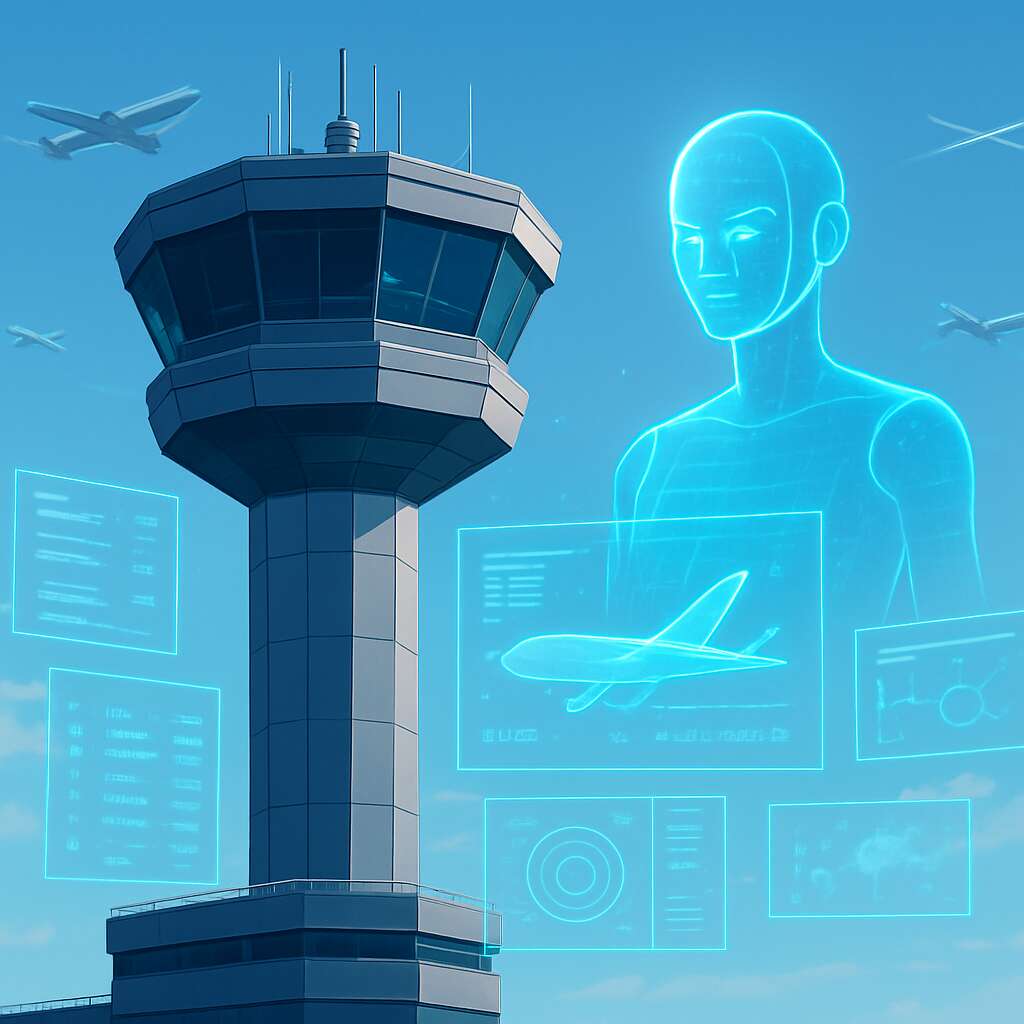
Introduction to AI in Air Traffic Management
Overview of Modern Air Traffic Control – Understanding traditional systems and their limitations
In the bustling orchestration of modern skies, traditional air traffic control systems often resemble a delicate ballet—precision, timing, and human judgment leading the performance. Yet, as the volume of flights continues to rise exponentially, these classical frameworks strain under increasing complexity. They rely heavily on manual data processing and human oversight, leaving room for delays, miscommunications, or human error, especially in moments of unforeseen turbulence.
The evolution towards AI-Powered Air Traffic Control offers a tantalizing glimpse into the future of aviation management. This innovation aims to replace or augment these traditional systems with algorithms capable of analyzing real-time data streams, predicting traffic congestion, and mitigating risks with unprecedented speed and accuracy. Imagine an intelligent network of radar, sensors, and machine learning models working seamlessly to redefine what airspace management means in an era of rapid technological advancement.
Rise of Artificial Intelligence in Aviation – Historical development and recent advancements
The evolution of artificial intelligence in aviation has been nothing short of remarkable. The integration of AI into air traffic management is transforming the way skies are orchestrated. Historically, breakthroughs in AI-powered systems have been driven by the increasing demand for safer, more efficient flight operations. Recent advancements have seen machine learning models analyzing vast streams of real-time data— from radar signals to weather updates — to anticipate and resolve potential conflicts before they escalate.
One of the most notable milestones is the rise of AI-powered air traffic control, where autonomous algorithms now assist human controllers in high-pressure situations. These systems employ complex predictive analytics to manage aircraft trajectories and prevent congestion. As technology progresses, the potential for AI to revolutionize airspace management becomes even more evident — enabling a smoother, safer flow of global air travel that feels almost poetic in its precision and grace.
Benefits of AI Integration – Improved safety, efficiency, and scalability
In the realm of modern aviation, the integration of AI-Powered Air Traffic Control is reshaping how we perceive airspace management. This innovation marries the precision of machine learning with the complexity of human oversight, creating a symphony of safety and efficiency that feels almost poetic in its grace. As global air travel continues to expand, the need for smarter, faster, and more reliable systems becomes undeniably apparent.
One of the most compelling benefits of AI-Powered Air Traffic Control is its ability to analyze vast streams of real-time data—from radar signals to weather updates—with unprecedented speed. This allows for immediate conflict resolution and smarter trajectory planning. Here’s where the art of orchestration deepens:
- Predictive analytics forecast potential conflicts before they materialize, enabling preemptive action.
- Automation facilitates seamless coordination among aircraft, reducing congestion and delays.
Scalability emerges as a natural advantage, allowing AI systems to adapt to growing air traffic volumes effortlessly. This not only enhances safety but also elevates efficiency across airports and congested air corridors. With AI-Powered Air Traffic Control, the skies become a canvas of precision, where technology and human intuition collaboratively craft a harmonious flow of global mobility. The ongoing evolution beckons a future where airspace is managed not just as a logistical challenge but as an elegant dance of intelligence and innovation.
Core Technologies Powering AI-Driven Air Traffic Control
Machine Learning and Data Analytics – Analyzing flight data for predictive insights
At the heart of AI-Powered Air Traffic Control lies a sophisticated fusion of machine learning and data analytics, revolutionising the way airspace is managed. These core technologies harness vast quantities of flight data, turning raw information into predictive insights that significantly enhance decision-making processes. By analyzing patterns in aircraft movement, weather conditions, and other variables, AI systems can forecast potential conflicts before they occur—ushering in an era of unprecedented safety and efficiency.
Machine learning algorithms excel at identifying subtle trends in complex data sets, enabling controllers to pre-emptively adjust routes or altitude changes in real time. Data analytics, on the other hand, transforms this information into actionable intelligence, streamlining traffic flow and reducing delays. Some systems incorporate sophisticated list-based models that prioritize aircraft, ensuring smooth sequencing even during peak hours. Combined, these technologies exemplify how AI-Powered Air Traffic Control is not merely reactive but proactively shaping the future of aviation safety and operational excellence.
Neural Networks and Deep Learning – Enhancing decision-making processes
At the heart of AI-powered air traffic control systems are neural networks and deep learning models that emulate the intricate decision-making processes of seasoned controllers. These technologies sift through vast streams of real-time data, identifying subtle patterns that humans might overlook. By training on diverse flight trajectories, weather updates, and operational constraints, neural networks continually improve their accuracy in predicting potential conflicts.
Deep learning, with its layered architecture, enhances the system’s ability to interpret complex variables. This results in AI systems that can evaluate multiple scenarios simultaneously, offering controllers a set of optimal routing options.
- Pattern recognition in aircraft movement
- Weather anomaly detection
- Predictive conflict resolution
These technological advances allow AI-powered air traffic control to make proactive decisions, reducing delays and improving safety margins. The integration of neural networks and deep learning is reshaping aviation management, making the skies safer and more efficient for everyone involved.
Real-Time Data Processing – Managing live airspace information seamlessly
In a world where every second counts, seamless management of live airspace information becomes a matter of life and death. AI-Powered Air Traffic Control systems excel at real-time data processing, capturing a torrent of vital information from radar feeds, satellite sensors, and aircraft transponders. This constant, unrelenting flow of data is too vast for human controllers to process alone, which is why AI algorithms act as vigilant sentinels—detecting minute deviations and emerging conflicts with uncanny precision.
To handle this complexity, these systems employ a combination of advanced technologies such as:
- Sensor fusion techniques that combine multiple data streams, creating a unified picture of the airspace.
- Optimized algorithms that analyze live data feeds to anticipate potential issues before they escalate.
- Dynamic data models capable of adapting instantly to weather changes, traffic density, and unforeseen disruptions.
This layered approach ensures AI-Powered Air Traffic Control systems maintain an almost supernatural awareness of the sky, enabling proactive conflict resolution and maintaining safety, even amid the chaos of dense flight corridors. The result is a finely tuned orchestration of aircraft that keeps traffic flowing smoothly and unpredictability at bay—an invisible force guiding the skies with unwavering precision.
Sensor and Radar Integration – Combining multiple data sources for accuracy
In the realm of AI-Powered Air Traffic Control, the integration of sensor and radar technologies stands as an invisible yet formidable force—one that converges diverse data sources into a unified, coherent picture of the sky. These systems process information from hundreds of radar feeds, satellite sensors, and aircraft transponders, transforming a chaotic torrent of data into actionable intelligence. This intricate dance of signals demands more than just raw power; it requires sophisticated sensor fusion techniques, capable of weaving together multiple streams for unrivalled accuracy.
Within this framework, an ordered approach emerges, often represented by a simple hierarchy:
- Radar data capture and initial analysis
- Satellite sensor input processing
- Transponder information interpretation
This layered methodology ensures that AI-Powered Air Traffic Control delivers a seamless, real-time understanding of evolving conditions. It’s not just about collecting data—it’s about translating that data into sharp insights, enabling the system to anticipate conflicts, adapt to weather disruptions, and manage dense traffic corridors with uncanny precision. As the sky grows busier, such technological mastery heightens safety and efficiency, guiding aircraft with unwavering confidence amidst constant change.
Simulation and Modelling Tools – Training and testing AI systems under various scenarios
In the orchestral ballet of the skies, where countless aircraft weave intricate patterns, AI-Powered Air Traffic Control emerges as the conductor’s unseen baton—guiding harmony amid chaos. To train these emergent systems to respond with the finesse of seasoned pilots, simulation and modelling tools become the crucible of innovation. These digital landscapes mimic the vast complexity of the real-world airspace, where scenarios range from routine transits to weather-induced turbulence. It’s a realm where every decision, every shift in flow, is tested—an endless loop of learning and refining.
Within these virtual theatres, core technologies such as sophisticated scenario generation, high-fidelity simulation engines, and real-time data integration work in concert. These tools create dynamic environments that challenge AI algorithms, forcing them to adapt and evolve. One such example uses
- scenario-based training,
- stress testing under congested traffic conditions,
- simulating weather anomalies, or
- evaluating response to unexpected events.
This layered approach ensures that AI-Powered Air Traffic Control systems develop resilience and precision—crucial attributes as the skies grow busier and constraints tighten.
It’s a fascinating dance of algorithms and models, where neural networks are fine-tuned through continuous cycles of testing—each iteration honing decision-making processes and predictive capabilities. The integration of machine learning with advanced simulation platforms allows for the exhaustive exploration of myriad scenarios, revealing subtle vulnerabilities and hidden opportunities for improvement. This meticulous work—training, testing, and validating—ensures that when the time comes to deploy in the real world, the AI system operates with unwavering confidence and impeccable safety standards, navigating the aerial choreography with clinical grace.
Implementation and Operational Aspects
Integration with Existing Infrastructure – Challenges and strategies for seamless transition
Implementing AI-Powered Air Traffic Control systems isn’t simply a case of flipping a switch—unless you’re keen on chaos and delays! The transition demands meticulous integration with the existing infrastructure, which is often built on legacy systems that stubbornly refuse to die. Navigating this requires strategic planning—think of it as a technological tango where old and new must dance flawlessly together.
One standout challenge is ensuring seamless data flow between AI modules and radar, sensor, and communication networks. To do this effectively, operators often adopt phased rollouts or hybrid systems, gradually shifting from manual to fully autonomous control. This incremental approach helps mitigate risks and counters resistance from traditionalists clinging to their manual override knobs.
A simple list can illuminate the path:
- Rigorous system testing in simulated environments.
- Ensuring redundancy in critical data pathways.
- Investing in staff training to foster confidence and competence.
Bringing AI-Powered Air Traffic Control into live operations demands more than just technical prowess—it’s about orchestrating a harmonious transition that respects the complexity of current airspace management while pushing forward into the future.
Autonomous Decision-Making Systems – Balancing human oversight and AI independence
Autonomous decision-making systems within AI-Powered Air Traffic Control represent a fascinating intersection of human oversight and machine independence. When integrating AI into complex airspace management, striking the right balance is both a technical challenge and an art. While AI can process vast quantities of data faster than any human, complete automation without human judgment risks detachment from nuanced operational realities.
One approach involves deploying layered decision-making, where AI systems handle routine tasks and flag anomalies for human experts. This hybrid model enhances efficiency while retaining oversight for high-stakes situations. To support this, many operators implement a phased integration—gradually shifting from manual command to autonomous modules—thereby fostering confidence and ensuring safety.
- Maintain human oversight as the ultimate arbiter in critical decisions.
- Allow AI to execute routine or data-heavy operations independently.
- Continuously refine algorithms with real-world feedback to improve decision quality.
Implementing these strategies ensures that AI-Powered Air Traffic Control can operate seamlessly, combining the strengths of human expertise with the speed and data-processing prowess of artificial intelligence. In a domain where milliseconds matter, this careful balance becomes the cornerstone of safe and reliable airspace management. The essence lies in designing autonomous decision systems that complement human intuition—creating a harmonious dance between man and machine that propels aviation into the future, reliably and responsibly.
Safety and Reliability Measures – Ensuring fail-safe operations and redundancies
Safety and reliability are the backbone of AI-Powered Air Traffic Control systems. The stakes are high, and one misstep can have catastrophic consequences. Implementing fail-safe operations requires a multilayered approach, where redundancies act as the safety net catching anomalies before they escalate. An array of backup protocols—such as parallel processing units and autonomous fallback mechanisms—becomes indispensable. These layers function in concert, ensuring continuous operation even in the event of component failure.
Within this framework, real-time data processing is meticulously monitored through automated health diagnostics, continuously assessing system performance. To maintain integrity and avoid unexpected outages, multiple copies of critical data are stored across distributed servers, establishing a resilient architecture that withstands cyber threats and technical glitches. This isn’t just about technology; it’s about fostering confidence among air traffic controllers and pilots that the AI component of air traffic management remains a steadfast guardian of safety. The harmony of these safety and reliability measures underscores the transformation AI brings into the domain of airspace management.
Regulatory Compliance and Standards – Adhering to international aviation regulations
Ensuring regulatory compliance is a cornerstone of deploying AI-Powered Air Traffic Control systems in the UK. As international aviation standards evolve, integrating these sophisticated technologies requires meticulous adherence to safety protocols, data protection laws, and operational guidelines.
Certification processes involve rigorous assessments—testing AI algorithms against predefined safety benchmarks and verifying their resilience under various scenarios. Moreover, compliance with standards like ICAO’s regulations ensures that AI components harmonise seamlessly with existing airspace management systems.
Handling sensitive flight data demands strict cybersecurity measures, which are integral to maintaining trust across aviation stakeholders. An ordered approach—such as implementing
- regular audits
- comprehensive validation routines
—supports reliable integration and operational excellence.
By aligning AI development with aviation legislation, authorities can foster innovation without compromising safety. This careful synergy between emerging AI capabilities and global regulatory frameworks ensures that AI-Powered Air Traffic Control remains a trusted guardian of the skies.
Stakeholder Roles and Collaboration – Coordination among pilots, controllers, and AI systems
In the sky’s vast expanse, where every second counts, the orchestration of human and machine becomes a delicate ballet. The implementation of AI-Powered Air Traffic Control hinges on seamless coordination among pilots, controllers, and intelligent systems that interpret real-time data with precision. Trust and clarity are vital—each stakeholder must operate harmoniously within this new paradigm, ensuring safety without musical discord.
Active collaboration begins with clear communication protocols, where AI assists controllers by providing predictive insights and alerting them to potential conflicts before they manifest. The air traffic ecosystem now reflects a symphonic blend of human intuition and artificial intelligence. To that end, structured workflows—such as:
- Shared dashboards displaying live predictive analytics
- Automated decision-support alerts
- Streamlined communication interfaces
—facilitate this synergy, enabling personnel to respond swiftly and accurately.
In real-world operations, pilot and controller engagement with AI systems must foster mutual trust, balancing automation with human oversight. As aircraft navigate increasingly crowded skies, AI-Powered Air Traffic Control stands as a testament to adaptive cooperation—predicting, guiding, and safeguarding every movement through an elegant dance of technology and expertise. This collaborative spirit weaves a resilient, reliable fabric for future airspace management.
Training and Workforce Adaptation – Preparing personnel for new technology adoption
Integrating AI-Powered Air Traffic Control into modern aviation is a transformative step that requires meticulous workforce adaptation. As machines become more capable of managing complex airspace, personnel must be equipped with the right skills to navigate this new terrain. The challenge lies in harmonising human expertise with advanced algorithms, ensuring that safety remains paramount while efficiency is heightened.
Preparation begins with comprehensive training programs designed to familiarise aviation professionals with AI systems. These sessions often incorporate simulation and modelling tools, allowing air traffic controllers and pilots to experience a variety of scenarios in a controlled environment. This hands-on approach helps build confidence in interacting with AI-powered decision-support tools and enhances trust in automation.
To facilitate smoother implementation, many aviation agencies employ structured workflows that include:
- Regular refresher courses on AI system updates
- Hands-on training with predictive analytics dashboards
- Role-playing exercises to reinforce collaboration between humans and AI systems
This layered training ensures personnel can respond swiftly and accurately, fostering a culture where automation complements human intuition rather than replacing it. As airspace becomes more crowded and complex, adapting the workforce to AI-Powered Air Traffic Control is about more than technical knowledge—it’s about cultivating a mindset receptive to innovation and change, shaping a resilient future for aviation safety and efficiency.
Future Trends and Challenges in AI-Powered Air Traffic Control
Emerging Technologies and Innovations – Anticipating future developments
As technological boundaries continue to expand, one cannot help but wonder what’s next for AI-Powered Air Traffic Control. The horizon reveals an array of intriguing innovations that promise to redefine altitude management in ways once regarded as science fiction. Expect to see the integration of quantum computing and advanced neural networks that can process vast amounts of live airspace data with astonishing speed. These emerging technologies are poised to enhance decision-making by enabling systems to adapt dynamically to unpredictable scenarios, potentially outperforming human controllers in complex situations.
Looking ahead, the challenge lies in maintaining safety and reliability amidst rapid innovation. Future developments might include layered autonomous decision-making capabilities within AI-Powered Air Traffic Control, assisting human controllers rather than replacing them outright. This dual approach balances the need for human oversight with the efficiencies of machine intelligence. As the aviation industry navigates these innovations, stakeholders will need to carefully consider regulatory frameworks and safety standards to ensure seamless implementation. After all, technology’s true promise emerges not just from advance but from harmony with existing infrastructure and skilled personnel.
Data Privacy and Security Concerns – Safeguarding sensitive information
In the intricate ballet of bustling skies, safeguarding data privacy and security in AI-Powered Air Traffic Control is not merely a technical checkbox but a matter of national pride and strategic finesse. As artificial intelligence intertwines into our most sensitive aviation operations, the question arises: how do we ensure that this sophisticated data ecosystem remains impervious to cyber intrusions? Protecting sensitive information—be it flight plans, passenger data, or real-time airspace movements—is paramount. A breach could ripple across safety protocols, disrupt schedules, and erode public trust faster than a jet in a nosedive.
The industry faces dual pressures: maintaining operational confidentiality while navigating the complexity of emerging technological advancements. To address this, robust encryption, layered access controls, and continuous security audits are woven into the fabric of AI-Powered Air Traffic Control systems.
Some experts suggest that a layered approach might be the most effective—think of it as a digital fortress with multiple lines of defence. This can include:
- Advanced intrusion detection systems
- Regular vulnerability assessments
- Strict compliance with international cybersecurity standards
The challenge is not solely in deploying these measures but in maintaining agility against adversaries who never sleep. As AI systems become more autonomous, the risk of malicious interference or data manipulation increases, demanding vigilant oversight.
Of course, the discord between openness and security can be delicate—especially as data sharing between agencies and stakeholders becomes more prevalent in AI-Powered Air Traffic Control. Safeguarding sensitive data without hindering the flow of vital information calls for a delicate dance of transparency and protection, underpinned by policy and technological innovation.
In a realm where seconds matter, the stakes for data security are sky-high, and the narrative is one of cautious optimism. As the skies grow busier and algorithms grow smarter, the guardians of this new frontier must remain several steps ahead—ensuring data integrity now and into the future.
Ethical and Legal Considerations – Addressing accountability and decision transparency
The silent watchers of our skies are poised on a precipice—an ethical and legal abyss where the luminous promise of AI-Powered Air Traffic Control clashes with shadowy questions of accountability. As algorithms become more autonomous, the line blurs between machine decision and moral judgment. Who bears the responsibility when a miscalculation leads aircraft astray? The weight of transparency hangs heavily in the air, demanding clear lines of oversight that are as unambiguous as the stars themselves.
In this new era, the challenge extends beyond mere technical mastery. It tinges the air with unease, a whisper of the unseen hand guiding the immense ballet of flight. Decision transparency becomes paramount; stakeholders require assurances that AI-Powered Air Traffic Control systems operate under strict legal and ethical standards. A breach in this delicate balance could unravel the fabric of trust that underpins modern aviation—an erosion difficult to repair once compromised.
Looking forward, the expanding scope of AI in aviation signals an inevitable evolution. Yet, it invites a host of quandaries that cannot be ignored. How do we establish rigorous accountability when machines are entrusted with lives in the sky? Can legislation keep pace with relentless innovation? These questions beckon regulators, technologists, and pilots alike to forge a symbiotic relationship—one rooted in deep trust and unwavering responsibility.
Amidst the dark drama of progress, ensuring decision accountability for AI-Powered Air Traffic Control requires layered scrutiny and continuous oversight. Establishing frameworks that encompass ethical guidelines, legal standards, and technological safeguards becomes a fortress guarding our aerial highways. As the horizon darkens with uncertainty, the need for unwavering vigilance becomes a shared vigil—one that safeguards our skies against the shadows of ambiguity and the specter of unchecked autonomy.
Scalability and Global Deployment – Expanding AI systems across different regions
As AI-Powered Air Traffic Control systems continue to evolve, one pressing challenge is scaling these innovations on a global stage. The logistical feat of deploying AI across diverse regions involves more than just installing new software; it’s about creating a harmonised command of standards, infrastructure, and cultural nuances. The future landscape of aviation demands systems that are adaptable, resilient, and sensitive to the varying needs of international airspaces.
Scaling AI effectively requires a commitment to interoperability—think of it as teaching different dialects to speak the same language without misunderstandings. This involves extensive collaboration among regulators, airports, and airlines to ensure smooth integration. The hurdles aren’t just technical; they include legal and linguistic barriers that could cause turbulence if not navigated carefully.
Expanding AI systems also raises the question of global deployment. Adapting advanced AI algorithms to different regions means addressing infrastructural disparities, from radar coverage gaps to varying data security regulations. Overcoming these hurdles demands innovative solutions like modular AI frameworks capable of customised regional tuning.
- Addressing regulatory differences
- Adapting to infrastructural disparities
- Ensuring data privacy and security compliance
As AI-Powered Air Traffic Control spreads its wings across borders, the challenge becomes clear: how do we ensure these systems aren’t just cutting through traffic lanes but also respecting the unique aspects of each airspace? It’s a complex ballet requiring foresight, technological agility, and international cooperation. The horizon is promising, but only if we can surmount the hurdles of scalability and global deployment with a strategic, thoughtful approach.
Addressing System Failures and Contingencies – Mitigating risks associated with AI errors
As the skies grow busier and the pace of global connectivity accelerates, the future of AI-Powered Air Traffic Control grapples with an unsettling paradox: how to keep our intricate web of flights safe when machine errors threaten to introduce chaos. In a domain where seconds matter, mitigating risks associated with AI errors isn’t just a safety measure — it’s an ethical imperative. The most sophisticated AI systems can swiftly identify anomalies, but no technology is infallible. That’s why layered safety nets, redundancies, and contingency protocols are becoming the bedrock of trustworthy AI-Powered Air Traffic Control solutions.
With the leap toward fully autonomous decision-making, concerns about unforeseen system failures loom large. Yet, by embracing a philosophy of resilience, developers are designing systems capable of alerting human operators when uncertainties arise. Embracing these revelations, the focus shifts towards creating adaptive algorithms that can recognize their own limits and initiate fail-safe procedures. Managing live airspace information seamlessly while safeguarding against unexpected malfunctions requires continuous refinement, rigorous testing, and an unwavering commitment to safety. As the industry journeys into this brave new world, it becomes clear that embedding flexibility into AI-powered frameworks will be decisive — ensuring that technology augments human oversight rather than replaces it.
Environmental Impact and Sustainability – Reducing carbon footprint through smarter traffic management
As global air travel increases, so does the importance of minimizing the environmental footprint of aviation. AI-Powered Air Traffic Control (ATC) systems are poised to play a vital role in reducing aviation’s carbon footprint. By optimizing flight paths and managing traffic flow more intelligently, these systems help airlines operate more efficiently, conserving fuel and lowering emissions.
Emerging trends show that AI-Powered Air Traffic Control can lead to smarter traffic management strategies that adapt to real-time conditions. This not only shortens flight durations but also decreases unnecessary holding patterns and excess fuel burn. The result? Significantly lower greenhouse gas emissions and a step toward more sustainable skies.
- Enhanced route planning through predictive data analytics
- Dynamic traffic allocation to balance airspace loads
- Integration with eco-flight initiatives for greener operations
Still, the challenge remains to balance environmental goals with safety and capacity demands. As AI systems evolve, so does the need for transparency and accountability in decision-making processes. Ensuring these high-tech solutions operate ethically and securely will determine their success in achieving sustainability objectives. The push for greener skies continues to accelerate, with AI-Powered Air Traffic Control at the forefront of pioneering smarter, cleaner airspace management.