
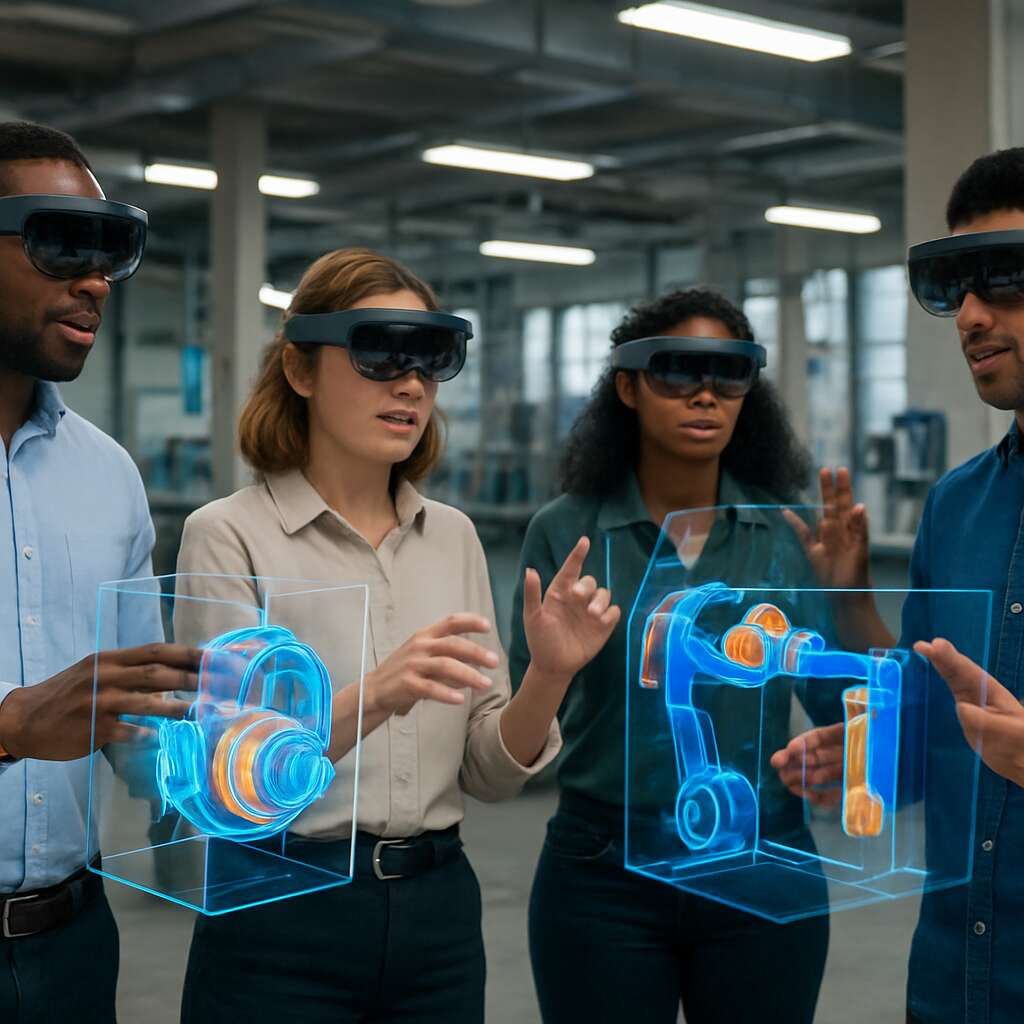
Understanding Augmented Reality Training in Workforce Development
Types of Augmented Reality Technologies
Augmented Reality Training for Workforce Development represents a transformative shift in how skills are acquired and refined within industries historically bound to conventional, sometimes outdated methodologies. This immersive approach creates a rich, contextual learning environment that anchors theory to practice, often within a matter of minutes rather than hours or days. It taps into the human predilection for experiential learning, fostering an intuitive grasp of complex procedures and machinery that once required significant hands-on instruction.
There are several types of augmented reality technologies for workforce development, each tailored to distinct training needs. These include marker-based AR, which uses visual markers to trigger digital overlays; location-based AR that relies on GPS signals to generate context-aware interactions; and projection-based AR, which projects virtual elements onto physical surfaces. Such diversity in AR implementation enriches the training landscape, making it adaptable to various operational environments.
Benefits of AR in Training Programs
When it comes to Augmented Reality Training for Workforce Development, the benefits are clear as day—yet often underestimated. Instead of slogging through endless manuals or relying solely on phased on-the-job training, AR immerses workers in a digitally-enhanced environment that feels as real as a face-to-face lesson. Industrial sectors, from manufacturing to healthcare, are rapidly realising that AR accelerates learning, reduces errors, and enhances safety standards all at once.
One of the standout advantages of augmented reality training is its ability to tailor experiences to specific job functions, ensuring employees develop nuanced skills quickly. For example, instead of fixing machinery blindfolded, a technician can see a virtual overlay guiding their every move, likened to having an invisible expert at their shoulder. The immersive nature of AR makes complex operations more approachable and memorably engaging.
- Students become confident in their skills faster
- Training costs decrease as fewer resources are needed for in-person instruction
- Workers can repeat scenarios as often as needed without risking real equipment or safety
Challenges and Limitations
Implementing Augmented Reality Training for Workforce Development is not without its hurdles. Despite the excitement around its potential, several challenges can hinder widespread adoption. One of the most immediate concerns involves technological limitations—such as the need for high-quality hardware and stable connectivity—that can create barriers, especially in remote or resource-constrained environments. These technical shortcomings can turn what should be an immersive experience into frustrating interruptions, diluting the training’s effectiveness.
Another obstacle lies in the resistance to change, often rooted in workforce apprehensions or unfamiliarity with AR technologies. Companies might face difficulties convincing employees to embrace new teaching methods that diverge from traditional training programs. To navigate this, organisations need to carefully manage change, ensuring adequate support and clear communication about the long-term benefits of Augmented Reality Training for Workforce Development.
- High initial investment costs for equipment and software
- Limited content tailored specifically for various industry needs
- Technical barriers including hardware compatibility and user interface complexity
These limitations highlight that, while augmented reality is a transformative tool, it isn’t a one-size-fits-all solution. It requires strategic planning, infrastructure upgrades, and cultural shifts to fully leverage its potential within workforce development programs. Understanding these challenges helps organisations prepare better for a future where AR could redefine industry standards in training effectiveness.
Applications of Augmented Reality in Workforce Training
Manufacturing and Industrial Skills
Augmented Reality Training for Workforce Development is rapidly transforming how industries approach skills enhancement in manufacturing and industrial sectors. Imagine workers donning AR headsets that overlay critical instructions directly onto complex machinery; the potential for reducing errors and accelerating learning curves is immense. With augmented reality, trainees can interact with virtual models of equipment, gaining hands-on experience in a controlled environment that closely mimics real-world scenarios.
This immersive approach enables seamless mastery of intricate processes without the risks or downtime associated with traditional training. Some practical applications include virtual assembly lines, real-time safety simulations, and troubleshooting guides that adapt to the user’s skill level. As industries increasingly seek agility and precision, augmented reality training platforms serve as an indispensable tool in workforce development, cultivating a skilled, versatile, and safety-conscious labour force.
Healthcare and Medical Training
Augmented Reality Training for Workforce Development is revolutionising medical education and clinical procedures in hospitals across the UK. With the help of AR, healthcare professionals can practice complex surgeries or emergency response protocols in a controlled, virtual environment that mimics real-world scenarios. This approach not only improves practical skills but also reduces patient risk and minimizes training costs.
In surgical training, AR applications overlay detailed 3D models of anatomy or surgical tools directly onto the trainee’s field of view, bringing theoretical knowledge into tangible focus. Some of the most effective uses include:
- Virtual dissections that enhance anatomical understanding
- Guided procedures with real-time feedback
- Simulated emergencies to refine decision-making under pressure
As health services demand faster, more accurate training methods, AR proves to be a flexible, immersive tool for developing a more skilled and confident medical workforce. The ability to interact with realistic virtual models without risking patient safety makes AR an invaluable asset in healthcare training ecosystems.
Customer Service and Retail
Across customer service and retail sectors, Augmented Reality Training for Workforce Development is transforming the way employees engage with their roles. In a landscape where customer satisfaction hinges on instant, accurate responses, AR provides a compelling edge. Imagine a sales associate donning AR glasses that project product information, customer profiles, and store layouts in real-time—turning mundane tasks into seamless, interactive experiences.
Retail employees can practice scenarios like handling difficult customers or managing stock with a virtual overlay that mimics real-world interactions. For customer service teams, AR simulations enable the development of problem-solving skills amid immersive, lifelike situations. In fact, some companies utilize
- virtual role-playing exercises
- instantaneous performance feedback
to sharpen communication strategies and build confidence.
As industries seek more adaptable and engaging workplace development strategies, Augmented Reality Training for Workforce Development continually proves its worth. It offers an innovative bridge between theory and practice—making training not just informative, but truly transformative. The result? A workforce prepared to meet the ever-evolving demands of Britain’s retail and service industries with style and resilience.
Implementation Strategies for Effective AR Workforce Development
Designing Immersive Learning Experiences
Implementing effective Augmented Reality Training for Workforce Development requires a strategic approach that aligns with organisational goals and technical capabilities. First, engaging stakeholders early on ensures that the immersive learning experience resonates with real-world needs. Tailoring AR applications to specific job roles enhances relevance and accelerates skill acquisition. It’s essential to choose the right hardware and software that are user-friendly and compatible with existing infrastructure.
Designing immersive learning experiences calls for a focus on interactivity and realism. Interactive scenarios, such as simulated maintenance tasks or safety drills, can make training sessions more impactful. Incorporate feedback loops within the AR experience to help learners understand their progress and areas for improvement.
When deploying AR tools, consider a phased rollout that includes pilot testing, iterative improvements, and scaled implementation. This approach ensures the technology integrates seamlessly into daily workflows and minimizes disruptions. For training in volatile or high-stakes environments, augmented reality offers a safe, controlled setting to build confidence and competence.
Integrating AR with Existing Training Systems
Integrating augmented reality training for workforce development into existing training systems isn’t just about adopting new technology; it’s about creating a seamless transition that respects current processes while elevating learning experiences. Many organisations find success by establishing robust pathways for integration that minimise disruption and maximise engagement. This often involves aligning AR modules with traditional training curricula, so learners can move smoothly between different modes of instruction.
To facilitate this process, companies might consider a phased approach. Start with pilot programs that test the compatibility of AR tools with established learning management systems (LMS) and enterprise resource planning (ERP) platforms. This allows for the collection of valuable insights and the fine-tuning of the integration process. For effective implementation, attention should be paid to system interoperability, data sharing capabilities, and user management, ensuring that augmented reality training for workforce development complements existing resources without confusion or redundancy.
Introducing a structured method can greatly enhance acceptance and engagement with AR. For instance, a gradual rollout that includes feedback sessions and training support helps workers of varying skill levels adapt comfortably to the new technology. When well-integrated, augmented reality training for workforce development becomes an intuitive extension of standard training pathways — making learning both more accessible and meaningful for employees everywhere.
Measuring Training Effectiveness and ROI
Measuring the effectiveness of augmented reality training for workforce development demands a meticulous approach—each metric, each insight, acts as a beacon guiding continuous refinement. As organisations invest in this innovative training modality, it is vital to establish clear benchmarks to gauge impact. The true essence lies in tracking progress not just through completion rates but through the transformative change in worker proficiency and confidence.
Deploying thoughtful evaluation techniques—such as pre- and post-training assessments, real-time engagement analytics, and performance metrics—illuminates the pathway to understanding ROI. Embracing a data-driven mindset helps organisations quantify the tangible benefits of augmented reality training for workforce development, turning insights into strategic evolution. This granular insight fuels the cycle of enhancement, ensuring the evolving AR experience remains aligned with organisational goals.
Capturing the nuanced shifts in employee capability fosters a deeper connection between immersive training and operational excellence. By integrating feedback loops and iterative updates—be it through surveys, usability tests, or direct observation—companies can nurture a culture of continuous improvement. After all, the true magic of augmented reality training for workforce development lies in transforming raw data into a powerful narrative of growth and success.
Future Trends and Innovations in AR Workforce Training
AI and Machine Learning Integration
The horizon of Augmented Reality Training for Workforce Development is shimmering with possibilities, driven by the silent revolution of AI and Machine Learning. As these technologies weave their intricate layers into the fabric of AR, the potential for creating personalized, adaptive learning experiences becomes almost magical. Imagine training modules that evolve in real-time, understanding a trainee’s strengths and areas for improvement, then tailoring scenarios that challenge without overwhelming.
Future innovations might include AI-powered virtual mentors within AR environments, guiding employees through complex processes with a whisper of insight. The integration of Machine Learning into AR systems promises to streamline the capture and analysis of performance data, transforming raw interaction into rich, actionable insights. As a result, workforce development could become increasingly precise and agile, navigating the evolving demands of industry with an almost intuitive grace.
- The development of intelligent, self-improving AR applications
- Enhanced real-time feedback loops powered by AI
- Seamless integration with existing learning management systems
Advancements in Hardware and Wearables
The silent evolution of hardware and wearables beckons a new era for Augmented Reality Training for Workforce Development. As technological ghosts grow ever more sophisticated, the hardware supporting AR becomes almost spectral—lighter, faster, more immersive—draped with sensors that whisper secrets only the most attuned can decipher. The days of bulky headsets fade into the shadows, replaced by sleek, intuitive devices that seem almost alive in the hands of trainees.
In this twilight of innovation, a curated list of advances reveals the path forward:
- Miniaturised AR glasses woven seamlessly into everyday workwear.
- Enhanced motion sensors that capture even the subtlest gestures with precision.
- Extended battery life, allowing longer immersion without the flicker of fading echoes.
Wearable devices, once a mere whisper of possibility, now linger as tangible spectres—transforming how organisations approach training. These advancements are not merely enhancements but gateways into a realm where augmented reality becomes entirely woven into the fabric of workforce development. As these ghostly apparatuses evolve, they promise to deepen the immersive experience, making learning feel less like an ordeal and more an extension of the natural world, echoing a future where AR training becomes as seamless as breathing. With the march of progress, hardware innovations herald a more intuitive, engaging, and eerily effective horizon for workforce development endeavors.
Emerging Fields and Industries
As industries evolve at an unprecedented pace, the horizon of Augmented Reality Training for Workforce Development teems with innovation. Future trends hint at an integration with emerging fields such as robotics, Artificial Intelligence, and the Internet of Things, which will further expand the realm of possibilities. Companies contemplating the next phase of workforce development are beginning to explore how immersive AR experiences can be tailored to niche sectors—from sustainable energy to aerospace engineering.
Emerging innovations suggest a future where AR seamlessly blends with virtual collaboration platforms, enabling teams across the globe to interact within shared augmented environments. Imagine a scenario where trainees can manipulate holographic models of complex machinery or hazardous environments safely from afar. The interplay of augmented reality with other cutting-edge tech is set to cultivate an ecosystem where real-world skills are honed through virtual mastery.
- Personalised AR training modules tailored to roles and skill levels
- Real-time data overlays providing instant feedback
- Immersive simulations of rare, high-stakes scenarios
From the automotive sector to renewable energy, industries across the spectrum are poised to harness these advancements, creating an ecosystem of learning that is as adaptable as it is engaging. This ongoing evolution in AR-powered workforce development promises not only to enrich employee capabilities but to craft a future where technology and human expertise dance together in perfect harmony.