
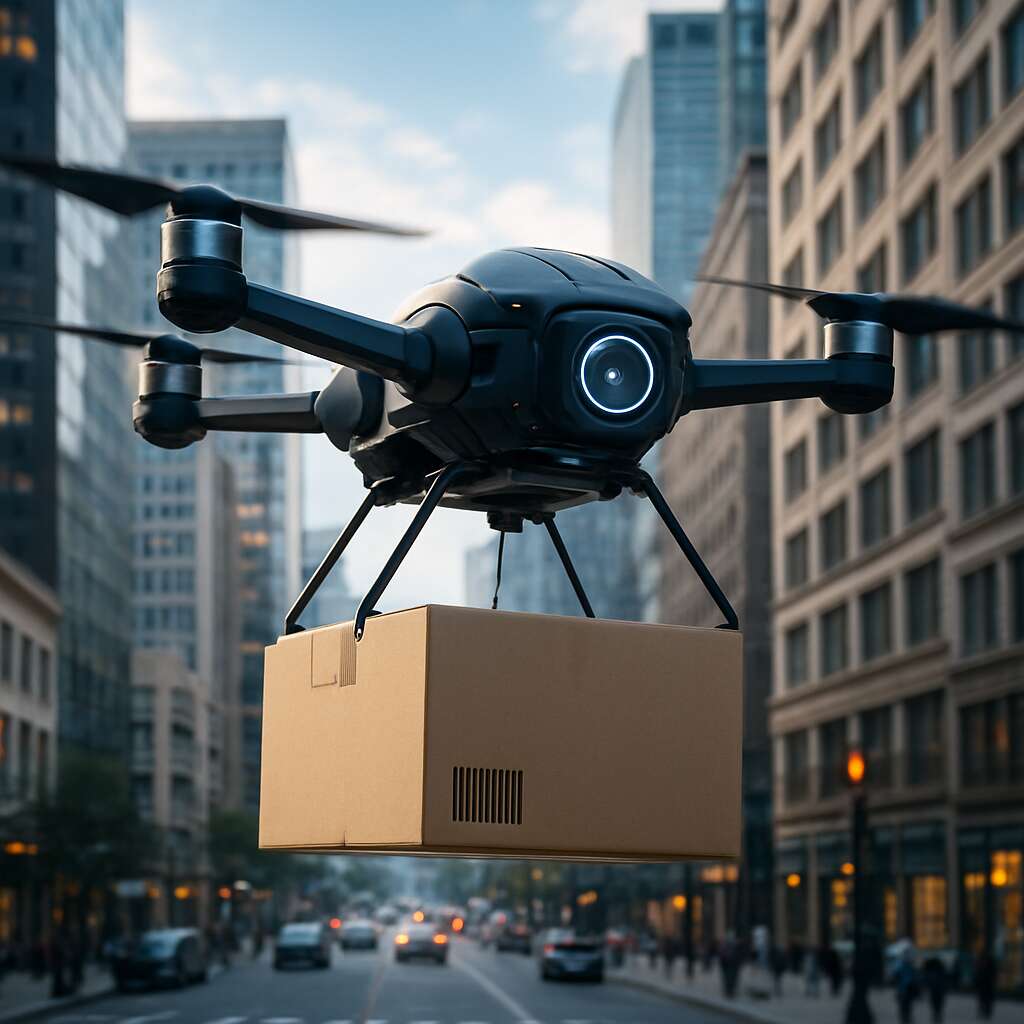
Technology and Innovation in AI-Powered Drone Delivery
Types of Drones Used in Delivery Services
In the realm of AI-Powered Drone Delivery, technological innovation is propelling these airborne couriers into new heights of efficiency and precision. At the heart of this revolution are the different types of drones engineered specifically for delivery services, each designed with unique capabilities to tackle diverse logistical challenges. Autonomous designs equipped with machine learning algorithms enable these drones to navigate complex urban landscapes while avoiding obstacles with uncanny accuracy. Their ability to adapt in real time marks a leap forward in delivery technology that was once considered science fiction.
Among the most prevalent types are multi-rotor drones, known for their agility and vertical takeoff and landing (VTOL) capabilities, making them ideal for urban delivery. Fixed-wing drones, on the other hand, excel in longer-range deliveries, covering vast distances with remarkable energy efficiency. Hybrid models also blend these traits, offering unparalleled versatility. To give a clearer picture, here are some common types used in AI-Powered Drone Delivery services:
- Multi-rotor drones for short-range, high-precision deliveries
- Fixed-wing drones for extended-range transportation
- Hybrid drones combining multi-rotor agility with fixed-wing endurance
The integration of advanced sensors, GPS technology, and AI processing units ensures that each drone operates seamlessly within the delivery ecosystem. As these drones become more sophisticated, we witness a transportation revolution that’s as fascinating as it is efficient—an outcome made possible through relentless technological innovation in AI-Powered Drone Delivery.
AI Algorithms Driving Autonomous Navigation
In the world of AI-Powered Drone Delivery, the innovation behind autonomous navigation systems is nothing short of extraordinary. These technological marvels rely heavily on advanced AI algorithms that enable drones to traverse complex urban landscapes with precision and ease. The challenge lies in creating software that can interpret a multitude of unpredictable variables, from shifting weather conditions to dynamic obstacles like pedestrians and vehicles.
At the core of this innovation are machine learning models that continuously refine their understanding of the environment, improving navigation accuracy over time. This adaptive capability allows drones to operate confidently in busy city centres, where human oversight might be limited. For example, AI algorithms often follow a set of carefully designed steps:
- Gather real-time data through sensors and GPS
- Analyze surroundings swiftly using neural networks
- Navigate optimized routes, avoiding obstacles dynamically
- Refine movement strategies based on new inputs for future flights
Such integration of sophisticated AI processing units has revolutionized how drones execute deliveries, making AI-Powered Drone Delivery more intelligent and resilient than ever before. This seamless combination of artificial intelligence and robotics creates a transportation ecosystem capable of delivering parcels with unmatched efficiency and safety, even in challenging conditions.
Sensor Technologies and Data Integration
In the silent revolution of AI-Powered Drone Delivery, the unseen forces powering these autonomous aircraft lie in sensor technologies that push the boundaries of possibility. These sophisticated sensors—ranging from high-resolution lidar to multispectral cameras—serve as the drone’s eyes, translating physical realities into data that the AI can interpret with astonishing clarity. This intricate dance of light, sound, and spatial information creates a rich tapestry of environmental awareness that never rests.
Data integration plays a pivotal role, stitching together streams from GPS, weather stations, and onboard sensors into a cohesive narrative. Through seamless data fusion, AI algorithms craft a real-time, multidimensional map of the drone’s surroundings, allowing it to adapt instantaneously. This technological synergy informs the drone’s decision-making, ensuring safety and efficiency even amidst unpredictable urban chaos.
- Real-time obstacle detection and avoidance
- Weather pattern recognition for dynamic route adjustments
- Predictive analytics for optimized delivery schedules
Such integration transforms raw sensor inputs into a form of digital intuition for AI-powered drones, elevating the entire delivery ecosystem to a new realm of resilience and precision. Every flight becomes a testament to how human ingenuity and machine intelligence converge, sculpting the future of urban logistics with each successful parcel drop.
Advancements in Battery Life and Payload Capacity
In the world of AI-Powered Drone Delivery, advancements in battery life and payload capacity are transforming the scope of what autonomous aircraft can achieve. Gone are the days of brief, limited-range flights; today’s drones are becoming veritable workhorses in urban logistics. With innovative battery tech—such as solid-state batteries and fast-charging systems—these drones now boast longer flight times, ensuring deliveries stay on schedule even when traversing sprawling neighbourhoods.
On the payload front, manufacturers are pushing the envelope to carry heavier parcels without sacrificing agility or efficiency. This involves re-engineering drone frames and integrating lighter materials that don’t compromise durability. An interesting trend is integrating modular payload systems, which allow for swift swap-outs—think of it as the digital equivalent of changing a lightbulb on the fly. Here’s how the evolution unfolds:
- Enhanced battery chemistry for extended flight duration
- Innovative charging solutions reducing downtime
- Modular payload designs for flexible parcel sizes
As these technological leaps unfold, AI-Powered Drone Delivery becomes increasingly viable for a broad spectrum of deliveries—from urgent medicines to oversized parcels—making it a cornerstone of tomorrow’s urban delivery landscape. The convergence of smarter batteries and beefed-up payload capacities signals a future where drone fleets can operate more independently, efficiently, and safely than ever before.
Software Platforms and Control Systems
Behind the scenes of AI-Powered Drone Delivery, there’s a quiet revolution unfolding in the realm of software and control systems. These technological advancements are shaping a new era where autonomous flights are not only safer but also more intuitive. Cutting-edge control platforms leverage sophisticated AI algorithms that adapt to real-time conditions, navigating urban skies with an almost human touch. It’s the seamless orchestration of hardware and software that allows a drone to make split-second decisions—sensing obstacles, adjusting routes, and ensuring timely deliveries without a single human intervention.
One such evolution is the development of integrated control systems that combine sensor data, machine learning, and predictive analytics. These platforms utilize
- high-fidelity mapping
- adaptive routing algorithms
- real-time environment monitoring
to optimise each flight. The result? An AI-Powered Drone Delivery network where every movement is precisely calculated, guaranteeing efficiency and safety at scale. Innovations like these make the concept of autonomous urban logistics feel less like science fiction and more like the next step in everyday life. As technology advances, control systems are becoming more resilient, fostering an environment where drone fleets operate fluidly within increasingly complex cityscapes.
Operational Aspects of AI-Powered Drone Delivery
Route Planning and Optimization Algorithms
The backbone of AI-Powered Drone Delivery isn’t just fancy tech; it’s the mind-blowing algorithms that turn flying robots into punctual parcel pushers. Route planning and optimization algorithms are the unsung heroes, carefully balancing the chaos of urban skies with the necessity of delivering on time. These algorithms analyze a barrage of real-time data — traffic congestion, weather conditions, no-fly zones — enabling drones to zigzag around obstacles like aerial ninjas on a mission.
Instead of following static routes, these AI systems continuously adapt, kind of like a GPS on steroids with a brain. To make this happen efficiently, many deploy a mix of techniques, such as genetic algorithms, to simulate evolution, or swarm intelligence inspired by nature’s most organised chaos: bird flocks. For example, the route sequences can be optimized through a simple list:
- Identify delivery points
- Calculate the most fuel-efficient, fastest pathways
- Adjust routes dynamically as new data streams in
- Navigate around obstacles swiftly without missing a delivery window
This seamless interplay of AI-Powered Drone Delivery and sophisticated optimization algorithms ensures that drones don’t just fly; they fly smart, reducing delivery times and increasing reliability in bustling UK cities.
Real-Time Traffic and Weather Adaptation
In an age where unpredictability reigns supreme—where weather and urban traffic are as capricious as the human psyche—AI-Powered Drone Delivery emerges as an emblem of technological resilience. It’s fascinating to witness how these autonomous systems adapt instantaneously to swirling variables such as sudden gusts of wind or congested city streets. The real-time integration of traffic and weather data manifests as a delicate dance—an orchestration of sensor inputs and AI algorithms—that enables drones to recalibrate their paths mid-flight. This rapid adjustment isn’t just a matter of convenience; it’s a matter of survival for the drone and its payload.
Operation in the bustling UK cities demands a level of agility that can be summed up in a simple but profound process:
- Continuous environmental analysis through high-resolution sensors
- On-the-fly route recalculations based on current weather conditions and no-fly zones
- Dynamic obstacle avoidance calibrated by AI algorithms, snaking around skyscrapers and airborne restrictions
When weather shifts unexpectedly or urban congestion becomes gridlock, AI-Powered Drone Delivery’s ability to adapt swiftly is nothing short of impressive. It makes the difference between a parcel delivered on time or lost in a storm of inefficiency, transforming the future of parcel logistics into something distinctly more intelligent and responsive. Watching these drones navigate through unpredictable skies underscores the profound potential of real-time data assimilation—making each delivery a testament to the skillful interplay of AI and environmental awareness.
Safety and Collision Avoidance Mechanisms
Safety and collision avoidance are the backbone of AI-Powered Drone Delivery. With hundreds of flights executing in complex urban environments, the risk of accidents must be minimized. These drones utilize an array of sensors—LiDAR, infrared, ultrasonic—to detect obstacles instantly. Their AI algorithms analyze this data continuously, enabling real-time response to changing circumstances. It’s a symphony of sensor inputs and machine learning decision-making that keeps drones out of harm’s way.
Integral to this process is an advanced obstacle avoidance system. It allows the drone to preemptively identify no-go zones—like bird flocks, temporary construction sites, or airborne restrictions—and recalibrate routes accordingly. These systems often deploy an unordered list of features that make AI-Powered Drone Delivery safer:
- Predictive path planning based on environmental data
- Adaptive altitude adjustments to avoid debris or power lines
- Fail-safe protocols, including automatic return-to-base procedures
- Continuous monitoring for unexpected hazards or dynamic no-fly zones
When combined, these mechanisms create a resilient safety net. They transform a potentially hazardous operation into a meticulously controlled process, making every delivery highly reliable. The focus on collision avoidance in AI-Powered Drone Delivery not only ensures parcel safety but also builds public trust in this innovative technology.
Regulatory Compliance and Airspace Management
As AI-Powered Drone Delivery expands across urban skies, navigating regulatory compliance and managing airspace becomes an intricate dance of precision and diplomacy. Governments across the United Kingdom have introduced frameworks that govern drone operations, aiming to balance innovation with safety. Ensuring adherence to these regulations is no small feat, requiring operators to maintain rigorous certification standards and coordinate with civil aviation authorities. This compliance doesn’t just prevent fines—it safeguards public trust in the technology’s reliability and safety.
Effective airspace management is increasingly vital given the proliferation of autonomous delivery drones. It involves deploying sophisticated traffic management systems that monitor and coordinate drone movements, much like air traffic control does for manned aircraft. Some regions implement virtual “geo-fences” or no-fly zones that dynamically adapt based on real-time data. Incorporating these features into the operational aspects of AI-Powered Drone Delivery ensures that delivery routes are not only efficient but also compliant with evolving regulations.
- Coordination with local air traffic authorities
- Implementation of geo-fencing and no-fly zones
- Real-time airspace monitoring and dynamic route adjustment
This meticulous attention to regulatory compliance and airspace management is central to the future of AI-Powered Drone Delivery. It shapes a landscape where innovation thrives within a framework of safety, enabling seamless integration into our increasingly crowded skies. As these systems evolve, they pave the way for smarter, more secure urban logistics that respect both laws and the environment.
Delivery Precision and Tracking Technologies
When it comes to AI-Powered Drone Delivery, precision isn’t just a luxury—it’s a necessity. These autonomous systems rely heavily on sophisticated delivery precision and tracking technologies to ensure packages arrive swiftly and safely. Accurate position data, combined with advanced GPS and sensor fusion, allows drones to navigate complex urban environments with minimal errors. Real-time tracking updates provide stakeholders with visibility throughout the entire delivery process, boosting confidence and accountability.
In many cases, multiple layers of safety mechanisms are integrated to prevent delivery mishaps. This includes obstacle detection sensors and collision avoidance systems designed specifically for aerial navigation. For optimal performance, some operations employ
- dynamic route adjustments
- delivery confirmation sensors
to adapt to unpredictable variables such as weather or sudden airspace restrictions. These systems are the backbone of trustworthy AI-Powered Drone Delivery, ensuring each flight is executed with unmatched accuracy and reliability. As these technologies evolve, the potential for seamless, precise urban logistics becomes a tangible reality.
Integration with Logistics and Supply Chain Systems
Integrating AI-Powered Drone Delivery into existing logistics and supply chain systems transforms the way parcels move through urban landscapes. This technology demands a seamless connection between delivery operations and enterprise-level logistics platforms to enable real-time coordination and data sharing. It’s not just about deploying autonomous drones; it’s about orchestrating their activity within a broader delivery ecosystem that includes warehouse management, inventory control, and customer service systems.
To facilitate this level of coordination, many operators implement dedicated software platforms designed to communicate effortlessly across various operational layers. These platforms allow for real-time updates on drone statuses, delivery routes, and environmental conditions—streamlining processes and reducing human errors. For example, through an integrated control room, logistics managers can oversee multiple drone flights simultaneously, adjusting routes dynamically based on evolving conditions.
In practice, combining AI-Powered Drone Delivery with traditional logistics indicates a shift toward more adaptive and resilient supply chains. This integration often involves
- automated inventory syncing
- instantaneous dispatch adjustments
- precise delivery tracking
all working in harmony to meet demand with agility. As urban environments become more congested and unpredictable, such systems must tap into sophisticated route planning and execution tools to remain competitive. The operational complexity is significant, yet it holds the promise of reshaping last-mile delivery into something smarter and more efficient than ever before.
Business Applications and Market Opportunities
E-commerce and Retail Delivery Solutions
Imagine a world where your online order zips from warehouse to doorstep in the blink of an eye—that’s not just a science fiction dream anymore. AI-Powered Drone Delivery is revolutionising ecommerce and retail with unparalleled efficiency, opening up fresh market opportunities that were once confined to sci-fi novels. Retailers are now exploring drone fleets for last-mile delivery, slicing through congested streets and sparing humans from mundane delivery duties.
This innovative approach transforms the traditional shopping experience, offering faster turnaround times, improved customer satisfaction, and real-time tracking. Smaller businesses, especially in remote or rural areas, are particularly poised to thrive by leveraging AI-powered drone delivery as a competitive edge. From groceries to gadgets, integrating drone delivery solutions means reaching customers faster and more reliably—ultimately reshaping the landscape of e-commerce.
Healthcare and Emergency Medical Supply Delivery
AI-Powered Drone Delivery isn’t just changing how packages land on your doorstep; it’s opening up entirely new business applications, especially in the healthcare sector. With rapid delivery of critical medical supplies, drones can eliminate delays that could be a matter of life or death. Hospitals and clinics in remote areas are harnessing this technology to ensure essential medicines, vaccines, and blood products arrive quickly and reliably, even when traditional logistics stumble in treacherous weather or rough terrain.
Market opportunities multiply as businesses explore tailored solutions for urgent healthcare needs. For example, some firms are developing specialized drone fleets equipped with temperature-controlled compartments designed specifically for sensitive medical cargo. Additionally, integrating AI algorithms with real-time data ensures these deliveries are optimised for safety and route efficiency, reducing bottlenecks and ensuring supplies reach their destinations without delay.
In the emergency medical supply delivery space, AI-Powered Drone Delivery is proving to be a game changer—cutting response times and broadening reach in crisis zones. This raises the bar for healthcare logistics, making far-flung communities more resilient and better served than ever before. As the market blossoms, businesses that seize these opportunities with innovative drone solutions are poised to lead the way in a fast-evolving landscape.
Food and Restaurant Delivery Innovations
The urge to get food faster than a microwave dinner has seasoned chefs wishing they had a secret weapon. Enter AI-Powered Drone Delivery—an innovation that’s no longer confined to sci-fi flicks but is stealthily transforming the food and restaurant delivery sector. Imagine a fleet of buzzing drones swooping through cityscapes, ferrying gourmet creations directly from kitchen to doorstep—no traffic, no human delays, just pure culinary magic delivered at lightning speed.
This is where businesses explore a territory ripe with opportunity—think tailored delivery solutions that not only bring food but also adapt to specific client needs. For instance, some startups are developing specialized drone units equipped with insulated compartments, ensuring that hot pizza or chilled drinks reach customers at perfect temperatures. AI algorithms orchestrate the entire operation, optimizing routes for swift, fuel-efficient journeys while accounting for unpredictable UK weather patterns. The result? A seamless food delivery experience that keeps customers coming back for more—without the wait and with a dash of futuristic flair.
- Implementing real-time traffic and weather adaptation systems to avoid delays.
- Developing innovative payload capacity to carry larger orders or multiple meals.
- Integrating with existing logistics platforms for end-to-end order tracking and management.
With these advancements, AI-Powered Drone Delivery is not just about convenience; it’s about revolutionising how restaurants and food delivery services operate, transforming every meal into an experience of speed and efficiency. As more players enter this fast-moving arena, those willing to take a leap into drones are poised to redefine what delivery means in the modern age—delivering culinary delights with a buzz that’s hard to beat.
Industrial and Commercial Usage
As the UK’s logistics and industrial sectors evolve, the potential for AI-Powered Drone Delivery to revolutionise how goods are transported becomes increasingly apparent. Businesses are recognizing an untapped market for commercial drone applications that extend beyond food to include high-value and time-sensitive cargo. The rapid deployment of drones in industrial settings offers a pathway to streamline operations, reduce overhead costs, and enhance delivery speed in congested urban environments. AI algorithms enable these drones to navigate complex delivery routes while adapting dynamically to obstacles and weather conditions, elevating safety and reliability.
In a landscape where efficiency in supply chains can make or break a business, many corporations are developing specialized drone units capable of carrying larger payloads or multiple packages simultaneously. These innovations are fostering a new market segment—industrial and commercial usage of AI-Powered Drone Delivery—that aligns with increasingly demanding logistics timelines. Firms are also integrating autonomous drones into their existing supply chain management platforms, facilitating end-to-end tracking and seamless operation. This strategic integration amplifies the effectiveness of AI-Powered Drone Delivery, offering unparalleled speed and precision.
- Enhanced handling of oversize cargo, tailored for construction or manufacturing sites, thanks to increased payload capacity.
- Development of fleet management systems employing AI for real-time logistics oversight and route optimisation.
- Creation of specialized drone units for urgent medical supplies, where delivery turnaround time is crucial for patient outcomes.
This confluence of technology and logistics agencies unlocks market opportunities in sectors such as e-commerce, retail, healthcare, and emergency response. With an ever-expanding demand for rapid, reliable delivery of industrial and commercial goods, the application of AI-Powered Drone Delivery is set to redefine traditional delivery models in the UK’s bustling urban and rural environments. Forward-thinking companies are seizing the moment, navigating regulatory landscapes while pioneering new horizons in autonomous, drone-enabled commerce. As these innovations mature, they promise to transform the very fabric of business logistics and supply chain efficiency.
Environmental Monitoring and Data Collection
Beyond the direct scope of logistics, AI-Powered Drone Delivery unveils extraordinary market opportunities in environmental monitoring and data collection. As industries seek innovative ways to understand and protect our environment, drones equipped with sophisticated sensors can gather critical data over hard-to-reach areas. Imagine fleets of autonomous drones silently surveying ecosystems, analyzing air quality, or monitoring agricultural health—all powered by the intelligence embedded within AI algorithms.
This level of precision drives a new wave of environmental stewardship, allowing for real-time data collection that was once painstakingly manual. Companies can utilize AI-Powered Drone Delivery systems not only for delivering goods but also to facilitate detailed environmental insights, such as tracking pollution sources or assessing water quality. These missions often demand extended flight times and adaptive navigation—capabilities that advanced AI algorithms and innovative battery technology support seamlessly.
- Wildlife conservation initiatives using drones to monitor species without human intrusion
- Pollution mapping in urban and rural areas with high-resolution data gathering
- Disaster response efforts with rapid environmental assessment after natural calamities
As these applications grow, they open avenues for collaboration between technology firms and environmental agencies. The potential for AI-Powered Drone Delivery to facilitate environmental monitoring in tandem with logistics operations is shaping a future where data-driven decisions and sustainable practices are no longer mutually exclusive but mutually reinforcing. Each flight armed with AI’s analytical prowess brings us closer to a more resilient, informed world right here in the UK.
Potential for Future Market Expansion
The rapid evolution of AI-Powered Drone Delivery is opening unprecedented market opportunities across multiple industries. Beyond the immediate benefits of faster deliveries, the potential for these intelligent unmanned systems to revolutionize business applications is staggering. Companies are exploring how AI-powered drones can streamline supply chains, reduce operational costs, and enhance service versatility—all while meeting increasing consumer expectations for speed and reliability.
In the realm of logistics, AI-Powered Drone Delivery enables enterprises to tap into new markets with high-margin, time-sensitive products. Retailers and e-commerce giants are already eyeing rapid last-mile solutions, turning to autonomous drones to navigate congested urban landscapes swiftly. Meanwhile, sectors such as healthcare benefit immensely from quick transport of emergency medical supplies, especially in remote or hard-to-reach areas. The integration with supply chain systems and sophisticated route planning techniques amplifies efficiency, making delivery logistics more resilient in unpredictable conditions.
Market expansion possibilities are further illustrated through the use of AI-driven drones for industrial and commercial usage. Industries ranging from agriculture to construction find value in deploying these drones for inspections, asset monitoring, or even targeted delivery of tools and parts. As technology advances, one can anticipate emerging applications such as urban pollution mapping and disaster response, where rapid deployment and real-time data collection can save lives and improve environmental management. This kaleidoscope of opportunities signals a future where AI-Powered Drone Delivery is not just a logistical innovation but a multifaceted driver of economic growth and societal progress.
Challenges and Future Perspectives
Technical and Infrastructure Challenges
As promising as AI-Powered Drone Delivery sounds, the path forward is riddled with formidable challenges rooted in technology and infrastructure. One of the primary obstacles is ensuring reliable connectivity and uninterrupted data flow, which are vital for seamless autonomous operations. Without robust real-time data integration, drones risk navigational errors or collisions that could compromise safety and efficiency.
Beyond technology, there’s a pressing need to develop resilient physical infrastructure. Urban environments demand sophisticated airspace management systems and dedicated corridors to prevent congestion and maintain safety standards. Low battery life and payload limitations still curb long-distance and heavy-duty deliveries, forcing us to rethink drone design and energy storage.
Addressing these hurdles requires strategic investments in ground-based support systems and regulatory adaptations. For instance, implementing
- high-capacity charging stations
- advanced traffic monitoring
can mitigate many technical constraints! The path toward widescale AI-Powered Drone Delivery hinges on overcoming these challenges—setting the stage for unprecedented logistics innovation.
Legal and Ethical Considerations
As the realm of logistics quietly transforms into a manifest of dreams and ingenuity, the legal and ethical landscape surrounding AI-Powered Drone Delivery begins to unfold like an intricate tapestry. Imagine a society where the skies are bustling with autonomous messengers—yet, beneath this spectacle lies a web of unparalleled regulatory complexity. With expanding drone fleets, questions around airspace sovereignty and safety standards sharpen in focus. This challenge is not merely technical but also deeply moral, as concerns about privacy and surveillance cast long shadows over progress.
Establishing governance that balances innovation and restraint remains an ongoing odyssey. Governments across Europe are exploring frameworks to regulate AI-powered drones, ensuring they do not infringe on individual rights or interfere with manned aircraft. To navigate this uncharted moral terrain, stakeholders are examining ethical considerations such as data security, consent, and transparency.
In the labyrinth of legal and ethical considerations, a strategic approach involves addressing public concerns through clear, consistent policies. Setting out guidelines for drone operation, accountability, and data management will directly influence the future of AI-Powered Drone Delivery. As this technology edges closer to mainstream adoption, the responsible alignment of technological ingenuity with societal values will determine whether these innovations flourish or falter amidst regulatory turbulence.
Public Acceptance and Privacy Concerns
While the promise of AI-Powered Drone Delivery captivates many with visions of seamless urban logistics, public acceptance remains one of its most formidable hurdles. Resistance often stems from a blend of privacy concerns and uncharted safety fears, sparking questions about how these autonomous messengers will coexist with daily life. People worry about drones infringing on personal privacy or disturbing quiet neighbourhoods—factors that could slow mainstream adoption.
Addressing these anxieties requires transparent policies that clearly delineate data security and operational boundaries. Regulatory frameworks must strike a balance, allowing innovation to flourish while assuaging the moral and ethical doubts that linger. Beyond legal boundaries, societal trust hinges on how well stakeholders communicate the tangible benefits of AI-Powered Drone Delivery without compromising individual rights.
As these flying couriers become more prevalent, public dialogue will shape their evolution. Perspectives may shift as familiarity with drone navigation and safety measures grows, yet initial acceptance hinges on the perception of privacy safeguards and responsible regulation. Stakeholders must navigate this delicate terrain—aligning technological advancements with societal comfort levels—to enable the future of drone logistics to take flight freely.
Environmental Impact and Sustainability
Amid the shadows of technological dawn, the environmental footprint of AI-Powered Drone Delivery emerges as a spectral concern—an echo of progress reverberating through the natural realm. As these autonomous messengers pulse through the sky, their silent hum whispers questions about sustainability and ecological impact. The challenge lies in balancing the marvel of instant deliveries with the precaution of reducing carbon footprints and safeguarding our fragile ecosystems.
Some obstacles are tangible. The production and disposal of drone components—particularly batteries—pose questions about long-term environmental repercussions. Optimising drone design for greater payload capacity without sacrificing energy efficiency remains a delicate dance. A growing trend suggests employing renewable energy sources for charging stations, transforming the entire process into a more sustainable ritual. For those navigating this labyrinth, a checklist might include:
- Minimising energy consumption through smarter route planning
- Utilising biodegradable or recyclable materials in drone manufacturing
- Integrating environmental monitoring to assess ecological effects in real time
Future perspectives swirl like distant storms—can AI-Powered Drone Delivery forge a path that aligns technological marvels with the environment’s silent plea? As innovation deepens, so too must the commitment to sustainability, wielding AI algorithms that not only navigate urban labyrinths but also respect the fragile balance of our planet’s ecosystems. The challenge remains in weaving these dark-wings into the fabric of a greener future, ensuring that every delivery does not leave a scar but a legacy of conscientious craftsmanship.
Emerging Trends and Upcoming Technologies
As AI-Powered Drone Delivery takes to the skies with remarkable agility, the pathway ahead isn’t without its share of cloudy skies and lightning bolts. Challenges like airspace regulation, cybersecurity vulnerabilities, and battery recycling standards must be navigated with precision. Without a doubt, technological innovation races faster than regulatory frameworks can keep up—leaving industry players playing a game of high-stakes catch-up. The next leap might involve enhancing drone autonomy with advanced AI algorithms capable of adapting to unpredictable urban chaos, rather than just sticking to pre-mapped routes.
Emerging trends point towards the integration of hybrid energy systems, combining solar power and improved battery technology to make AI-Powered Drone Delivery more sustainable. Upcoming technologies include swarms of drones operating in formation—imagine a digital flock delivering supplies in perfect synchrony—reducing the risk of congestion and boosting efficiency. The push toward environmentally conscious UAVs encourages biodegradable components and smart energy management systems, anchoring the future of drone logistics firmly in eco-friendly territory.
Looking ahead, the industry anticipates hyper-personalised delivery experiences, powered by AI-driven data analytics that tailor routes in real time based on consumer habits and environmental conditions. The ongoing development of seamless integration with existing logistics infrastructure promises even faster, more reliable delivery services. With every technological advance, the question remains: will AI-Powered Drone Delivery be able to propel itself from futuristic novelty to an indispensable component of daily life—without leaving a trail of debris in its wake?
Policy Development and International Regulations
As the sky teems with the silent hum of AI-powered drone delivery systems, the path to a seamless aerial logistics network is layered with intricate policy challenges. Governments and regulatory bodies face the formidable task of crafting policies that balance innovation with public safety and privacy. The shadows cast by cybersecurity vulnerabilities threaten to undermine trust, creating a maze where safety and technological advancement must dance in harmony. Without swift policy development, the revolution in AI-powered drone delivery risks being grounded before it ever truly takes flight.
Looking toward the horizon, international regulations emerge as a keystone in shaping a cohesive framework for global drone operations. The necessity of harmonised standards becomes apparent—imagine a digital tapestry woven from the threads of diverse legislation, allowing drones to cross borders with confidence. To navigate this, nations are beginning to adopt structured frameworks, such as comprehensive airspace management protocols and safety zones, designed specifically for the complexities of AI-powered drone delivery. Some regions implement
- regulated flight corridors
- standardised cargo safety measures
- real-time identification systems
that delineate safe operational practices, easing the transition into a sky teeming with autonomous delivery fleets. Such cohesive policies not only facilitate international collaboration but also act as a safeguard against chaos in the bustling aerial highways.
In the backdrop of this rapidly evolving landscape, the future beckons with a call for regulations that adapt at the pace of technological innovation. The dialogue surrounding AI-powered drone delivery increasingly revolves around preemptive legislation, echoing the ethos of fostering responsible growth. As more countries recognise the potential for drones to revolutionise logistics—especially in remote or congested urban areas—the importance of unified international standards grows into an unavoidable priority. The challenge lies in striking an elegant balance: encouraging innovation while maintaining a robust safety net, ensuring that the skies remain a realm of possibility rather than peril.