
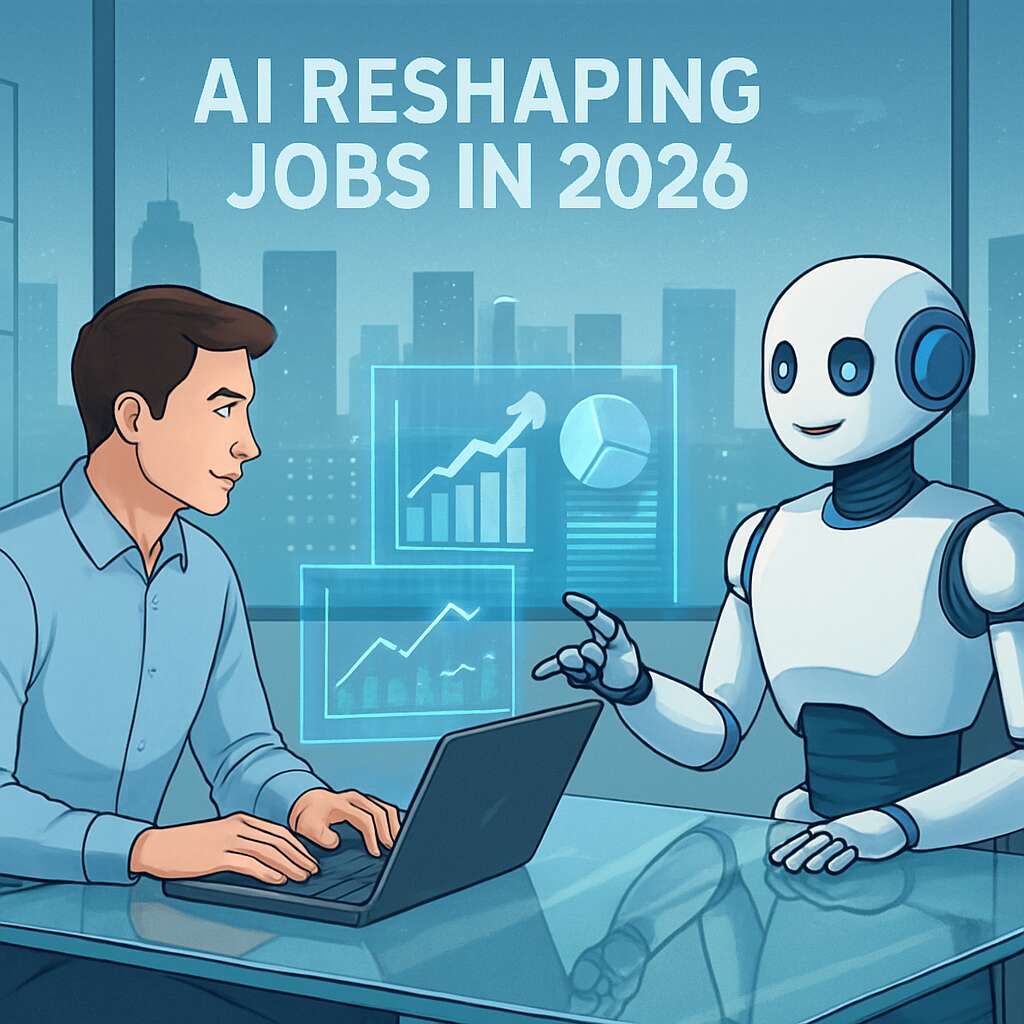
When the Clock Learns to Think: AI Replacing Jobs in 2026
The future does not knock.
It arrives barefoot, silent as mist,
already inside the house before we rise.
By 2026, the question will no longer be whether artificial intelligence reshapes work, but how deeply it has already done so. The phrase ai replacing jobs 2026 is no longer speculative jargon whispered at conferences or tucked into analyst footnotes. It is a living, breathing undercurrent—threading itself through offices, factories, studios, call centres, hospitals, farms, and even the sacred quiet of creative work.
This is not the apocalypse.
Nor is it salvation.
It is transformation—swift, uneven, and utterly indifferent to nostalgia.
The Quiet Replacement
AI does not arrive with pink slips.
It arrives with dashboards.
In 2026, jobs will not always vanish overnight. Many will simply thin out, hollowed from the inside. Tasks once performed by teams of humans will be reduced to prompts, workflows, and automated decisions. The job title remains. The headcount does not.
But the soul of the work has changed.
Customer support agents will watch as conversational models handle 80% of inbound queries without fatigue or frustration. Junior analysts will see reports generated in seconds that once consumed days. Designers will collaborate with systems that sketch, iterate, colour, and revise at machine speed. Recruiters will manage pipelines filtered by algorithms that never sleep and never forget.
This is ai replacing jobs 2026 in its truest form—not mass extinction, but selective redundancy.
Which Jobs Feel It First
History teaches us this: technology never replaces people first—it replaces patterns.
The roles most exposed in 2026 are those built on repetition, prediction, and standardisation.
Administrative and clerical roles shrink as AI handles scheduling, document processing, invoicing, and compliance.
Entry-level marketing roles fade as content, ads, and SEO strategies are generated, tested, and optimised automatically.
Data analysts find their early-career ladders missing rungs as AI produces insights before humans open spreadsheets.
Customer service roles are redefined as escalation-only positions, not frontline work.
Junior legal, accounting, and finance roles compress as AI drafts, reviews, reconciles, and flags anomalies at scale.
The irony is sharp: many of these jobs were once considered safe—knowledge-based, professional, and white-collar. Yet in 2026, it is the knowledge itself that has become abundant.
The Creative Illusion
For years, creatives believed themselves immune. Art, after all, was human. Emotional. Intuitive.
And yet—by 2026—AI writes copy that converts, music that moves, visuals that persuade, and videos that engage. Not perfectly. Not soulfully. But sufficiently.
That is the real disruption.
AI does not need to be better than you.
It only needs to be good enough, faster, and cheaper.
This is where ai replacing jobs 2026 becomes uncomfortable. Because what is replaced is not brilliance—but baseline competence. The middle collapses. What remains are those who are exceptional, and those who are assisted.
What the Experts Are Really Saying
Institutions like the World Economic Forum and McKinsey & Company are cautious with language, but clear in implication: tens of millions of roles globally will be restructured by 2026, not necessarily eliminated—but fundamentally altered.
Meanwhile, organisations building the tools—such as OpenAI—are transparent about the trajectory: models are becoming more autonomous, more multimodal, and more capable of decision-making across domains.
This is not a temporary wave.
This is tectonic movement.
The Human Cost No Dashboard Shows
What no report captures cleanly is the emotional residue.
The quiet anxiety of professionals who sense their value slipping but cannot name why. The fatigue of reskilling while working full-time. The erosion of identity when a job—once a marker of purpose—becomes optional.
In 2026, displacement will often be psychological before it is economic.
People will ask:
If a machine can do this faster, what am I for?
And the answer will not be universal.
New Roles Rising from the Ashes
Yet history is stubbornly hopeful.
Just as AI replaces roles, it creates new ones—often invisible until suddenly essential.
By 2026, demand surges for:
AI orchestrators who design workflows between humans and machines
Prompt engineers evolving into intent architects
Ethics and compliance specialists for algorithmic decisions
AI trainers who shape tone, bias, and accuracy
Human-centered designers who translate machine output into meaning
Strategic thinkers who ask better questions than machines ever could
The paradox of ai replacing jobs 2026 is this: the more automation grows, the more judgment, context, and responsibility matter.
The Real Divide: Assisted vs. Unassisted
The future will not split cleanly between “humans” and “AI.”
It will split between those who work with AI
and those who compete against it.
The former will move faster, think broader, and scale further.
The latter will feel constantly behind, even when working harder.
This is not about coding.
It is about adaptability.
The winners of 2026 are not necessarily the most technical—but the most synthetic, able to combine intuition, ethics, strategy, and machine leverage into something coherent.
Education Will Lag—Painfully
Universities will still teach yesterday’s curricula. Job descriptions will still list skills already automated. Governments will still debate policies while markets move.
By the time institutions respond, the workforce will have already adapted—or fractured.
Those who self-direct learning will thrive.
Those who wait for permission will struggle.
This, too, is part of ai replacing jobs 2026: the acceleration of inequality not by intelligence, but by responsiveness.
So What Remains Unreplaced?
AI struggles with meaning.
It predicts. It calculates. It generates.
But it does not care.
In 2026, the irreplaceable work lives where stakes are human:
Leadership that inspires trust
Care that requires presence
Ethics that demand accountability
Creativity that challenges norms
Strategy that navigates ambiguity
The machine may suggest.
But the human must decide.
A Closing Reflection
The future of work is not being stolen.
It is being renegotiated.
AI replacing jobs 2026 is not a prophecy of doom, but a mirror—held uncomfortably close. It asks what value we bring beyond repetition. It strips away comfort and exposes essence.
Those who adapt will not merely survive.
They will redefine what work means.
And those who resist?
They will swear the future arrived too fast.
But the truth is quieter:
It was always coming.